
Wasp and Yellowjacket Control in Spring and North Houston
We locate the nest, identify which wasp built it, and treat it at the entrance, usually late in the day when the foragers are home. Paper wasp nests under eaves come down once the colony is dead. Yellowjacket nests in the ground or inside a wall get a dust the workers carry deep inside.
Call 281-627-4810 Request a free inspection
Year-round protection plans from $70 Core · Premium · Legendary See the plans

Wasps: the job at a glance
| What it covers | Paper wasps, southern and eastern yellowjackets, baldfaced hornets and mud daubers on houses, sheds, playsets, fences and commercial buildings |
|---|---|
| Included | Finding every active nest and entrance, treating the colony, taking down reachable nests, treating common nesting spots and a follow-up check on hidden colonies |
| Not included | Opening finished walls or repairing stains or damage a nest already caused; honey bees are handled under bee control |
| How long it takes | Most accessible nests are handled in one visit; a wall-void or ground colony may need a return check to confirm it is dead |
| Best timing | Early spring for starter nests the size of a golf ball; by August a yellowjacket colony is at full size |
| What it costs | Free inspection, then a written price before work starts; nest height, location and the number of colonies set it |
Why the wasp season runs so long here
Wasps in north Houston are not a six-week problem. A queen that spent the winter under loose bark or in a crack in the soffit comes out in early spring, builds a nest the size of a thumb, and raises the first workers herself. From then on the colony grows every week the weather stays warm, which here is most of the year.
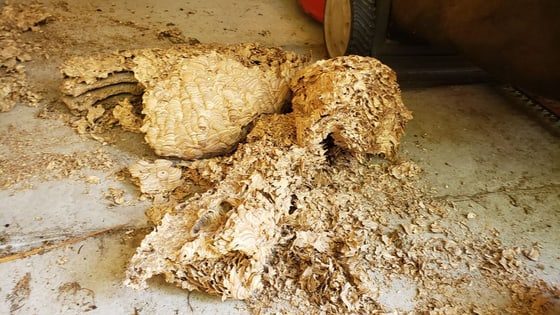
Texas A&M AgriLife Extension’s fact sheet on paper wasps, yellowjackets and solitary wasps puts the scale plainly. In Texas, a southern yellowjacket nest can range from a few inches to six feet or larger, with up to 45 levels of comb and as many as 20,000 workers. Maximum colony size arrives in August or September. Males and next year’s queens appear in October and November, and in most places the old nest is then abandoned and breaks down.
Most places, but not always ours. The same AgriLife publication says that in sheltered sites or during mild winters the nest may not be abandoned, and a perennial colony can carry on into the following year. Perennial colonies are larger than annual ones. A Gulf Coast winter without a hard freeze is exactly the condition that allows it, which is one reason we take a big yellowjacket nest under a deck in December seriously.
Telling them apart
Getting the identification right decides how the nest is treated, and whether it needs treating at all.
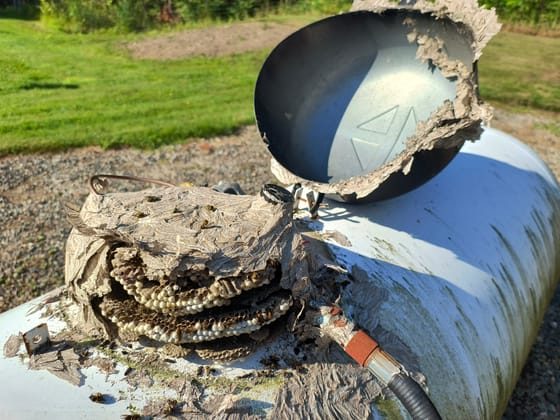
Paper wasps. Three-quarters of an inch to an inch long, reddish-orange to dark brown, often with yellow markings, with long legs that dangle in flight. The nest is a single open comb of hexagonal cells hanging from one stalk, under eaves, porch ceilings, mailboxes, swing sets and the lids of grills. AgriLife puts a typical mature nest at 20 to 30 adults. They build a new nest every year, often in the same spot as last year’s.
Yellowjackets. About half an inch long, bright yellow and black, with a smooth body and legs tucked up when they fly. The southern and eastern yellowjackets are the ones we deal with. Nests are enclosed in a paper envelope with a single entrance hole, most often underground in an old rodent burrow or flower bed, but also in wall voids, soffits, attics, under decks and inside stored furniture. Traffic at the hole is constant and quick on a warm day. Yellowjackets scavenge, so they are the ones at your soda can and your trash can in late summer.
Baldfaced hornets. AgriLife notes this is the only true hornet reported in Texas. It is black and white rather than yellow, and it builds a round or pear-shaped gray nest up to three feet long, usually high in a tree. A nest that high, away from where people walk, is usually best left alone.
Mud daubers. Long, thread-waisted wasps that are black and yellow or metallic blue. They build tubes of mud under eaves, in garages and in attics, and stock them with paralyzed spiders. They do not defend the nest. Our page on mud daubers under the eaves covers them in detail.
Lookalikes. Cicada killers are large, rusty-red solitary wasps that dig holes in lawns while the cicadas are singing; the males buzz people but cannot sting. Small black cricket-hunter wasps sometimes emerge indoors in winter from wall voids or slab openings. Neither one builds a colony to defend. Carpenter bees and honey bees are covered on our carpenter bee and bee control pages, and they are treated differently.
Are red wasps in Texas aggressive?
Red wasps in Texas are paper wasps, and they are defensive rather than aggressive. Texas A&M AgriLife classes the familiar red wasp as one of the paper wasps, and says social wasps like it will vigorously defend a disturbed nest but rarely sting away from it unless trapped or pressed against the skin.
That makes the nest’s location the whole question. A red wasp comb over the back door, under a grill lid or inside a swing set tube puts people within arm’s reach of it every day, and that is where stings happen. The same wasps on a fence corner at the back of the lot can usually be left alone. AgriLife’s guide to the venomous animals of Texas says the reaction to a paper wasp sting is immediate but should subside in a few hours to a few days.
Black wasps in Texas are mostly a different group. The solid black or blue-black wasps around a house are usually solitary hunters: mud daubers, which AgriLife describes as dull black, black and yellow, or iridescent blue-black, and small cricket-hunter wasps in the genus Liris that sometimes appear indoors. AgriLife’s wasp fact sheet (E-239) says solitary wasps rarely sting unless mishandled, since they have no shared nest to guard.
Our winters add one more case. E-239 notes that paper wasp queens overwinter in peaked attics, chimneys and tall buildings and often wander into homes and offices during warmer periods, and it describes these overwintering wasps as not aggressive. AgriLife insect specialist Wizzie Brown told Texas Standard that a sunny, warm winter day can fool these founding females into thinking spring has arrived, so a sluggish red wasp on a January window is usually one of those queens, not a sign of a nest indoors. For more on each species, see the paper wasps and mud daubers profiles and our post on Texas stinging insects.
Wasp exterminator and nest removal in Houston
These are our steps for stinging wasps.
- Inspect and identify. We find every active nest and every entrance. Yellowjackets often have a second opening a few feet from the obvious one, and a wall nest can have an exit around a weep hole, a light fixture or a gap in the trim.
- Plan around the location. A paper wasp nest at the front door, a ground nest in the middle of the lawn, and a colony inside a second-story wall are three different jobs. We plan the approach, the protective gear and the timing for the one you have.
- Treat at the right time. AgriLife recommends treating late in the evening, when most of the colony is back on the nest. That is our default for exposed nests and usually for yellowjackets too.
- Put the product where the colony lives. For ground and wall-void yellowjackets we apply a residual dust or aerosol directly into the entrance. Returning foragers track the dust deep into the nest, which is what reaches the queen. AgriLife’s guidance matches this, noting that liquid sprays poured on a ground nest often soak into the soil before they reach the colony.
- Remove what can be reached. Once the colony is dead, accessible paper wasp nests and mud dauber tubes come down. For a wall void, we make sure the nest is knocked down and the void addressed, so a decaying nest does not draw in other pests.
- Confirm and prevent. We come back to check that a hidden colony is finished, and we treat the eaves and sheltered corners wasps keep choosing. Recurring service is covered by our 100% Service Guarantee, which spells out the terms.
Signs and what they mean
- One wasp hovering under the eave in April. A queen starting a nest. This is the easiest point in the whole season to deal with it.
- A steady line of yellowjackets into a hole in the lawn. A ground nest. Do not mow over it. Our yellowjackets in the ground or a wall page covers what happens next.
- Buzzing or scratching inside a wall, or a damp spot on drywall. A wall-void colony, sometimes chewing toward the room. Call rather than investigating.
- Wasps indoors on a warm January afternoon. Usually overwintering paper wasp queens that sheltered in the attic. AgriLife describes them as not aggressive at that stage.
- Gray paper on a gutter or a shutter. An old paper wasp nest. Check whether anything is still coming and going before you knock it down.
What waiting costs
A yellowjacket nest found in May might hold a few dozen workers. The same nest in September can hold thousands, and every one of them can sting more than once because, unlike a honey bee, a wasp does not leave its stinger behind. AgriLife notes that wasps rarely sting away from the nest but defend it vigorously, which is why most bad stinging incidents start with a mower, a hedge trimmer or a child stepping on a ground hole.
For anyone with a venom allergy the stakes are higher. AgriLife reports that allergic reactions to stings usually begin within 20 to 30 minutes, that respiratory reactions account for more than half of sting deaths, and that people with a known allergy should ask their doctor about carrying epinephrine. If someone in your household has that history, mention it when you call so we can put the nest at the front of the plan.
When the nest is inside the house
Brick veneer homes across Spring and Klein give yellowjackets an easy way in. The weep holes along the bottom course of brick lead straight into the air gap behind it, and a queen looking for a dry, dark cavity in spring will take one. From outside you see a few wasps at a weep hole. Inside the wall there may be a nest the size of a basketball by late summer.
Those are the jobs where people get hurt trying to help. Spraying a can of foam into a weep hole kills the few wasps it touches and agitates the rest. Stuffing the hole with steel wool or caulk sends the colony looking for another exit, and AgriLife warns that wasps may force their way into the home when that happens. Leave the entrance exactly as it is, close the interior door to that room if you hear buzzing in the wall, and let us treat it through the opening the wasps already use. Screening the weep holes afterward, rather than caulking them, keeps the wall able to drain.
Residential and commercial jobs
At a house the usual places are eaves, porch ceilings, playsets, fence rails, the underside of a deck and the yard. At a business the nest tends to be somewhere the public walks under: a covered entry, a drive-through canopy, a sign, a parking lot light pole or the edge of a patio dining area. Commercial work often means coordinating around opening hours and treating at the end of the day. See our commercial service page for how that is arranged.
Prevention you can do yourself
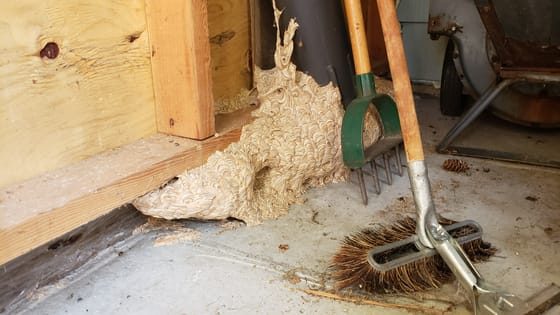
- Walk the eaves, porch, shed and playset every couple of weeks in spring and knock down starter nests while they are still small.
- Seal gaps in siding, soffits and around utility lines before spring, but only where no colony is active.
- Keep outdoor trash and recycling lidded and rinsed, and cover food and sweet drinks at cookouts. AgriLife suggests emptying outdoor garbage daily when yellowjackets are foraging.
- Fill abandoned rodent burrows in the lawn, a favorite yellowjacket site.
- Hang yellowjacket traps away from where people sit, early in the season. They reduce foragers but, as AgriLife notes, they do not eliminate a colony.
- Leave a hornet nest high in a tree alone if nobody walks under it.
Problem pages under this service
Related services
Honey bees are a separate job with separate rules, covered on our bee control page. Round holes in fascia boards point to carpenter bees. Gaps that let wasps into a soffit are often the same gaps rodents use; see exclusion and repairs. If someone has already been stung, read what to do after a wasp sting, and Texas stinging insects helps sort wasps from bees, hornets and the other insects that sting here. We treat wasp nests across Harris County and Montgomery County, from Tomball and Magnolia to Kingwood and Atascocita. For a free inspection, contact us.
Frequently asked questions
Should I plug the hole the yellowjackets are using in my siding?
No. Texas A&M AgriLife advises against sealing a wall nest entrance until the colony is dead, because trapped wasps go looking for another way out and that is often into the house. Leave the hole open, keep people away from it, and let us treat through it first.
Is it true wasp nests in Houston can survive the winter?
It can happen. AgriLife notes that in sheltered sites or mild winters a yellowjacket nest may not be abandoned, and so-called perennial colonies carry on into the next year with workers and one or more queens. Those colonies are larger than the usual single-season nest, which matters on the Gulf Coast.
Are mud daubers dangerous?
Rarely. Mud dauber females do not defend their nests, and the larvae are fed spiders, including brown recluses. The mud tubes can be scraped off with a putty knife. We remove them during a visit, mainly so the old tubes do not attract other insects.
What should I do while I wait for you to get here?
Keep children and pets away from the nest, skip the mower and string trimmer near a ground hole, and do not spray it yourself. When you call, tell us where the nest is, how high it is, roughly how big it looks, and whether anyone in the household has a known sting allergy.
Someone was stung several times. What should I watch for?
AgriLife says allergic reactions usually begin within 20 to 30 minutes and can include widespread hives, swelling, and trouble breathing. Any of those means calling 911 immediately. Swelling around the sting itself, even a large patch, is common and is not the same as a systemic reaction.
Do you treat wasps on a business or a school property?
Yes. Restaurants, offices, apartment complexes and schools call us for nests on entryways, signs, playground equipment and parking lot light poles. Commercial nests are often high or over a walkway, so tell us the height and the foot traffic beneath it.
Do black wasps sting?
They can, but rarely. Most black wasps around Texas homes are solitary mud daubers or cricket hunters, and Texas A&M AgriLife says solitary wasps seldom sting unless handled or trapped against the skin. Their venom usually causes only brief pain.
Our largest service areas
From the blog
Wasp & Yellowjacket Control in north Houston?
No long-term contracts, and service agreements are backed by our 100% Service Guarantee.
Because we are based in Spring, we can often come out the same or next day for urgent problems. Call before noon, Monday through Friday, for the best chance at next-day service.
Last updated