
Paper Wasps and Red Wasps in Spring and North Houston
Stinging insects
Paper wasps are long-legged, reddish-brown to dark brown wasps, three-quarters of an inch to an inch long, that hang an open, umbrella-shaped comb from one thin stalk under eaves and porch ceilings. Colonies stay small, usually twenty to thirty adults. A nest out of everyone's way can be left; one beside a door is worth treating.
Call 281-627-4810 Request a free inspection
Year-round protection plans from $70 Core · Premium · Legendary See the plans
Sometimes worth treating, sometimes not — it depends on what is below.
Paper wasps at a glance
| Size | Three-quarters of an inch to an inch, with a narrow waist and dangling legs |
|---|---|
| Color | Reddish-orange to dark brown, often with yellow markings; the red wasp is one kind |
| Wings | Cloudy, folded lengthwise when at rest |
| Nest | One open, downward-facing comb of six-sided cells hanging from a single stalk |
| Colony size | Typically 20 to 30 adults, rarely more than 200 cells |
| Season | Founded in spring by an overwintered queen; new queens and males in late summer and fall |
| Sting | Immediate pain and swelling; can sting more than once |
Signs you have them
- A single wasp working on a thumb-sized comb under an eave or porch ceiling in early spring
- An open gray comb with visible cells hanging from a door frame, shutter, mailbox or grill lid
- Wasps flying with their legs hanging down below the body
- Old gray nests in the same spots each year, with a new one started nearby
- Slow-moving wasps inside the house or attic on a warm winter afternoon
The wasp with the umbrella nest
Paper wasps are the wasps most north Houston households meet first. They build in the open, where you can see the comb, under the eave over the back patio, inside the top rail of a swing set, under the lid of a grill that has not been opened since Labor Day. The nests look like a small gray umbrella turned upside down, a single layer of six-sided cells hanging from one stalk.
Texas A&M AgriLife Extension’s publication Paper Wasps, Yellowjackets and Solitary Wasps (E-239) calls them one of the most common vespid wasps around homes and buildings. They are also, in most respects, the most manageable stinging insect on a property. Their colonies stay small, their nests are visible, and they rarely sting unless the nest is disturbed.
Identification
AgriLife describes paper wasps as three-quarters of an inch to an inch long, generally reddish-orange to dark brown, and often marked with yellow. Texas A&M AgriLife’s Venomous Terrestrial Animals of Texas adds three features that help: a narrow waist, cloudy wings folded lengthwise when the wasp is resting, and a nest that is open on the bottom with no papery covering. The same guide notes that the common “red wasp” is a paper wasp. E-239 pictures Polistes exclamans and Polistes carolina among the Texas species.
In flight, paper wasps let their long legs hang down. That posture alone separates them from most other wasps at a glance.
Lookalikes
- Southern yellowjackets are shorter, stockier and bright yellow and black, fly with their legs tucked, and build an enclosed nest with a single entrance, usually underground or inside a wall. E-239 notes that yellowjackets are often confused with paper wasps.
- Mud daubers have a long, thread-thin waist and build nests of mud, not paper. They do not defend their nests.
- Baldfaced hornets are black and white and build an enclosed, football-shaped gray nest, usually high in a tree. E-239 says this is the only true hornet reported in Texas.
Biology and the Houston season
AgriLife lays out the year. Colonies are founded in spring by queens that spent the winter in sheltered hiding places. Early in the season more than one queen may cooperate on a nest, but by midsummer there is usually only one egg-laying queen. She lays a single egg in each cell; the larvae are fed by the queen and later by the workers, then pupate inside capped cells and chew their way out as adults.
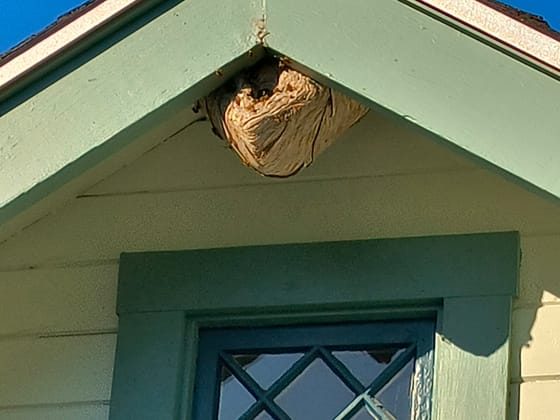
Paper wasp colonies have three castes: infertile female workers, which make up most of the wasps on a summer nest, plus males and queens. Unlike yellowjackets and hornets, the queen is not much bigger than her workers. AgriLife puts the typical mature nest at 20 to 30 adults and rarely more than 200 cells.
Males and new queens appear in late summer and fall. After mating, the males die and the fertilized queens go looking for a place to spend the winter. AgriLife says they seem to prefer high structures such as peaked attics, chimneys and tall buildings, and may gather in large groups. During the winter they often come inside, especially in warm spells, and they are not aggressive at that stage.
That last point explains a lot of January calls around Spring and The Woodlands. A mild Gulf Coast winter has many warm afternoons, and every one of them can bring a few drowsy queens down out of the attic and into a bedroom. AgriLife’s advice for those is low-key: put them outside or use a fly swatter.
New nests are built every year, often in the same general spot as the year before. If the corner of your porch had a nest last summer, expect a queen to look at it again this spring.
Where nests show up
E-239 lists eaves first, then attics, garages, storage sheds, barns, shrubbery, trees and other protected sites. Around north Houston homes the regular places are:
- Eaves, soffits and porch ceilings, especially over patios
- Door frames, shutters, light fixtures and the backs of signs
- Mailboxes, grill lids and outdoor cabinets
- Swing sets, playhouses and fence rails
- Shrubs next to walkways, where a nest gets brushed
- Pool equipment covers and the underside of deck boards
Stings and health risk
Paper wasps sting to defend the nest. E-239 says social wasps rarely sting away from the nest unless trapped or pressed against the skin, but defend it vigorously when disturbed, and that unlike honey bees, wasps do not leave the stinger behind and can sting repeatedly. If a colony comes after you, AgriLife’s advice is to cover your head and get to a building or car.
A normal reaction is intense pain, redness and swelling at the sting. AgriLife describes a large local reaction as swelling that spreads more than two inches from the sting, sometimes over a whole hand or arm, lasting two to seven days. About 5 percent of people who have a large local reaction will have a serious allergic reaction to a later sting.
A sting reaction anywhere beyond the sting site needs medical help immediately. AgriLife says systemic reactions range from widespread rash and swelling to difficulty breathing, rapid pulse and shock; they usually begin within 20 to 30 minutes and can come on in 10 to 15. Respiratory problems account for more than half of all deaths from stinging insects. Anyone who knows they are allergic should ask a physician about carrying epinephrine.
What treatment realistically involves
The “depends” verdict comes straight from where the nest is. AgriLife’s guidance on wasps generally is that most are beneficial predators, and that control is justified when people are at risk of being stung. A paper wasp nest on the far side of a fence line is eating caterpillars from your garden. The same nest over the front door will eventually sting someone carrying groceries.
When a nest does need to go, AgriLife’s points shape the job. Treat in the late evening, when most of the wasps have come back to the nest. Stand well away. Do not knock the nest down until every wasp is dead, which AgriLife says can take up to two days, and then remove and discard it. E-239 also notes that exposed nests can be treated with insecticidal soaps and plant-oil products, which kill on contact and may need repeating.
Under our wasp and yellowjacket control service, paper wasp nests are handled the way the owner describes that work: find every active nest, plan around where each one is, treat at the right time of day, take down the nests that can be reached once the colony is dead, and treat the eaves and sheltered corners wasps keep returning to. Recurring service carries our 100% Service Guarantee.
Anyone with a heart condition or a known venom allergy should not attempt a nest at all; E-239 says so plainly.
Prevention
- Walk the eaves, porch, playset and shed every week or two in March and April.
- Knock down a starter nest with a long pole while only the queen is on it.
- Open grill lids, mailboxes and outdoor cabinets regularly so queens do not settle in.
- Seal gaps in soffits and attic vents in late fall, after the colony season ends.
- Trim shrubs back from walkways so nests in them are visible.
- Check last year’s nest sites first; queens often return to the same spots.
Related reading
The other stinging insects in this library each call for a different response: southern yellowjacket, mud daubers, the honey bee and the eastern carpenter bee. Or browse the full pest library. If a nest is somewhere you cannot reach without a ladder, let us handle it.
Frequently asked questions
Do I need to get rid of a paper wasp nest?
Not always. Texas A&M AgriLife notes social wasps rarely sting away from the nest but defend it vigorously. A nest high on a back fence that nobody walks past can be left. One over a door, a mailbox or a playset usually needs dealing with.
Why are there wasps in my house in January?
They are probably overwintering queens. AgriLife says fertilized paper wasp queens gather in sheltered, high places such as peaked attics and chimneys, and often come indoors during warm spells. They are not aggressive at that stage and can be swatted or put outside.
Are red wasps different from paper wasps?
The red wasp is a paper wasp. Texas A&M AgriLife's guide to venomous animals of Texas lists it as one type of Polistes. It builds the same open comb and behaves the same way, though its color is a solid reddish brown.
When does a wasp sting become dangerous?
When the reaction moves beyond the sting site. AgriLife says allergic reactions usually begin within 20 to 30 minutes, can start in 10 to 15, and can include widespread hives, swelling and trouble breathing. Call 911 for those. Anyone with a known venom allergy should ask their doctor about carrying epinephrine.
Sources
- Texas A&M AgriLife Extension — Paper Wasps, Yellowjackets and Solitary Wasps (E-239) — read October 5, 2026
- Texas A&M AgriLife Extension — Venomous Terrestrial Animals of Texas — read October 5, 2026
Next scheduled review of this page against its sources: October 5, 2027.
Pest problem in north Houston?
No long-term contracts, and service agreements are backed by our 100% Service Guarantee.
Because we are based in Spring, we can often come out the same or next day for urgent problems. Call before noon, Monday through Friday, for the best chance at next-day service.
Last updated