
Ant and Fire Ant Control in Spring and North Houston
Most ant calls around Spring come down to three groups: fire ants in the lawn, small trailing ants in the kitchen, and the occasional carpenter or tawny crazy ant. Each needs different work. We identify the ant, find where it nests, then use baits, targeted sprays or mound treatments suited to that species.
Call 281-627-4810 Request a free inspection
Year-round protection plans from $70 Core · Premium · Legendary See the plans
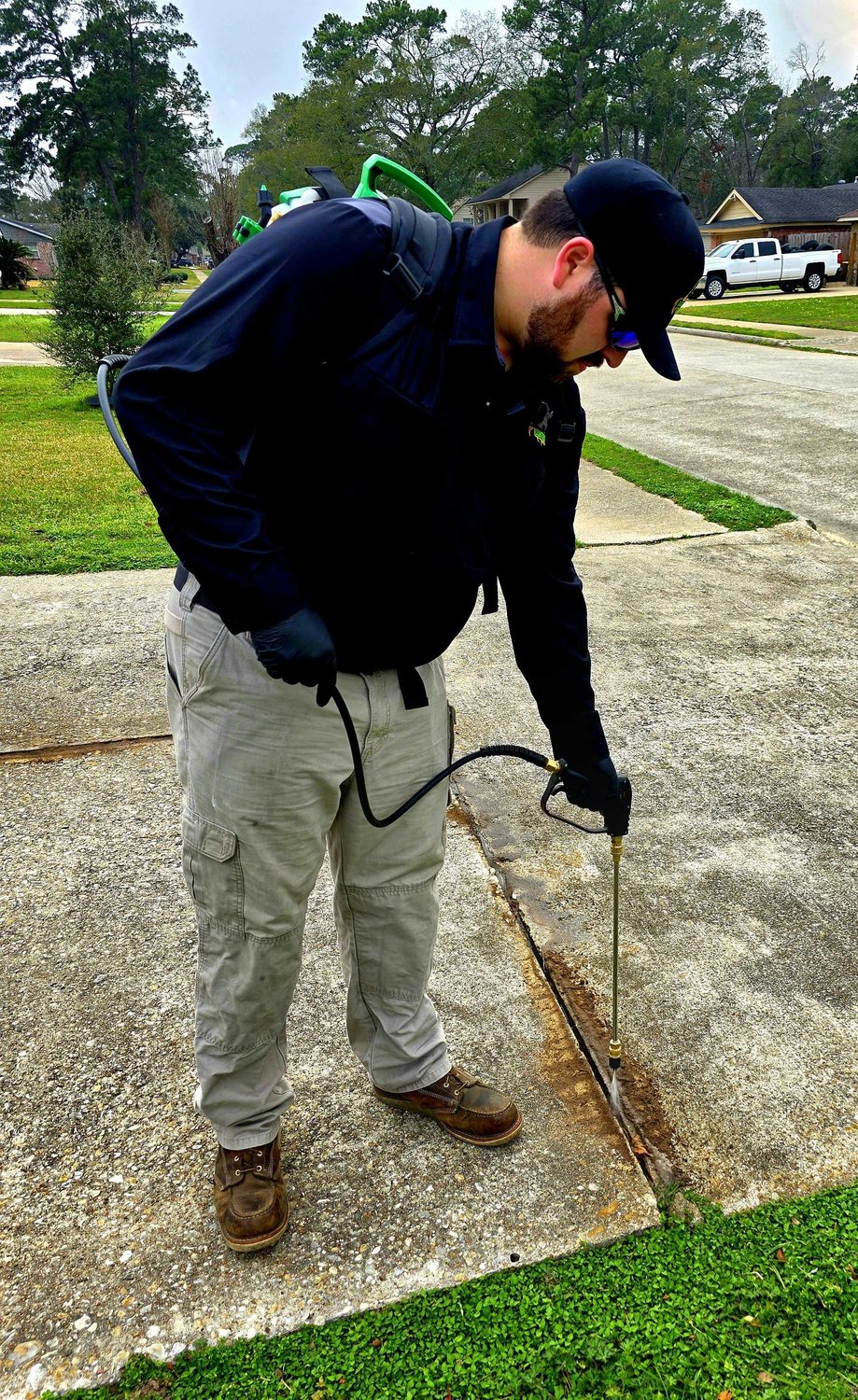
Ants: the job at a glance
| What it covers | Fire ants, carpenter ants, tawny crazy ants and household trailing ants at homes and businesses in Harris and Montgomery counties |
|---|---|
| Included | Species identification, an indoor and outdoor inspection, interior crack-and-crevice or gel bait work, and exterior treatment matched to the ant |
| Not included | Replacing rotted wood, fixing roof or plumbing leaks, or repairing anything ants have already damaged |
| How long it takes | Mound drenches act within a day or two; colony baits take longer, and some species need repeat visits to stay down |
| Best timing | Spring and fall for fire ant baiting, and as soon as indoor trails show up for everything else |
| What it costs | Free inspection, then a written price; how many mounds and whether the trouble is indoors, outdoors or both set it |
Four kinds of ant problem, four different jobs
Ant control fails most often for one reason: somebody treated the ant they could see without working out which ant it was. Around Spring, Klein, Tomball and The Woodlands, the calls we get sort into four groups, and each group wants a different plan.
- Fire ants in the yard, along sidewalks and around utility boxes.
- Small trailing ants in kitchens and bathrooms, the ones people call sugar ants.
- Carpenter ants, larger ants that nest in damp or damaged wood.
- Tawny crazy ants, an invasive species that shows up in huge numbers and ignores most of the usual tools.
A treatment that works on one of these can do nothing to another, and in a couple of cases it can make things worse. That is why our first visit is about identification, not spraying.
Why north Houston keeps us busy with ants
Warm weather most of the year and frequent rain mean ant colonies around here rarely get a real break. Fire ant mounds are a good example. Texas A&M AgriLife’s guidance on the Two-Step Method for fire ants points out that spring rains make mounds easier to see, while in hot, dry summer stretches the ants go deeper and the mounds flatten out. Homeowners often read a dry August lawn as a victory. In most cases the colonies are still there, just lower in the soil.
Slab foundations add their own wrinkle. Expansion joints, plumbing penetrations and hairline cracks give small ants a route into the house that no one can see from the living room. Ants that turn up in the middle of a kitchen floor, far from any door, often came up through the slab along a pipe.
Fire ants
The red imported fire ant is the one most yards here have. Workers come in a range of sizes in the same colony, reddish-brown with a darker rear section. The mounds are loose, fluffy soil with no single opening on top. Touch one and the defenders boil out and climb.
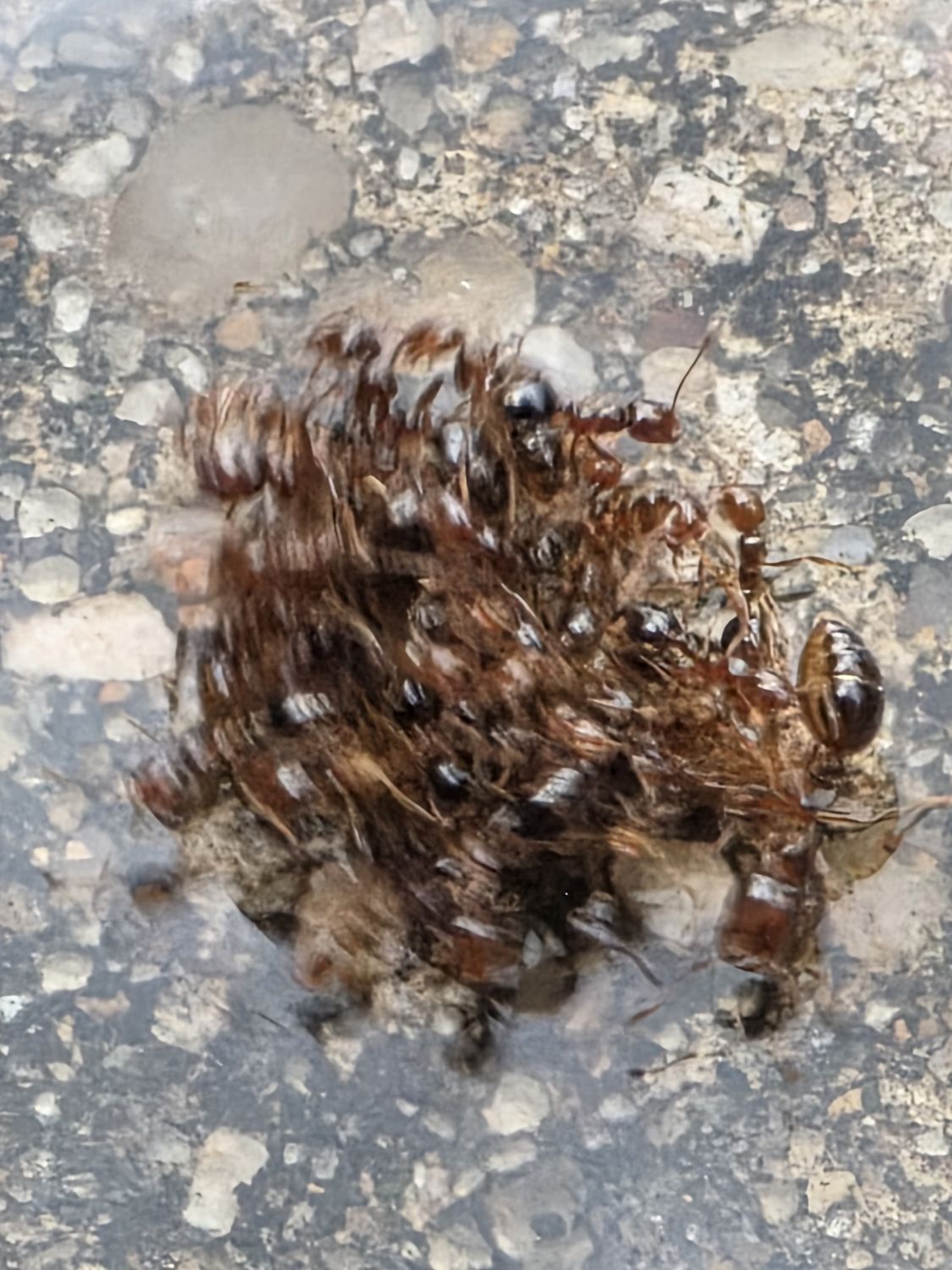
The stings matter. Texas A&M’s fire ant program describes the white pustule that forms within a day or two of a sting, and notes that a small number of people react severely. Anyone with chest pain, trouble breathing or swelling well beyond the sting site should get medical care right away. The same page lists electrical equipment and utility housings among the places fire ants invade, which matches what we find inside AC disconnect boxes and irrigation controllers.
Fire ants have their own page, with more on mounds, timing and yard layout: fire ant mounds in the yard.
Carpenter ants
Carpenter ants are the big ones, a quarter inch or more for workers, black, reddish or a mix. They have a pinched waist and elbowed antennae, which is how you tell a winged carpenter ant from a termite swarmer. Texas A&M’s carpenter ant publication (E-412, Carpenter Ants) says something many homeowners find reassuring: Texas species cause less damage to structural wood than carpenter ants elsewhere in the country and rarely damage framing lumber.
The same publication is just as clear that their presence points to moisture, rot or other conducive conditions. A colony in a window frame usually means water has been getting into that frame. We will show you where the ants are coming from and what wet wood is feeding them. Fixing the leak is a job for a roofer or plumber, and it is the part that keeps the ants from coming back.
More detail lives on carpenter ants in the house.
Tawny crazy ants
Tawny crazy ants (once called Rasberry crazy ants) first turned up around Houston in 2002, and Texas A&M’s Urban and Structural Entomology program lists both Harris and Montgomery among the counties with confirmed infestations. The program’s tawny crazy ant profile describes reddish-brown workers about an eighth of an inch long that run in erratic, jittery paths, colonies with many queens, and accumulations inside electrical equipment that short out switches.
The detail that matters most for treatment is this one: the same profile says workers are not attracted to most bait products, and that the control tactics used for other ants do not work well on them. We tell people that up front. Crazy ant work leans on perimeter treatment, removing the boards, pots, leaf litter and debris they nest under, and coming back as needed, because a neighboring property can resupply them. Our tawny crazy ants page goes further into what to expect.
The trailing ants in your kitchen
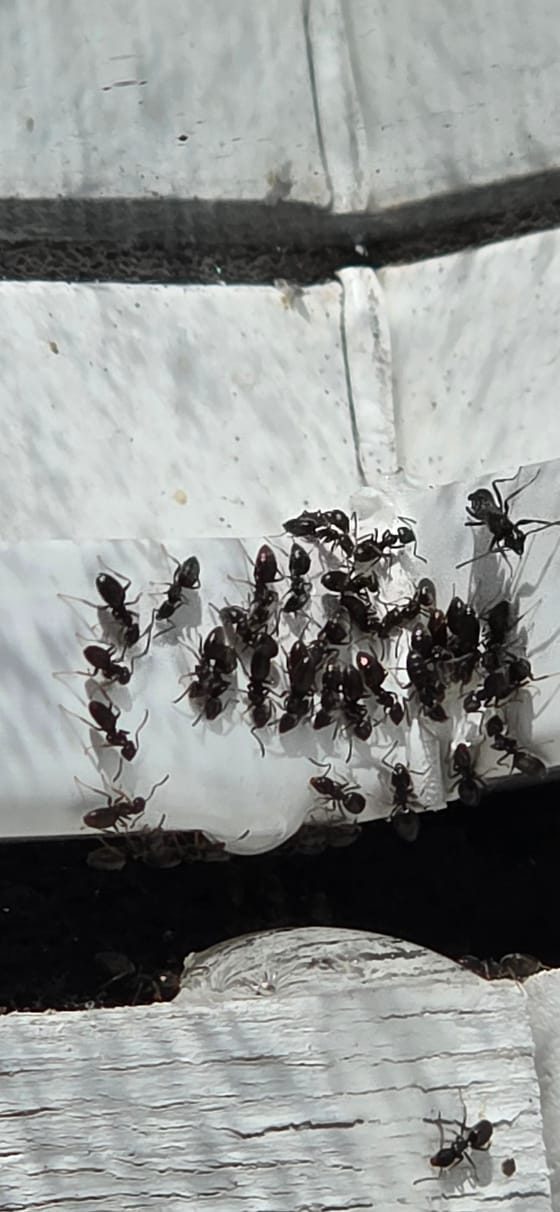
The small ants marching from a window sill to the dog bowl belong to several species, and they are the ones most often made worse by a store-bought spray. Repellent products kill the workers in the line but leave the nest alone, and some species respond by splitting into several colonies. That is the reason our technicians ask people to leave the trail in place until they arrive. The tiny pharaoh ant is the best-known example, and it has its own entry in our pest library.
How we handle an ant job
The method below is the one the company describes for ant work, written out in plain steps.
- Identify the ant. Nothing else gets decided until we know the species. Fire ants, carpenter ants, crazy ants and sugar ants each change the plan.
- Walk the problem areas with you. You know where the ants show up and when. We go through those spots with you first, then look outside for trails, entry points and the conditions drawing them in, such as mulch piled against the slab or a branch resting on the roof.
- Treat inside where the ants are. Depending on the species and where the activity is, that means a crack-and-crevice treatment along baseboards, gel bait placed where foragers will pick it up, or other targeted applications. We use the least product that will control the problem.
- Treat the outside. Exterior work covers the foundation, cracks and crevices, eaves, the frames around windows and doors, gutters, light fixtures and any other access point. For ants that respond to them, we use exterior granular baits. Choosing between repellent and non-repellent products depends on the ant, because the wrong choice can scatter a colony.
- Set the follow-up. How often we come back depends on the species and how heavy the activity was. Some ants settle after an initial treatment and a check. Others, crazy ants in particular, need monthly visits for a stretch to stay under control.
Every visit is covered by our 100% Service Guarantee, and there is no long-term contract.
Signs, and what each one tells us
| What you see | What it usually means |
|---|---|
| Domed mounds of loose soil in sunny lawn areas | Fire ant colonies, often more than you can count from the porch |
| A line of tiny ants from a window or outlet to food | A foraging trail from a nest in the wall, slab or yard |
| Coarse sawdust with insect parts under a window or beam | Carpenter ants pushing debris out of a gallery |
| Winged ants inside in spring | A mature colony nearby; worth checking against termite swarmers |
| Masses of small brown ants inside an AC box or meter | Fire ants or tawny crazy ants, both drawn to electrical housings |
| Ants on the ceiling or along the top of cabinets | Often a nest in the attic or a wall void above |
The ant calendar around Spring
Ants here do not keep a tidy season, but the pattern through the year is predictable enough to plan around.
Spring is the busiest stretch. Fire ants are foraging hard, and rain brings fresh mounds up where they are easy to find, which is why AgriLife names spring and fall as the best windows for broadcast bait. It is also swarm season for carpenter ants. Their publication explains that winged reproductives develop in late summer, spend the winter inside the nest and fly in spring and early summer, and that in Texas carpenter ants and termites sometimes swarm at the same time. If winged insects pour out of a wall in April, save a few in a zip bag so we can tell which you have.
Summer pushes fire ants lower in dry soil, while kitchen ants come indoors looking for water. Trails to sinks, dishwashers and pet bowls pick up in July and August.
Fall is the second good window for yard baiting, and a sensible time to knock fire ant colonies back while the ants are still taking bait readily.
Winter is quieter outside. Large black ants walking around indoors in January deserve a look, because a carpenter ant colony foraging in cold weather is often nesting in a heated part of the house.
What waiting tends to cost
Kitchen ants mostly cost patience and food. Fire ants cost more: a yard the kids cannot play in, stings during mowing, and sometimes a dead contactor in an AC unit. Carpenter ants rarely bring down a wall here, but the moisture they point to keeps working on the wood whether or not anyone treats the ants. Crazy ant colonies grow quickly and spread from yard to yard, so a block that waits a season usually ends up dealing with them at every house.
Homes and commercial properties
At a house, the job is usually one colony or a few, plus the yard. Commercial sites change the scale. Restaurants deal with trailing ants near food prep, where gel baits and careful placement matter. Apartment communities have shared walls and common landscaping, so a single unit treatment is rarely enough. Office parks and retail centers have long stretches of irrigated beds where fire ants build along walkways. Those accounts run through our commercial program, with service records kept for property managers.
What you can do between visits
- Wipe up spills and crumbs the same day, and keep sugar, honey and pet food in sealed containers.
- Pull mulch back a few inches from the foundation and keep firewood off the ground and away from the house.
- Trim shrubs and tree limbs that touch siding or the roof. They are bridges.
- Fix dripping hose bibs, irrigation leaks and clogged gutters. Water draws carpenter ants and fire ants alike.
- Leave fire ant mounds alone rather than kicking or flooding them. Disturbing a mound moves the colony; it does not kill it.
- Caulk gaps around pipes where they leave the slab and around window frames.
Problem pages under ant control
Where people go next
Ants are often the first pest people notice, not the only one. If you are also finding large roaches in the garage, see cockroach control. Webs along the eaves usually follow the insects ants and lights attract, which is covered under spider control. For a year-round schedule that covers ants along with other household pests, look at our Home Protection Programs.
We work ant jobs across Spring, Klein, Cypress, Conroe, Kingwood and the rest of Harris County and Montgomery County. To set up a free inspection, use the contact page.
Frequently asked questions
Should I spray the ant trail in my kitchen before you come out?
Please leave it. The trail is the map back to the nest, and our technician follows it. Knocking it down with a household spray scatters the foragers, and with some species it can push the colony to split into several smaller nests that are harder to reach.
Why do fire ant mounds keep popping up after I treat them?
Treating a single mound only deals with the colony underneath it. Neighboring yards, easements and open lots keep supplying new queens. A yard-wide bait reaches colonies you cannot see yet, and pairing it with direct mound treatment is the approach Texas A&M recommends.
Are carpenter ants going to destroy my house?
Usually not. Texas A&M notes that Texas carpenter ants do far less damage than the species up north and rarely harm framing lumber. What they do signal is moisture: a leak, a soaked window frame or wood touching soil. Finding and fixing that is half the job.
What makes tawny crazy ants different?
They form enormous colonies with many queens, they forage in erratic swarms, and they pile into electrical boxes and AC equipment. Most baits that work on other ants do not attract them, so control leans on targeted perimeter treatment and clearing out the clutter they nest under.
Do you treat ants at commercial properties?
Yes. Restaurants, offices, apartment communities and retail sites get the same identification-first approach, with service notes kept for managers or auditors. Commercial accounts are set up through our commercial program so the visit schedule fits the business.
Our largest service areas
From the blog
Ant & Fire Ant Control in north Houston?
No long-term contracts, and service agreements are backed by our 100% Service Guarantee.
Because we are based in Spring, we can often come out the same or next day for urgent problems. Call before noon, Monday through Friday, for the best chance at next-day service.
Last updated