
Tick Control in Spring and North Houston
Ticks in north Houston yards concentrate where lawn meets brush, leaf litter, ground cover and dog runs, not in open sunny grass. Control means treating those edges and pet resting spots, cutting back the cover ticks need, and keeping every dog on a veterinarian's preventive. Indoor brown dog tick infestations also need cracks and baseboards treated.
Call 281-627-4810 Request a free inspection
Year-round protection plans from $70 Core · Premium · Legendary See the plans

Ticks: the job at a glance
| What it covers | Lone star, brown dog and American dog ticks in residential yards, fence lines, wood edges, dog runs and kennels |
|---|---|
| Included | Inspection of tick hot spots, barrier treatment of edges and vegetation, treatment of pet resting areas, and indoor crack and baseboard treatment for brown dog ticks |
| Not included | Treating the animals themselves, which is for your veterinarian, and wooded acreage beyond the maintained yard |
| How long it takes | A typical yard visit runs under an hour; the first visit includes a walk of the whole property |
| Best timing | Late winter into spring, ahead of the lone star tick's March to May adult peak, then follow-up visits through summer |
| What it costs | Free inspection, then a written price before work starts; yard size and how much brush borders it set the figure |
Why ticks hang on in north Houston
Ticks need humidity more than almost anything else, and the edges of a typical north Houston lot supply it all year. Pine and hardwood lots in Spring, Tomball, The Woodlands and Magnolia back onto greenbelts, drainage easements and undeveloped brush, and the strip where mowed lawn meets those areas stays shaded, damp and full of leaf litter. That transition zone is where ticks wait.
Mild winters matter too. The Texas Department of State Health Services notes on its tick-borne diseases page that ticks are most active in the warmer months of spring and summer, and on the Gulf Coast the warm months start early. Texas A&M’s tick program gives the timing for the lone star tick: adults become active in January and February and peak from March through May, nymphs follow from April into August, and larvae peak from June through August. Something is active in most months of the year.
Wildlife keeps resupplying yards. Deer along wooded edges, raccoons, opossums, feral cats and stray dogs carry ticks in and drop them where they rest. Your own dog brings them back from walks along the bayou trail or the neighborhood greenbelt.
Which tick you have
AgriLife’s fact sheet Control Those Ticks describes ticks as flattened, eight-legged biting pests that usually feed on more than one host, which is how they move disease between animals and people. The species matter because they behave differently.
Lone star tick. Texas A&M’s lone star tick profile describes the adult female as reddish-brown with a single pale spot in the center of her back. It is a generalist that feeds on deer, livestock, dogs and people at every life stage, and the CDC recognizes it as the principal vector of the bacteria that cause human ehrlichiosis. This is the aggressive one that people pick up walking through brush.
Brown dog tick. Plain light-to-dark brown with no markings. AgriLife calls it the most common tick in urban areas. Texas A&M’s brown dog tick profile notes that dogs are its main host at every stage, that infestations start in pens and kennels and spread into homes, and that a single engorged female can lay up to 4,000 eggs. Of the ticks in this list, it is the one most likely to settle inside a house.
American dog tick. A brown tick with pale markings near the head, common in tall grass and along trails. A DSHS Rocky Mountain spotted fever pamphlet names it the major carrier of spotted fever organisms in Texas, with the lone star and brown dog ticks playing a minor role. The same pamphlet puts the peak months for that disease in Texas at April through September, and notes that ticks usually have to stay attached for several hours before they can pass on disease, which is why prompt removal matters.
Lookalikes. Fleas are wingless and jump; ticks crawl. Chiggers are almost too small to see and leave itchy welts around the waistband and ankles rather than an attached body. If the problem is fleas, our flea control page covers it.
Why it is worth taking seriously
Most bites are an itchy red spot and nothing more. But DSHS lists anaplasmosis, ehrlichiosis, Lyme disease, spotted fever rickettsiosis, tick-borne relapsing fever and tularemia among the tick-borne diseases it tracks in Texas. Ehrlichiosis and anaplasmosis usually start with fever, headache, muscle aches and fatigue, which is easy to mistake for the flu. Rocky Mountain spotted fever typically brings fever and a measles-like rash and, DSHS says, can cause serious illness or death if it is not treated quickly. DSHS also describes Texas as a low-incidence state for Lyme disease, so the bigger local risks are the others.
Dogs carry their own risks. AgriLife notes that heavily infested dogs can die from blood loss, and the brown dog tick transmits canine ehrlichiosis and babesiosis. Treating the dog is your veterinarian’s job. Treating the places where the dog sleeps, plays and patrols is ours.
Can a lone star tick bite cause a red meat allergy?
It can. The CDC says the lone star tick is the tick most often associated with alpha-gal syndrome in the United States, a serious and potentially life-threatening allergy that can follow a tick bite. Most providers advise people with it to avoid red meat such as beef, pork, lamb and venison.
The CDC’s alpha-gal syndrome overview explains the mechanism in plain terms. Alpha-gal is a sugar molecule found in most mammals but not in people, and a bite can carry it into the bloodstream and set off an allergic response. Reactions range from mild to severe, can differ from one exposure to the next, and some patients also have to steer clear of dairy and certain medications. Diagnosis comes from a provider, using an exam, a detailed history and a blood test for alpha-gal antibodies. The CDC adds that most reported cases come from southern, eastern and central states, which is where most lone star ticks live.
There is a Houston resource worth knowing about. Baylor College of Medicine’s Texas Tick Project, based in Houston, screens ticks found in Texas for pathogens that infect people and lists alpha-gal syndrome among the conditions it is concerned with. It accepts ticks taken off pets or found around the house; ticks removed from a person go to the state health department instead.
The CDC’s answer to prevention is the same as for every other tick-borne illness: avoid the bite. In a yard, that comes down to the brushy edges and shaded beds this service treats. Our profile of the lone star tick covers identification, and the guide to ticks in Texas covers the species and seasons across the state.
How we handle it
These are our steps for ticks.
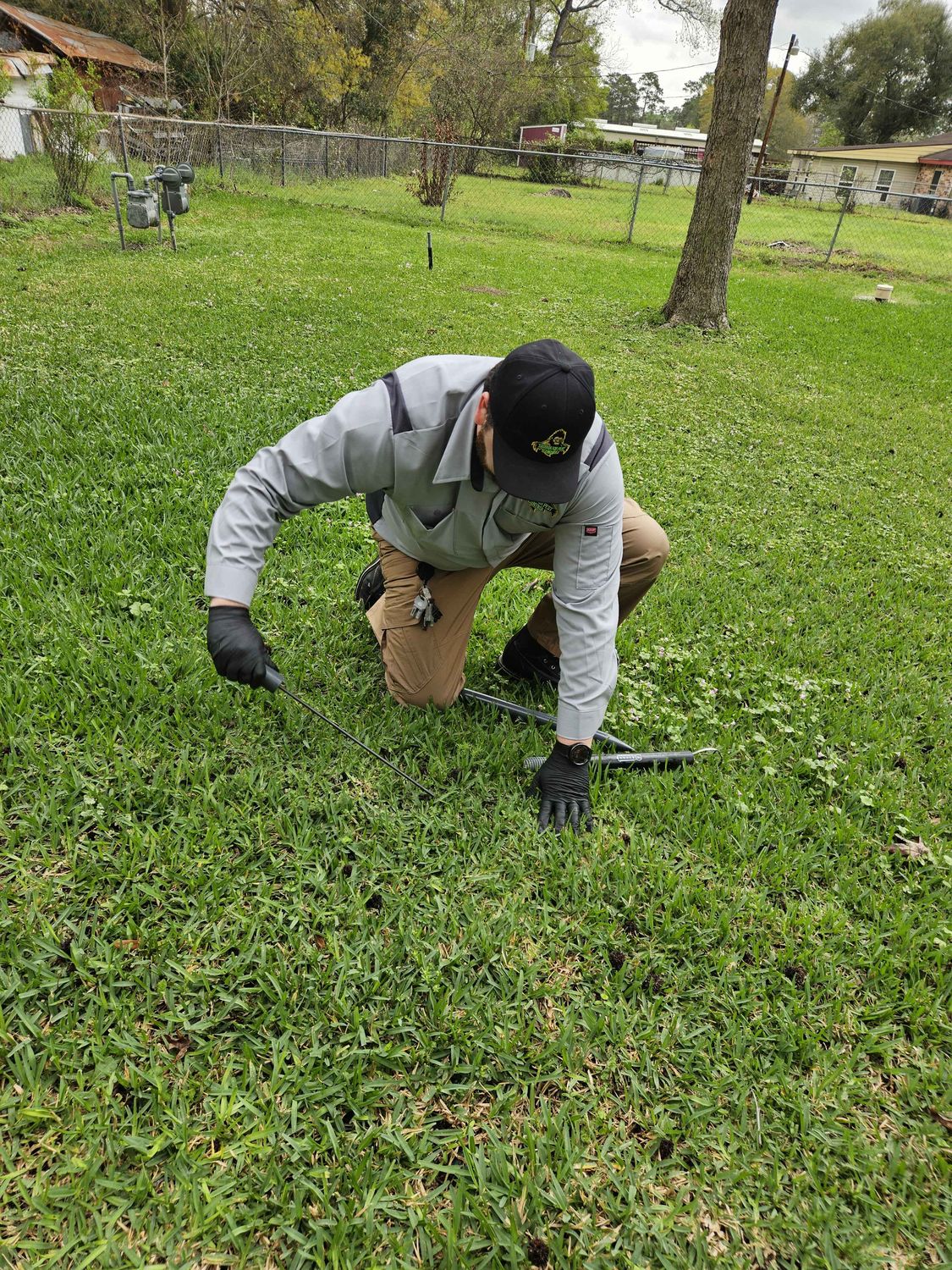
- Inspect for hot spots. We walk the yard perimeter, wood lines, fence rows, ground cover, leaf litter, shrub borders and the places pets rest or patrol. Where you have been finding ticks on people or animals tells us a lot.
- Barrier-treat the edges. A targeted treatment goes on those zones and the vegetation edges where ticks wait for a host. Following AgriLife’s guidance for brown dog ticks, that includes the siding of the house, fences, tree trunks and other vertical surfaces they climb to rest after feeding, as well as the lawn near them.
- Treat the dog areas. Kennels, dog runs, the underside of decks and the spot under the porch where the dog naps get specific attention.
- Treat indoors when brown dog ticks are inside. Cracks, baseboards, door frames, pet bedding areas and the kennel are where they hide and lay eggs.
- Follow up. Because new larvae and nymphs keep hatching after the first visit, we recommend follow-up service through the season to catch them.
Products go on at label rates and only where ticks live. Recurring service is covered by our 100% Service Guarantee, and that page explains the conditions, including the part where you correct conditions we point out, such as overgrown cover.
Signs and what each one means
- Ticks on ankles and waistbands after yard work. Questing ticks in the edges and ground cover. Treat the borders and cut the cover back.
- Ticks on the dog’s ears, neck and between the toes. The dog is picking them up along a regular route, usually a fence line or shrub border it patrols.
- Ticks on walls, curtains or ceilings indoors. Brown dog ticks breeding in the house. Both the dog and the home need treatment at the same time.
- Clusters of tiny ticks on one spot of skin. Larvae, often from one female’s egg mass in leaf litter. The source is close to where you were standing.
- A dog scratching, shaking its head or with small scabs. Worth a vet visit and a check of the dog’s bedding and run.
What waiting costs
A yard tick population does not fix itself while the brush stays and the wildlife keeps visiting. Indoors it is worse. A brown dog tick infestation left alone multiplies with every engorged female, and because adults can survive for well over a year without feeding, an empty house does not starve them out. The longer the infestation runs, the more of the house it reaches and the more visits it takes to finish.
If you find one attached
Finding a tick on a child after an afternoon in the back yard is unsettling, but the steps are simple and the clock is on your side if you act. Use clean, fine-tipped tweezers, grip the tick right at the skin, and pull it straight out with slow, steady pressure. Do not twist it, squeeze its body, burn it or smother it with anything first. Wash the bite and your hands afterward, and check the rest of the body, including the scalp, behind the ears and the backs of the knees.
Put the tick in a sealed bag or a jar of rubbing alcohol and write the date on it. If a fever, rash or aching joints show up in the following weeks, your doctor will want to know when the bite happened and where you were. Then tell us where in the yard you had been, because that spot is where the next treatment should be heaviest.
Residential focus
Tick work is mostly residential: family yards, dog runs and the edge of the greenbelt. Where a business has a kennel, a boarding facility, a groomer’s yard or landscaped grounds that border woods, the same approach applies, and our commercial service page explains how we set that up.
Prevention you can do yourself
AgriLife’s tick guidance and ours overlap heavily.
- Keep grass and weeds cut short, especially along fences and beds.
- Rake leaf litter out from under shrubs and along the back fence.
- Lay a strip of mulch or gravel where the lawn meets woods or tall brush, so ticks have a dry, sunny gap to cross.
- Move woodpiles, bird feeders and play equipment away from wooded edges.
- Keep every dog and cat on a tick preventive your veterinarian recommends.
- Wash and dry pet bedding regularly, and vacuum around it.
- When you go into brush, wear long pants tucked into socks and light colors that make ticks easy to see, as AgriLife suggests.
- Check yourself, your kids and your pets after time outdoors, and remove attached ticks promptly using the CDC’s steps described on its after-a-tick-bite page.
- Fence out deer and stray dogs if they cross the yard regularly.
Related services
Fleas often ride in on the same dogs and the same wildlife, and our flea control page covers treating the yard and house for them. Raccoons and opossums that carry ticks into yards are handled under raccoon removal and opossum removal. If mosquitoes are the other reason you stay indoors in summer, see mosquito control. We treat yards across Harris County and Montgomery County, including Spring, Tomball, Magnolia, The Woodlands and Kingwood. For a free inspection, contact us.
Frequently asked questions
Do ticks drop out of trees onto people?
No. Texas A&M AgriLife says ticks find hosts by waiting on the edges of grass and shrubs and climbing onto whatever brushes past. That is why the treatment goes along fence lines, bed edges and the border where the lawn stops, rather than in the canopy.
How do I remove a tick that is already attached?
The CDC says to grasp it as close to the skin as possible with clean fine-tipped tweezers and pull straight out with steady, even pressure, without twisting or jerking. Then clean the bite and your hands. Skip petroleum jelly, nail polish and heat.
Why are there ticks crawling on the walls inside my house?
That is almost certainly the brown dog tick. Texas A&M's tick program notes it is often seen literally crawling up the walls of infested homes, and that adults can survive more than 18 months without feeding. It needs the dog treated by a vet and the house treated at the same time.
Will one treatment take care of it?
Rarely. Ticks have egg, larval, nymph and adult stages that peak at different times, and wildlife, strays and your own pets keep bringing new ones in. Follow-up visits catch the stages that hatch after the first treatment.
Is the yard treatment a problem for my dog?
AgriLife warns that tick insecticides can be dangerous to pets and children if they are misapplied, which is why products go on at label rates and only where ticks live. Keep pets and people off treated areas until they dry, and your technician will tell you how long on the day.
When should I see a doctor after a tick bite?
The CDC advises seeing your doctor if you develop a rash or fever within several weeks of removing a tick. Tell them when you were bitten and where you had been, since Texas ticks carry several diseases with flu-like early symptoms.
Can I get a tick tested in Texas?
Often, yes. Baylor College of Medicine's Texas Tick Project in Houston tests ticks found in Texas at no charge, including ones from dogs or found inside. It asks that ticks pulled off a person go to the Texas Department of State Health Services. Seal the tick in a container and freeze it before sending.
Our largest service areas
Guides
Tick Control in north Houston?
No long-term contracts, and service agreements are backed by our 100% Service Guarantee.
Because we are based in Spring, we can often come out the same or next day for urgent problems. Call before noon, Monday through Friday, for the best chance at next-day service.
Last updated