
Termite Control in Spring and North Houston
North Houston has three termite problems, not one: native subterranean termites, the Formosan termite that arrived through the Houston Ship Channel, and drywood termites in attics and trim. Each leaves different evidence. We start with a free look at the property, confirm which one you have, then use targeted treatment and follow-up monitoring.
Call 281-627-4810 Request a free inspection
Year-round protection plans from $70 Core · Premium · Legendary See the plans
Termites: the job at a glance
| What it covers | Native subterranean, Formosan subterranean and drywood termites in homes and commercial buildings across Harris and Montgomery counties |
|---|---|
| Included | A free inspection, identifying the termite, targeted treatment of the activity found, and follow-up monitoring |
| Not included | Repairing wood termites have already damaged, and fixing the leak or drainage fault behind it |
| How long it takes | Depends on the species, the size of the structure and the method chosen; the plan says so in writing before work begins |
| Best timing | As soon as you see swarmers indoors or mud tubes on the slab; Formosan flights come at night in late May and early June |
| What it costs | Free inspection first, then a written price for the treatment and the monitoring before any work starts |
Three termites, three different problems
Around Spring, Klein, Tomball and The Woodlands, three termites matter, and they behave so differently that treating the wrong one is a common way to spend money and still have termites.
Native subterranean termites. These belong to the genus Reticulitermes, which the Texas A&M Urban and Structural Entomology Program calls the most economically important termite in the country. They live in the soil and have almost no tolerance for drying out, so they have to stay connected to soil moisture or to an above-ground water source like a leaking pipe or a roof that lets water in. That one need explains most of what you see: the mud tubes, the damage that starts low, and the way a plumbing leak can turn a quiet colony into an active one.
Formosan subterranean termites. This is the one people in Harris County have heard about, and the reputation is earned. Texas A&M’s Formosan termite page records the first Texas infestation in 1956 around the Houston Ship Channel, probably carried in on imported wooden shoring timbers, and lists Harris among the counties where it is now established. A typical colony can top a million insects, and they work through a wider range of wood at a quicker pace than the native species. The detail that changes how we work is that Formosan colonies regularly build aerial nests above ground inside the buildings they infest, sometimes several cubic feet in size. A nest in a wall void with a steady moisture source does not need the soil at all.
Drywood termites. These skip the soil entirely. They live in sound, dry wood above ground and get the water they need from the wood itself, so you find them in eaves, siding, attic framing, window trim and furniture rather than at the slab. Texas A&M’s drywood termite page says they occur statewide but are most concentrated along the Gulf Coast, which puts north Houston squarely in their range.
Why the Houston area keeps termites busy
Subterranean termites need moisture, and a north Houston lot supplies plenty of it: clay that holds water against the slab after a storm, sprinkler heads aimed at the foundation, AC condensate lines dripping beside the wall, flower beds built up above the slab edge, and gutters that dump at the corner of the house. Every one of those keeps the soil at the foundation damp for long stretches, which is exactly the condition a colony looks for.
Most homes here sit on slab foundations, and that matters for what you will and will not see. On a pier-and-beam house you can crawl under and look at the sills. On a slab, termites come up through expansion joints, plumbing penetrations and cracks, and then travel inside the walls. The first visible evidence is often a mud tube on the exposed slab edge, a swarm indoors, or trim that gives under a thumb.
Swarm timing differs by species. Texas A&M notes that native subterranean termites swarm as early as January and February in South Texas and as late as April and May in the Panhandle; north Houston sits between the two, so a late winter or spring flight is the one to watch. Formosan termites, according to the same program, swarm at night in late May and early June and are drawn to lights, which is why the first sign many families notice is a cloud of small winged insects around a porch fixture or a bathroom vanity light.
What you are actually looking at
Before anyone talks about treatment, the insect has to be identified. Here are the things people bring us, and what they usually turn out to be.
Swarmers versus flying ants. Texas A&M’s termite control FAQ gives the quick test: a termite swarmer has no pinched waist and its two pairs of wings are the same length. A winged ant has a narrow waist and front wings longer than the back pair. Fire ants, crazy ants and carpenter ants all fly here, and a swarm of them in May looks alarming without meaning anything about the wood. If it is carpenter ants, see our carpenter ants page instead.
Mud tubes. Pencil-width tunnels of soil climbing the slab, a pier, a pipe or the inside of a garage wall are the signature of subterranean termites. They are shelter tubes that keep the workers moist while they travel. A tube that is damp and crumbly when broken open is active; a dry, hollow one may be old. Our page on mud tubes on the slab walks through what to check before calling.
Pellets instead of tubes. Small, hard pellets piling up on a windowsill or below a piece of trim point to drywood termites. Texas A&M describes them as about a thirty-second of an inch long, with lengthwise ridges, blunt on one end and pointed on the other. Fine, fluffy sawdust with insect parts mixed in is more likely carpenter ants.
Round holes in fascia. A perfectly round half-inch hole in bare wood under the eaves is a carpenter bee, not a termite. That is a different job, covered on our carpenter bee control page.
Damaged wood. Wood eaten by subterranean termites often has soil packed into the galleries and sounds dull when tapped. Drywood galleries are smooth and clean, with pellets inside.
How we handle termites
Termite work comes down to finding the colony’s way in, treating where the termites are, and keeping watch afterward. Here is that, step by step.
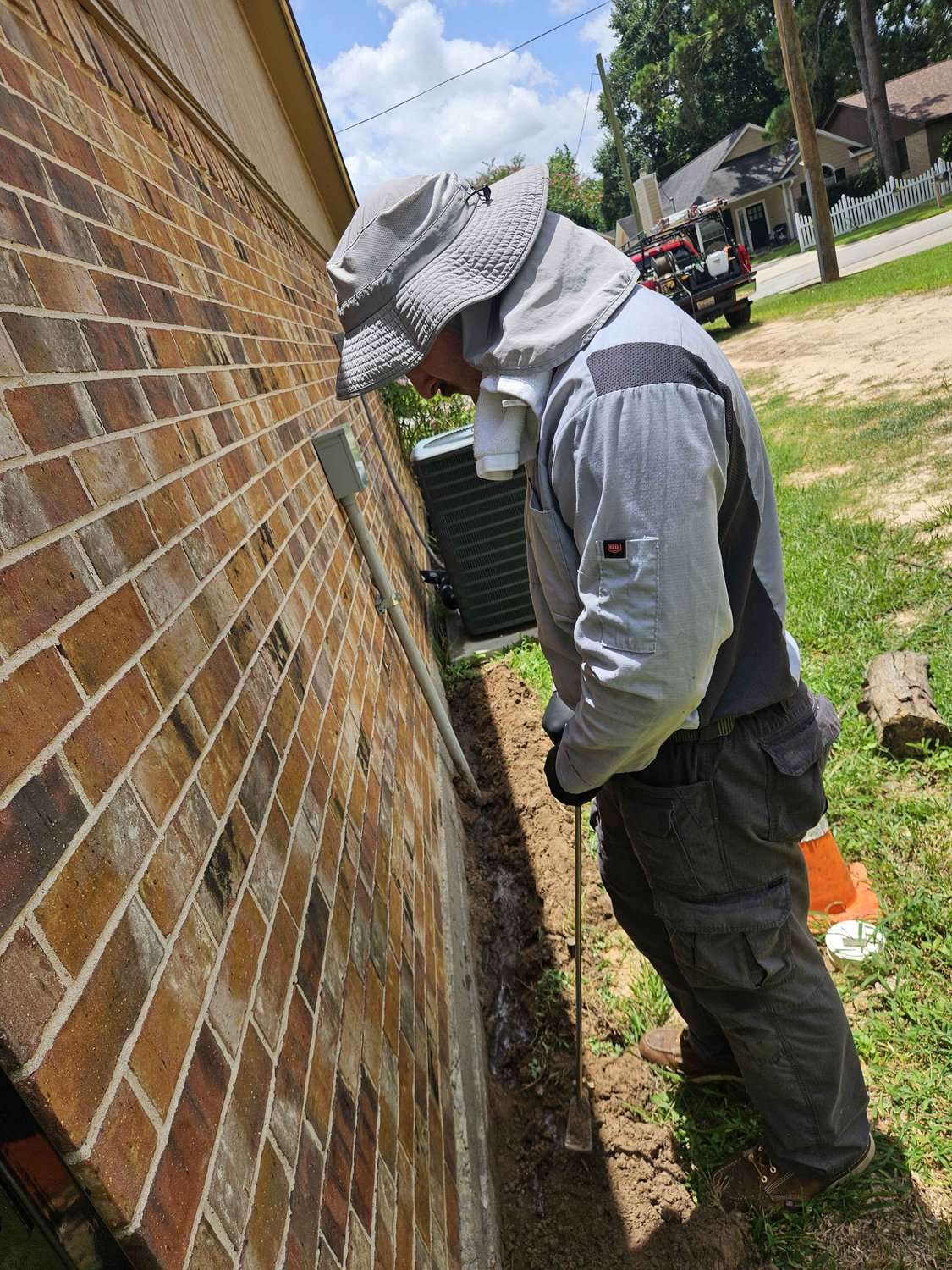
- A free inspection. We walk the outside of the foundation, the slab edge, the garage, accessible attic space and the places water collects. We are looking for activity, for the moisture that feeds it, and for conditions such as soil or mulch against siding that invite it back. This is a general look at your property, not a document for a home sale.
- Identify the termite. Native subterranean, Formosan or drywood, because the method follows the species. A drywood problem in attic framing is not solved from the soil, and a Formosan nest in a wall may need attention above ground as well as below.
- Choose the method with you. For subterranean termites the two broad approaches are a soil-applied liquid treatment and a baiting system. Texas A&M’s FAQ explains that baits use a slow-acting toxicant or growth regulator that workers carry back and share, aiming to suppress or eliminate the colony, while liquids create a treated zone in the soil around the structure. The same source reports that, in Texas A&M field tests, currently registered soil termiticides have lasted roughly four to ten years, and that baits carry the trade-off of ongoing servicing. Spot treatments of active galleries are used where the activity is localized, as with many drywood cases.
- Treat the activity we found. Targeted means the product goes where the termites are and where they are getting in, not a blanket spray of the yard.
- Monitor. We come back to check that the activity has stopped and that tubes have not rebuilt. If a station or a treated area shows new activity, it gets dealt with.
- Hand you the moisture list. Termites here follow water. If a leak, a drain line or a grading problem is feeding the colony, we tell you plainly, even though the fix usually belongs to a plumber, roofer or contractor rather than to us.
This follows the integrated pest management approach the EPA describes: identify the pest correctly, decide whether action is warranted, prevent where you can, and use the most targeted control that works.
Around Houston the plan still starts from which termite is in the house, and in Harris County the Formosan subterranean termite is the one that reshapes it. Texas A&M’s urban entomology program, cited above, lists Harris among the counties where it is established. Because Formosan colonies can nest above ground inside a wall that stays wet, a soil treatment around the foundation may not reach a colony living off a roof or plumbing leak, so the work also looks up into the walls and attic for the water feeding it.
Slab construction shapes the rest. With no crawlspace to look into, the routes in are hidden at expansion joints, plumbing penetrations and slab cracks, and treatment concentrates on the perimeter and those entry points. Many families first learn they have termites during a swarm, and our post on when termites swarm in Texas covers the months to watch. A swarm inside the house is the point to stop waiting and have the slab edge and garage looked at.
Something to be clear about: our general service agreement and the 100% Service Guarantee that comes with it exclude termites and wood-boring beetles, and we are not responsible for damage pests have already done to a structure. Termite work is quoted separately, with its own written terms.
What are the signs of termites in a Texas home?
The main signs of termites in a Texas home are winged swarmers or piles of shed wings indoors, pencil-width mud tubes on the slab or piers, wood that sounds hollow or gives under pressure, and, with drywood termites, small pellets below trim. Texas A&M says swarmers on windowsills are usually what homeowners notice first.
- Swarmers indoors, or wings piled on a sill. A colony is very likely in or under the structure. Texas A&M’s Formosan page treats swarmers inside a home as a sign of active infestation.
- Swarmers outdoors only. Termites are in the neighborhood, which is true of most of north Houston. Worth knowing, not a reason to panic.
- A fresh mud tube on the slab. Active subterranean termites with a route into the wall.
- Old dry tubes, nothing else. Possibly past activity, possibly a colony that moved. It needs checking, not assuming.
- Pellets below trim or in the attic. Drywood termites working above you.
- Doors and windows suddenly sticking, paint bubbling. Could be moisture, could be termites, frequently both.
Texas A&M’s native termite page adds two details that help sort the evidence. Wings stuck in cobwebs or lying on an indoor sill count as swarm evidence even if nobody saw the flight. And damaged wood, though it is rarely the first thing found, is positive indication of a current or past infestation. For drywood termites, the program says winged reproductives are usually the first sign, and that the fecal pellets they leave generally match the color of the wood being eaten, so pellets under pale trim look pale rather than dark.
The Houston calendar shapes which sign you are likely to see. Formosan swarmers come out after dark toward lights in late May and early June, and Texas A&M says drywood termites reach their highest concentrations in Texas along the Gulf Coast, with one species also flying at night toward lights. Winged insects around a bathroom fixture on a May evening could be either one, so a few collected in a sealed bag are worth more than a description. Our termites in Texas guide sets the species side by side, and the Formosan subterranean termite and drywood termites profiles in our pest library cover each one in detail.
What waiting costs
Termites do not stop on their own, and nobody can tell you how long a colony has been feeding by looking at a swarm. The real cost of waiting is that the damage is hidden. Subterranean termites eat from the inside of a stud outward and leave the surface for last, so by the time a baseboard crumbles the wood behind it is usually worse. A Formosan colony is large enough to do more in a season than a native one, and an aerial nest fed by a roof leak can run in a wall that never touches the soil.
Homes and commercial buildings
On a house, the work is mostly the slab perimeter, the garage, the attic and the places water collects. Commercial buildings add complications: long slab runs, multiple tenants, loading areas with pallets and stored cardboard, landscaped islands irrigated right up to the wall, and occupants who need to know when and where work is happening. If you manage a commercial property, start at our commercial page and we will plan around your operating hours.
Prevention you can do this weekend
None of this replaces treatment of an active colony, but each item takes away something termites rely on. Texas A&M’s native termite page stresses that any cellulose touching the soil, from trees and vines to plumbing fixtures, can serve as an avenue of infestation, and recommends good drainage and pruning vegetation off the walls.
- Pull mulch and soil back so there is visible slab between the bed and the siding.
- Turn sprinkler heads away from the foundation and stop beds from being built up over the slab edge.
- Run AC condensate and downspouts well away from the house.
- Fix plumbing and roof leaks promptly; a wet wall is an invitation.
- Store firewood, lumber and cardboard off the ground and away from the walls, including in the garage.
- Keep wood fences, trellises and planter boxes from bridging soil to siding.
- Leave the slab edge visible so you can spot a tube when one appears, a point the Texas A&M FAQ also makes about keeping the foundation inspectable.
Problem pages for termites
Two situations bring most termite calls in north Houston, and each has its own page:
- Formosan termite swarms in spring: the evening flights around lights in late May and June.
- Mud tubes on the slab: what a tube on the foundation means and what to do before calling.
A note on rules in Texas
In Texas, the Texas Department of Agriculture’s Structural Pest Control Service regulates the structural pest control industry, from one-person operations to national franchises, and investigates complaints about pest control done without a license. Whoever you hire for termite work, it is reasonable to ask which categories their business holds and to check with the department.
Where we work
We come out across Harris County and Montgomery County, including Spring, Klein, Tomball, The Woodlands, Cypress, Conroe, Kingwood and Atascocita. If you think you have termites, send us a note with a photo of what you found and where, and we will set up a time to look.
Frequently asked questions
I found a pile of wings on the windowsill. Do I have termites?
Wings shed in one spot indoors usually mean swarmers flew from a colony in or under the house, which is worth having looked at. Wings outdoors, or a single winged insect at a porch light, mean a lot less. Keep a few in a sealed bag so the insect can be identified, because flying ants shed wings too.
Are Formosan termites really in north Houston?
Yes. Texas A&M's urban entomology program dates the first Texas find to 1956 on the Houston Ship Channel and lists Harris County among the infested counties. Formosan colonies are larger than native ones and can nest above ground inside a wall, which is why we confirm the species before choosing a method.
Should I go with baits or a liquid treatment?
Texas A&M says there is no single right answer. Baits are built to suppress or eliminate the colony and need ongoing servicing; soil-applied liquids set up a treated zone and need no station checks. The species, the slab, nearby plumbing and how you use the yard all push the choice one way or the other, and we explain the trade-off before you pick.
Does your 100% Service Guarantee cover termites?
No, and we would rather say so up front. Our general service agreement excludes termites and wood-boring beetles, and we do not take responsibility for damage pests have done. Termite work is quoted on its own, and what follow-up it includes is written into that quote so you know exactly what you are buying.
Is the inspection really free?
Yes. We look at the slab edge, the garage, the accessible attic and the places water collects, tell you whether there is termite activity and which termite it is, and put a written price for treatment in front of you before any work starts. There is no obligation attached to the visit.
What does termite damage look like in a Texas house?
Often very little from the outside. Subterranean termites hollow wood from within and leave soil in the galleries, so trim can look sound until it is pressed. Drywood termites push out small pellets that match the wood's color. Texas A&M treats any damaged wood as proof of current or past activity.
Our largest service areas
Guides
From the blog
Termite Control in north Houston?
No long-term contracts. Termite work is quoted separately, with its own written terms; our 100% Service Guarantee does not cover termites.
Because we are based in Spring, we can often come out the same or next day for urgent problems. Call before noon, Monday through Friday, for the best chance at next-day service.
Last updated