
Commercial Pest Control for Houston Businesses
Sasquatch Pest Control runs recurring commercial pest programs for facilities across north Houston: food processors, restaurants, warehouses, healthcare and senior living, multifamily properties, hotels and schools. Each program is built around the facility and keeps the service record an inspector or auditor asks to see.
Call 281-627-4810 Request a free inspection
Programs by industry
Capability statement
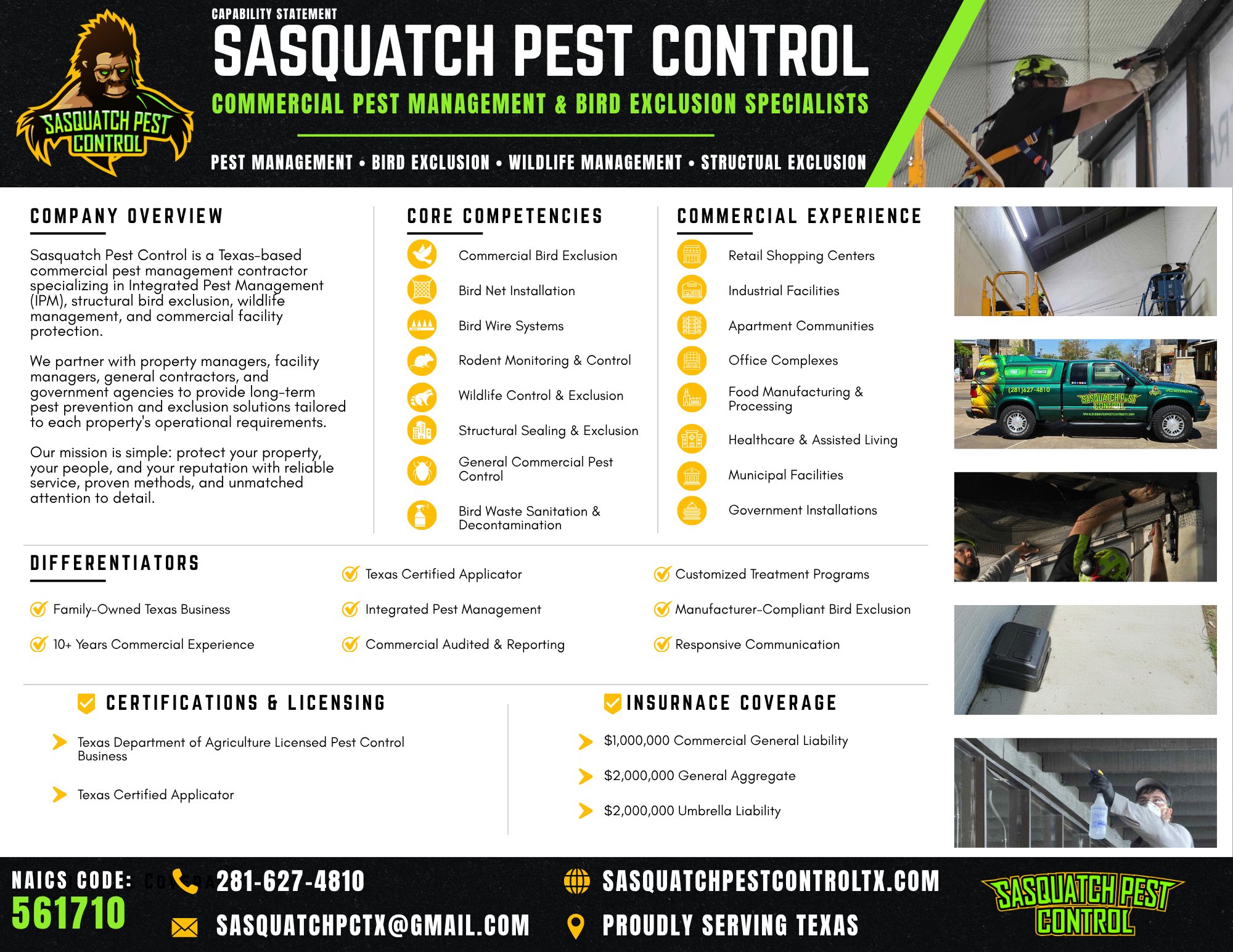
Texas Department of Agriculture licensed pest control business (TPCL 0983791), NAICS code 561710. Commercial general liability of $1,000,000, with a $2,000,000 general aggregate and $2,000,000 in umbrella liability. Property managers and contractors can download the full capability statement.
How a commercial program is built
A commercial account is not a house call repeated every month. It is a program written for one building, and it is built in the same order every time, whether the site is a restaurant in Tomball or a distribution center off the Hardy Toll Road.
Inspection. It starts with a free inspection of the whole property, inside and out, with whoever knows the building best: the facility manager, the kitchen lead, maintenance. We look for where pests are getting in, what is feeding them and where they are living, and we note the conditions the business controls, such as a dock door that does not seal or a dumpster pad that never gets washed.
Device map. Every monitor, trap and bait station gets a number and a marked spot on a site plan. The map is what makes the record readable later: a reading logged at station 22 means something only if anyone can walk to station 22.
Service cadence. Most commercial programs run weekly, every other week or monthly, depending on the kind of facility, how much pressure it is under and any audit calendar it keeps. A food plant or a busy kitchen usually sits at the frequent end; an office with no food service sits at the other.
Visit records. Each visit is logged with what was checked, what was found, what was done and what we are asking the business to fix.
Corrective actions. Those requests become a running list of open items, each one dated, each one staying open until someone closes it. A gap under a back door is a corrective action. So is a broken door closer, a drain that needs cleaning or a pallet of cardboard stored against an outside wall.
Trend review. Over months the visit records turn into a picture: which areas keep producing activity, which have gone quiet, whether a change in sanitation or a sealing job actually made a difference. That review is how a program is adjusted instead of simply repeated. It follows the logic of integrated pest management as the EPA describes it: decide what level of activity calls for action, monitor and identify, prevent, and control with the lowest-risk method that works.
What the record looks like
The record is written for the person who was not there: a health inspector, a third-party auditor, a corporate quality manager, a property owner or the next shift supervisor. It has to make sense without a technician standing beside it. On a typical account it holds:
- the date and time of each visit and who carried it out;
- the areas serviced and each device's reading, tied to the map;
- any product used, how much, and exactly where it went;
- findings in plain language, with the location;
- the corrective-action list, with open and closed dates;
- a trend view of activity by area across months.
What the record cannot do is pass an inspection for you. An auditor or inspector judges the facility, and the facility owns its sanitation, its repairs and its own policies. A good record shows that the program was run and that problems were found and followed up. Whether the building meets a particular standard is a question for the people who enforce it.
Inside the building and outside it
Most of what happens inside a commercial building is decided outside it. Rodents reach a roofline from trees and utility lines, or come in at ground level around dock doors, conduit and weep holes. Cockroaches and ants arrive in deliveries, cardboard and pallets. Flies breed in dumpster pads and grease traps a few yards from the back door.
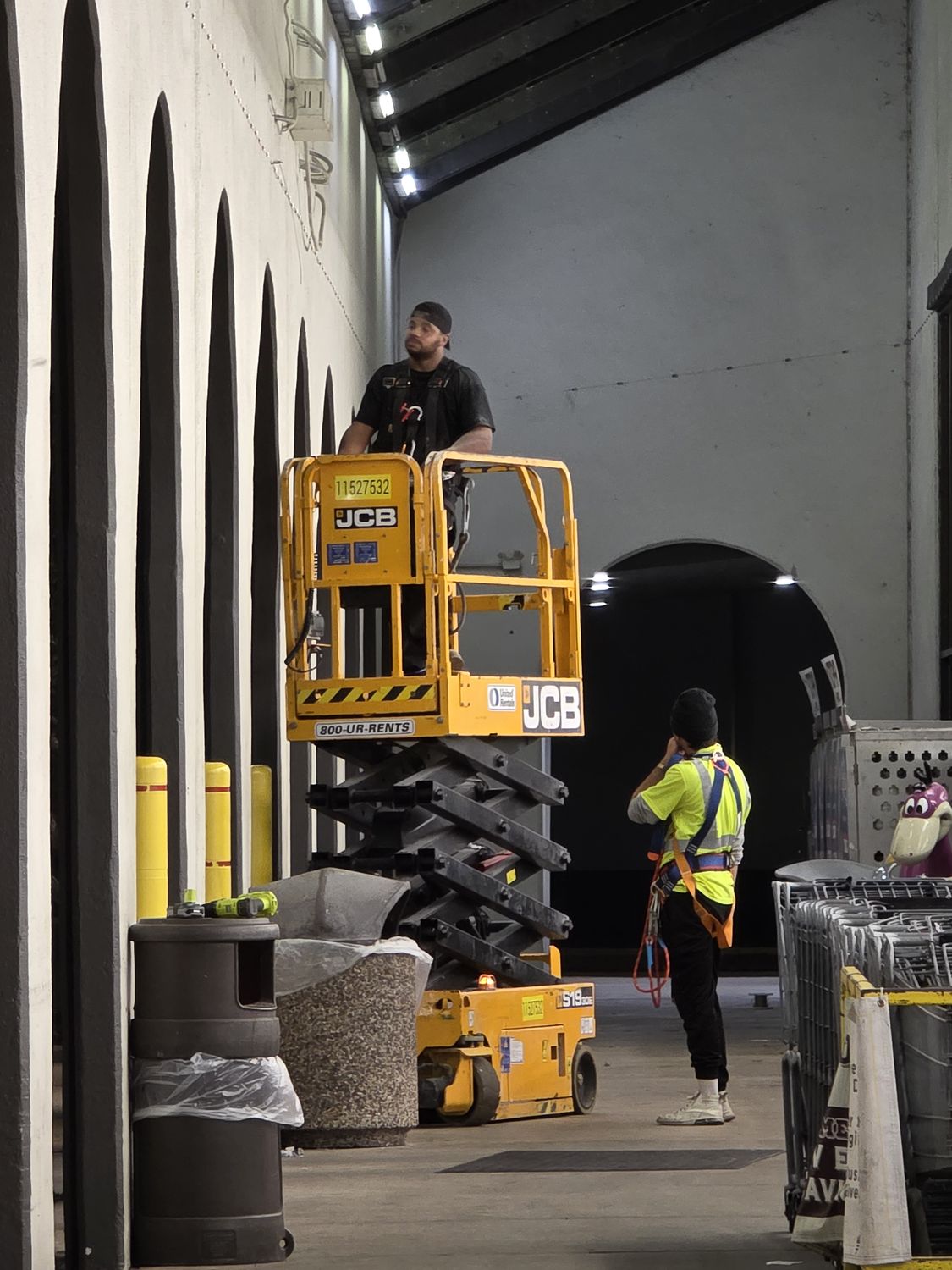
So the exterior gets as much attention as the interior: bait stations around the perimeter, inspection of the roofline and the loading area, sealing of gaps and penetrations, and a hard look at the trash and recycling area. Inside, the work concentrates where food, water and warmth meet: kitchens, break rooms, restrooms, mechanical rooms, storage and receiving. Our exclusion and repairs work and rodent control are usually the backbone of a commercial program, because a sealed building needs far less of everything else.
Scheduling around your hours
A commercial program works around the business, not the other way round. Visit times are written into the service agreement: before a restaurant opens, after an office empties, between production shifts, during a planned shutdown, or in the quiet stretch of a school break. Exterior checks and station service often fit into a normal working day without anyone noticing. Any application that needs people out of a room is planned for a time when the room is empty and can stay that way for as long as the product label requires.
When something goes wrong between visits
Problems do not wait for the next scheduled visit. A live rodent in a dining room, a cockroach sighting the week before an audit, a resident reporting bed bugs, a failed health inspection: these need a response outside the normal cadence. We do not publish a response time, because the honest answer depends on the day, the distance and what else is already on the schedule. What we can tell you is how to get a problem handled well.
Call or text and tell us:
- which site, and which room or area;
- what was seen, how many, and when;
- whether it is near food, patients, residents or children;
- whether a deadline is involved: an audit date, a re-inspection, a guest checking in;
- a photo, if anyone took one, and what has been done since.
Calls go to the front of the schedule when they involve food contact, people in care, a regulator or an imminent audit. The visit itself is an inspection of the source, treatment where it is warranted, and an entry in the record describing what was found and what was done, so the incident is documented alongside the routine visits rather than sitting apart from them. If the cause is a building problem, it goes on the corrective-action list like anything else.
Birds, bats and wildlife on commercial property
Commercial buildings attract more than insects and rodents. Pigeons roost on parapets, signs and loading-dock canopies, and their droppings land on walkways, product and rooftop equipment. Bats move into expansion joints, soffits and gaps at the roofline of older buildings. Raccoons and opossums work dumpster areas.
Birds are partly a legal question. Texas Parks and Wildlife notes that European starlings, house sparrows and feral pigeons are not protected, while other wild birds native to or migrating through Texas are protected under state and federal law. That decides what can be done about a nest. Our bird control work on commercial sites is exclusion first: netting, ledge deterrents and closing the openings birds use, with a list of what needs cleaning for your staff or a cleaning contractor.
Bats are protected and have a pup season when they cannot be shut out without trapping young inside, so bat exclusion on a commercial building is timed and done with one-way devices before the gaps are sealed. Both kinds of work fit inside the same program, the same map and the same record as everything else.
Who we work with
Commercial accounts run from Spring across north Houston, in Harris County and Montgomery County. The industry pages listed above go deeper into what each kind of facility is held to, and every program starts the same way, with a walk of the site. Commercial accounts carry the same no-long-term-contract terms and 100% Service Guarantee as our residential service.
Frequently asked questions
Do you keep records for inspections and audits?
Yes. Every commercial visit is logged with what was found, what was done and what was recommended, and the service history is available when an inspector or auditor asks for it.
Do commercial accounts require a long-term contract?
No. Commercial programs are recurring because pest pressure is, but there is no multi-year lock-in and no cancellation fee. The service agreement sets the schedule and scope in writing.
What kinds of facilities do you work with?
Food processing and manufacturing, restaurants and food service, warehouses and distribution, healthcare and senior living, multifamily and property management, hotels, and schools and childcare.
What should I do if we find pests between scheduled visits?
Call or text with the site, the area, what was seen and when, and whether it is near food, residents or a deadline such as an audit. Photos help. Calls involving food contact, people in care, or a regulator are put at the front of the schedule.
Can service happen outside our business hours?
Usually, yes. Visit times are set in the service agreement around how your building runs: before opening, after close, between shifts, or during a planned shutdown. Some work, such as exterior station checks, fits into a normal day without anyone noticing.
Guides
Commercial pest control in north Houston?
No long-term contracts, and service agreements are backed by our 100% Service Guarantee.
Because we are based in Spring, we can often come out the same or next day for urgent problems. Call before noon, Monday through Friday, for the best chance at next-day service.