
Carpenter Bee Control in Spring and North Houston
Carpenter bees bore half-inch round holes into bare softwood such as fascia, deck rails, pergolas and fences, then reuse and lengthen those tunnels every year. We find each active gallery, treat inside the hole with a residual dust the bees carry through the tunnel, follow up to confirm it is dead, and then recommend sealing the holes.
Call 281-627-4810 Request a free inspection
Year-round protection plans from $70 Core · Premium · Legendary See the plans

Carpenter bees: the job at a glance
| What it covers | Carpenter bee galleries in fascia, soffits, eaves, decks, railings, pergolas, fences and other exterior wood |
|---|---|
| Included | Mapping active holes, dust treatment inside each gallery, timing around new generations, and a follow-up check |
| Not included | Replacing damaged wood, painting or refinishing, and woodpecker damage repair |
| How long it takes | Set by the number of active holes and how many need a ladder; a deck rail is a short job, a full roofline is longer |
| Best timing | Spring, as adults come out in April and May and start boring, and again if new holes appear in summer |
| What it costs | Free visit to count the galleries, then a written price before any treatment |
A big black bee and a perfect round hole
Every spring someone in Spring, Klein or Cypress notices a large bee hovering under the eaves and a neat round hole in the fascia with sawdust below it. That is a carpenter bee, and the hole is the start of a gallery.
Texas A&M’s Urban and Structural Entomology Program describes them as three-quarters of an inch to an inch long and metallic blue-black. They look like bumble bees until you check the top of the abdomen: on a carpenter bee it is shiny black and mostly hairless, while a bumble bee’s is fuzzy. The same program notes their preference for softwoods like redwood, cypress, cedar and pine, the very woods used for north Houston fences, pergolas, decks and trim.
Texas A&M AgriLife Extension’s leaflet L-1826, Carpenter Bees, fills in the rest. The entrance is almost perfectly round and about half an inch across, and the leaflet notes that no other insect makes an opening that large and that round. The bee bores straight in up to an inch, turns at a right angle, and runs a gallery along the grain that averages four to six inches and can reach a foot. Inside, the female builds a row of six to nine cells, each provisioned with a pollen and nectar mix the leaflet calls bee bread.
Why north Houston keeps them busy
The leaflet says adults spend the winter inside old tunnels and usually emerge in April and May, mate within a few weeks, and start building. That is when you see the most activity. It also says there are two or more generations a year across much of Texas, and that in warmer parts of south Texas activity and breeding may continue all year. Our mild winters mean the season here starts early and runs long.
The building stock helps them too. Houses across Harris and Montgomery counties carry a lot of exterior softwood: cedar fences, pine fascia, cypress or cedar pergolas, and decks that go unsealed for a few summers. Hot sun and humidity weather that wood quickly, and weathered, unpainted wood is what carpenter bees pick. South- and east-facing surfaces that warm first in spring and sit under an overhang are especially popular, which matches the leaflet’s note that entries are usually in well-lit spots with overhead protection.
What you are actually looking at
- Carpenter bee. Large, glossy black abdomen, round half-inch hole, coarse sawdust below. Males hover and dive at people but cannot sting.
- Bumble bee. Similar size, but the abdomen is fuzzy with yellow bands. Bumble bees usually nest in the ground or in existing cavities rather than boring into solid wood.
- Carpenter ants. Wingless workers carrying out fine shavings, often from damp wood indoors, with no round entry hole. That is an ant job; see carpenter ants.
- Termites. No round holes at all. Mud tubes on the slab or pellets below trim point to termites instead, covered on our termite control page.
- Woodpecker damage. Ragged, torn-open wood along a line of holes often means a woodpecker was digging out larvae from carpenter bee galleries, which makes the damage worse.
Yellowish streaks running down the wood or siding below a hole come from the nest, and the leaflet lists staining of wood and painted surfaces among the problems these bees cause.
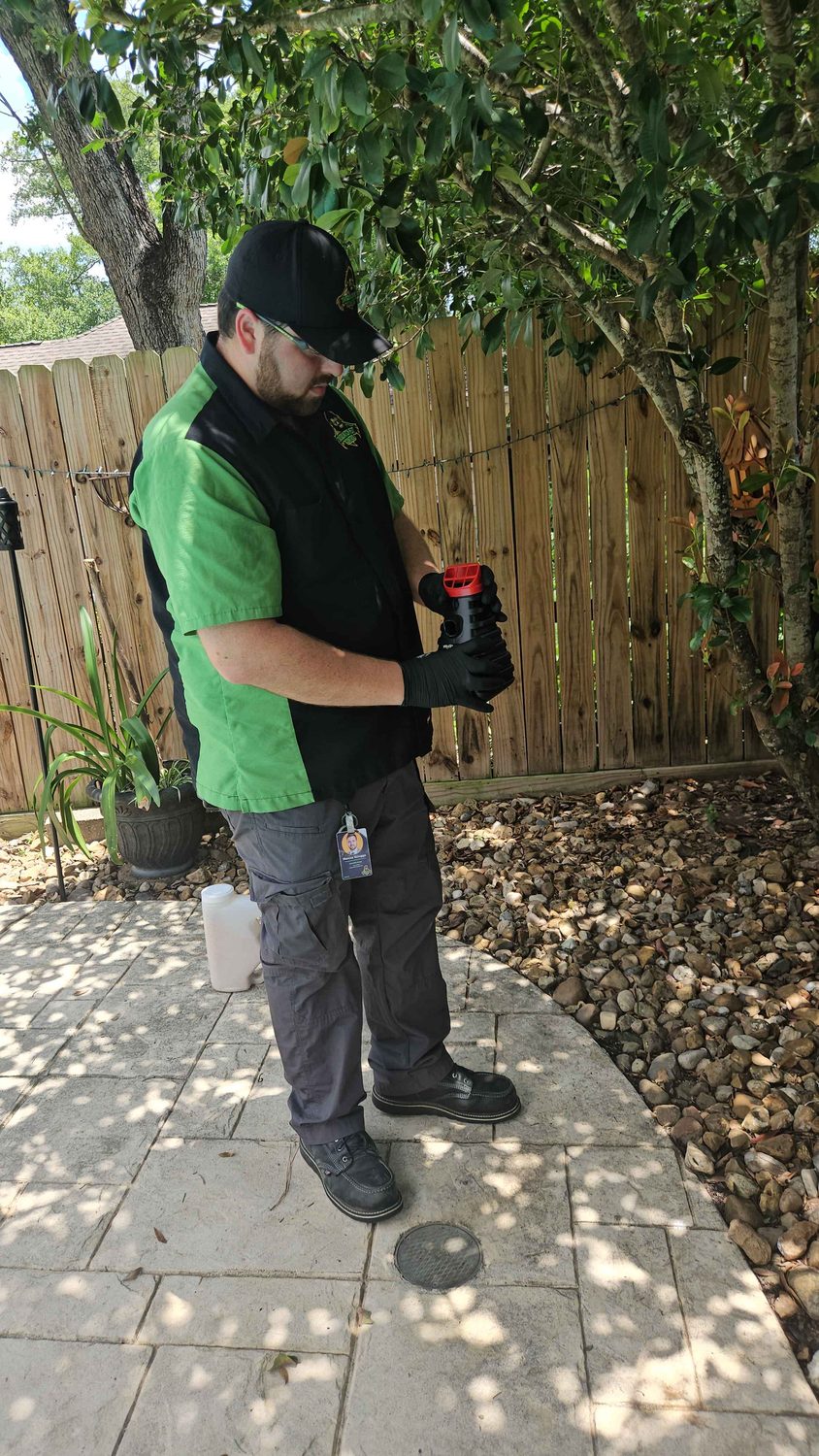
How we handle carpenter bees
This service is a sequence: inspect the wood, treat each gallery, time the work, seal afterward and confirm. Here it is in order.
- Free look at all the vulnerable wood. Fascia, soffits, eaves, decks, railings, pergolas, fences, swing sets and outdoor furniture. The goal is a map of every active gallery, because one missed hole keeps the cycle going. The leaflet’s tip is to look for perfectly round holes above sawdust piles, or to watch where the bees disappear into the wood.
- Treat inside each hole. A residual dust goes directly into each gallery, so it coats the tunnel and bees pick it up moving in and out. The leaflet describes dusts and sprays applied into each entrance and onto the wood a few inches around it, and notes that for nests out of reach or too numerous to do one by one, treating the surrounding wood gives only limited control.
- Time it around new generations. Treating as adults become active, and before the next generation comes out of the wood, catches bees in the gallery rather than after they have spread to new boards.
- Wait, then seal. The leaflet recommends waiting at least half a day, and up to a full day, after treatment before plugging, so bees returning from foraging are also exposed. Then the holes are plugged with hardwood dowel or wood filler so they cannot be reused.
- Follow up. We check that the galleries are inactive and look for any new holes started nearby.
Every product is applied according to its label. The leaflet itself makes the point that the person applying a pesticide is responsible for following label directions, and that labels change.
This is covered by our 100% Service Guarantee, under the terms on that page: if carpenter bees covered by your service come back between scheduled visits, we come back and re-treat at no added charge. The guarantee does not extend to repairing wood the bees or woodpeckers already damaged.
Fixing the wood afterward
Treating the bees is half the job. The other half is making the wood unattractive to the next female that comes looking.
Once a gallery is confirmed dead, the hole should be closed. The leaflet’s suggestion of hardwood dowel or wood filler works well for a few holes; a dowel glued in and sanded flush is stronger than putty on a deck rail that gets leaned on. Where a board is riddled with holes or woodpeckers have torn it open, replacing it with pressure-treated or painted lumber is usually cheaper over time than patching.
Then finish the surface. Oil-based or polyurethane paint is what L-1826 rates highest. On houses where the homeowner wants the look of natural cedar, it is worth knowing that stain alone will not stop carpenter bees, so expect to watch that wood each spring. Wood repair and painting are not part of our treatment, but we are happy to point out which boards need it.
Why spring timing matters
The window that matters most is the few weeks after adults come out in April and May. That is when females are boring, the bees are easiest to spot, and a treated gallery catches the bee that is building it. Wait until midsummer and the first generation of larvae may already be developing inside the wood, sealed off behind the partitions the female built, and new holes from a second generation can appear on boards that looked clean in spring.
Treating near people and pets
Carpenter bee galleries are often right where people sit: deck railings, pergola beams, the porch ceiling. Treatment goes into the hole itself rather than broadly across the surface, which keeps the product inside the gallery where the bees contact it. Where the wood around the hole is treated too, it is a few inches around the entrance, as the leaflet describes, not the whole deck. Let us know about children, pets or a pool nearby so the visit can be planned around them.
The signs, and what each means
- Sawdust on the deck or below the eaves in spring. A female is boring a new gallery or extending an old one right above it.
- Bees hovering at the same spot every day. Males guarding territory around an active nest.
- Faint chewing or buzzing in a board. Active excavation inside the wood.
- Yellow-brown stains running down from a hole. A gallery in regular use.
- Holes torn open in a row. Woodpeckers feeding on larvae, a sign the infestation is well established.
- Old plugged holes with fresh sawdust. Bees inside were sealed in without treatment and are chewing their way out.
What waiting costs
One hole in a fence rail is a cosmetic problem. The trouble is that it does not stay one hole. L-1826 says succeeding generations keep expanding old tunnels or start new ones in the same wood, that tunnel lengths can add up to more than three yards over several years, and that when several females share one entrance the wood can be completely honeycombed and seriously weakened. Texas A&M’s urban entomology page adds that abandoned galleries attract other pests, including wasps, ants and beetles. Add woodpeckers ripping into the fascia to reach the larvae, and a few seasons of waiting can turn a short treatment visit into a carpentry bill.
Homes and commercial properties
This is mainly a residential service, but the same bees work on wooden pavilions, porch railings at restaurants, playground structures and the wood trim of small office buildings. On commercial sites the main differences are access, height and scheduling around people using the space. If you manage a property, our commercial page explains how we plan around operating hours.
Prevention you can do yourself
Most of this comes straight from the Texas A&M leaflet:
- Paint exposed softwood. Oil-based or polyurethane paints, or pressure-treated wood, are the most effective at discouraging nesting. Latex paint usually works if it is kept up.
- Do not count on stain. The leaflet says stains give inadequate protection and sealants work only until they weather.
- Replace badly tunneled boards with pressure-treated or painted wood rather than patching them repeatedly.
- Plug holes only after treatment, with hardwood dowel or wood filler, so bees are not sealed in alive.
- Use flashing or screen as a last resort on wood that keeps getting attacked.
- Give them somewhere else. For people who want to keep a few pollinators around, the leaflet suggests a bundle of cedar or redwood placed off the ground in a sunny part of the garden, with a few shallow half-inch starter holes drilled in the end grain.
Related services
Carpenter bees sit with our other stinging-insect work. Paper wasps and yellowjackets under the same eaves are handled through wasp and yellowjacket control, and mud daubers have their own page under mud daubers under the eaves. A honey bee swarm or colony in a wall is a different situation, covered under bee control. If the wood damage is low on the house or near the slab, look at termite control as well.
Where we work
We treat carpenter bees across Harris County and Montgomery County, including Spring, Klein, Cypress, Tomball, The Woodlands and Kingwood. Send us a message with a photo of the holes and roughly how many you see, and we will set up a visit.
Frequently asked questions
Will carpenter bees sting me?
The bees that dive at your head near the deck are males, and males have no stinger at all. Females can sting, but Texas A&M's carpenter bee leaflet says they do so only when handled or provoked. The real concern is the wood, not the bee.
Can I just fill the holes with caulk?
Not first. Texas A&M warns that newly emerged adults will bore back out of a gallery that was not treated before it was plugged. Treat the tunnel, wait a day or so so returning bees contact the product, then plug the hole with a hardwood dowel or wood filler.
Why do they keep coming back to the same board?
Because the tunnel is already there. Females clean out and reuse old galleries, extend them, or branch new ones off an existing entrance. Over several seasons that adds up, which is why one weathered fascia board can end up honeycombed while the painted trim beside it is untouched.
Does staining the deck keep them away?
Not reliably. Texas A&M notes that stains give inadequate protection and that wood sealants deter attack only until they weather. Oil-based or polyurethane paint, or pressure-treated wood, works best, and latex paint helps if it is kept up.
Are they a protected bee I should leave alone?
Carpenter bees are native pollinators, and if a few in a shed or an old fence do not bother you, leaving them is a fair choice. Treatment is aimed at galleries in the house, the deck and the trim, where repeated tunneling weakens wood you want to keep.
Our largest service areas
From the blog
Carpenter Bee Control in north Houston?
No long-term contracts, and service agreements are backed by our 100% Service Guarantee.
Because we are based in Spring, we can often come out the same or next day for urgent problems. Call before noon, Monday through Friday, for the best chance at next-day service.
Last updated