
Mud Daubers Under the Eaves in Spring and North Houston
Tubes or lumps of dried mud under an eave, on a garage ceiling or in an attic are mud dauber nests. These solitary wasps do not defend them and seldom sting. Most homeowners can scrape the mud off with a putty knife. A treatment only makes sense when they keep returning to the same sheltered spots.
Call 281-627-4810 Request a free inspection
Year-round protection plans from $70 Core · Premium · Legendary See the plans

What to do, in order
- Confirm it is mud and not gray paper; paper means paper wasps or yellowjackets, which do defend a nest.
- Look for small round exit holes in the tubes; holes mean the young have already left and the nest is empty.
- Scrape the tubes off with a putty knife or a paint scraper, working from a stable ladder or the ground.
- Wash the mud stain off painted trim with water and a soft brush before it sets in the sun.
- Check the attic, garage rafters and the underside of a boat cover or grill lid for more tubes.
- If they rebuild in the same high spots every season, ask us to include those eaves in a wasp visit.
What you are looking at
Mud daubers build with mud the female collects a mouthful at a time from the edge of a puddle or a flower bed. Depending on the species, the result is a row of parallel tubes like organ pipes, a single fat lump the size of a thumb, or a cluster of cells plastered into a corner. They show up under eaves and soffits, on garage ceilings, inside attics, on the back wall of a shed and under the roof of a patio cover.
Texas A&M AgriLife’s publication on paper wasps, yellowjackets and solitary wasps describes the adults as three-quarters of an inch to an inch long, ranging from dull black with bright yellow markings to blackish or iridescent blue-black, with longer and thinner waists than most wasps. Inside each mud cell the female stocks paralyzed spiders and lays an egg, and the larva feeds on them as it grows.
The lookalikes
The thing that matters is whether the nest is made of mud or of paper.
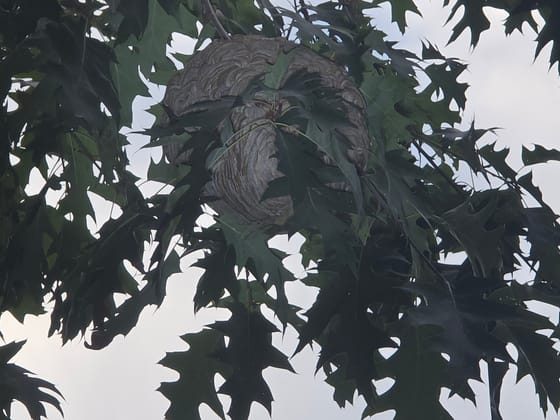
- Paper wasp nests are gray, papery, open combs of hexagonal cells hanging from a short stalk. Paper wasps guard them and will sting. They belong on our wasp control list, not in the do-it-yourself pile.
- Yellowjacket nests are enclosed paper balls with one entrance, or a hole in the ground or a wall with steady traffic. Those are the most defensive wasps around here; see yellowjackets in the ground or a wall.
- Old swallow or phoebe nests are also mud, but cup-shaped and lined with grass or feathers. Those belong to birds, not wasps, and our bird control page covers what can and cannot be done.
- Termite mud tubes run up a foundation or a wall from the ground, flat and branching, and they are pencil-width tunnels rather than cells stuck to a ceiling. If mud is climbing up from the slab, have it looked at.
How to tell at home
Get close enough to see texture. Mud dauber nests look like dried clay, often with visible bands where each load was added. Tap one with a broom handle. Nothing pours out to defend it, and at most a single wasp will leave. Small round holes in the end of the tubes mean the young wasps have already chewed their way out and the nest is empty. A smooth, unbroken tube may still hold a larva or a pupa, but it still poses next to no risk to you.
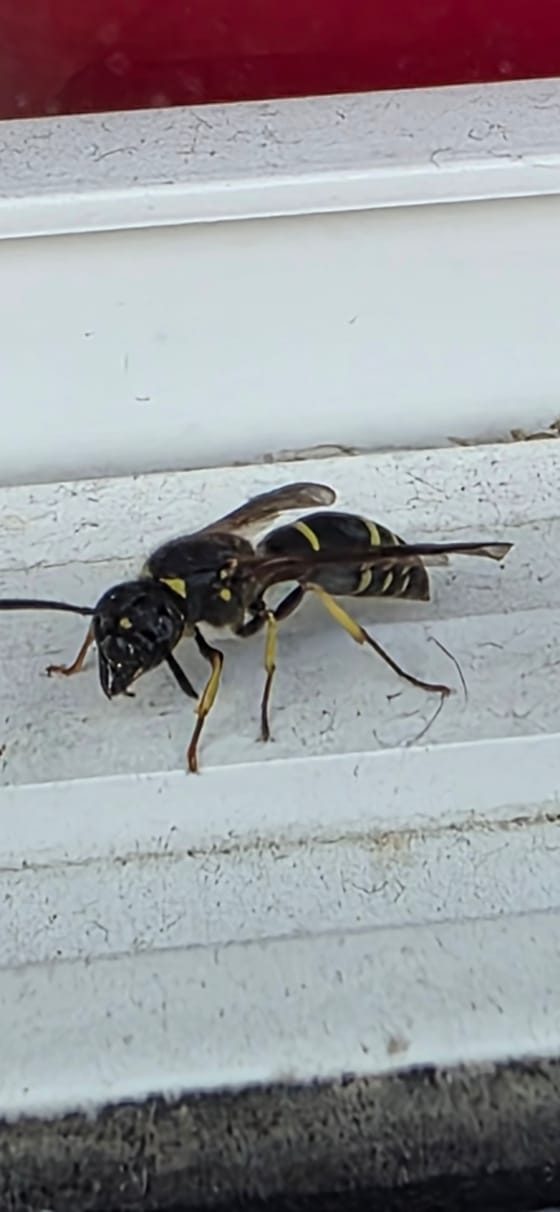
The adults themselves are calm. You will often see one walking slowly over the brickwork or hovering at a puddle’s edge collecting mud, ignoring people a few feet away.
What we do, and when it is not worth calling
AgriLife’s control advice for mud daubers is short: because the females do not defend their nests, the mud can simply be removed by hand with a putty knife. The same publication adds that even when an insecticide is used, the nest should still be scraped off so it does not attract other insects. We agree with both halves of that, and for a handful of tubes under a porch ceiling we will tell you over the phone that you do not need us.
When we are already out for wasps, the mud dauber tubes we can reach come down as part of the visit, and the eaves and sheltered corners that wasps keep choosing get treated. That matters most on the high second-story eaves people cannot reach from an ordinary ladder, on commercial buildings with long covered walkways, and on properties where paper wasps and mud daubers share the same overhangs. Visits are covered by our 100% Service Guarantee.
Keeping them from coming back
You will not keep every mud dauber off a Gulf Coast house, but a few habits cut the numbers.
- Keep the garage door down when the garage is not in use. An open garage is the biggest single invitation.
- Screen attic and gable vents, and repair torn soffit vent screens.
- Knock down new mud early in the season, before a female finishes and stocks a row of cells.
- Fix leaking hose bibs and drippy irrigation heads beside the house. A constant muddy patch next to the wall is a convenient supply of building material.
- Fewer spiders around the eaves means less food, which is one more reason webs along the soffits are worth sweeping. Our spider control page covers that side.
When to call
Call when you are not sure the nest is mud, when it is too high to reach without a tall ladder, or when wasps of any kind are building in the same places year after year. If you see paper instead of clay, or a steady stream of wasps into a hole, treat it as a different problem and keep your distance. For a free inspection, use the contact page.
Frequently asked questions
Will a mud dauber sting me if I knock its nest down?
It is unlikely. Texas A&M AgriLife says solitary wasps rarely sting unless they are handled or trapped against skin, and that their venom seldom causes more than brief pain. Mud dauber females do not defend their nests, which is why removal by hand is the usual advice.
Are mud daubers good to have around?
In a way. Their larvae are fed spiders, and AgriLife notes the prey includes the brown recluse. Most people still do not want mud tubes over the front door, and leaving old nests in place can draw other insects, so removing them is reasonable.
Why do I keep finding them in the garage and attic?
They want a dry, sheltered overhead surface, and open garages, attics and storage buildings are exactly that. Keeping the garage door shut when you are not using it and screening attic vents cuts down on the number of females that find a place to build.
Do mud daubers do any damage?
Not to the structure. The mud stains paint and stucco and looks untidy, and a tube built over a weep hole or a small vent can block it. Beyond that they are a nuisance rather than a threat, which is why we usually tell people they can handle these themselves.
Wasp & Yellowjacket Control in north Houston?
No long-term contracts, and service agreements are backed by our 100% Service Guarantee.
Because we are based in Spring, we can often come out the same or next day for urgent problems. Call before noon, Monday through Friday, for the best chance at next-day service.
Last updated