
Yellowjackets in the Ground or a Wall in Spring and North Houston
Wasps flying in and out of one hole in the lawn, a weep hole or a gap in the siding are almost always yellowjackets with an enclosed nest behind it. Leave the hole open and keep people away. The colony is treated through that entrance with a dust the workers carry inside, usually late in the day.
Call 281-627-4810 Request a free inspection
Year-round protection plans from $70 Core · Premium · Legendary See the plans

What to do, in order
- Stop mowing, edging and trimming within several yards of the hole, and mark the spot so nobody steps on it.
- Do not plug, caulk, flood or spray the entrance; a blocked colony looks for another way out, sometimes indoors.
- From a good distance, note where the hole is, roughly how busy it is, and whether you see a second opening nearby.
- If buzzing comes from inside a wall, close the door to that room and keep children and pets out of it.
- Tell us when you call if anyone in the household has ever had a serious reaction to a sting.
- After treatment, wait for our follow-up before sealing or screening the opening the wasps used.
What the hole in the lawn usually turns out to be
A line of wasps dropping into a hole in the grass, one after another, all day long, is one of the most reliable signs in pest work. Around Spring, Klein and Tomball it is nearly always the southern or eastern yellowjacket, and the hole is the only door to a paper nest underground.
Texas A&M AgriLife’s publication on paper wasps, yellowjackets and solitary wasps describes yellowjackets as primarily ground nesters that also build in wall voids, open garages, sheds, porches and abandoned furniture. The nest is wrapped in a paper envelope with a single entrance hole, which is why you only ever see the traffic and never the comb. After the first batch of workers emerges in spring, the same publication says a nest can expand to a foot long or more within days or weeks.
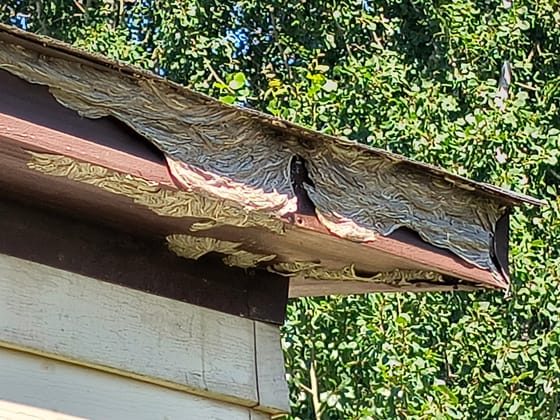
The wall version looks different from outside but works the same way. On brick homes the entrance is often a weep hole near the ground. On siding it is a gap at a corner board, a dryer vent or the spot where a cable enters. You see a few wasps coming and going and assume it is small. The nest behind the brick is usually much larger than the traffic suggests.
The lookalikes
- Paper wasps have long legs that hang down in flight and build an open comb you can see, under an eave or a porch ceiling. They do not use a hole.
- Honey bees going into a wall are fuzzier, browner and slower. That is a different job, covered on our bee control page, and it usually means removing comb and honey.
- Cicada killers are large, rusty red solitary wasps digging holes in bare patches of lawn in summer. Each hole belongs to one female, the males buzz people but cannot sting, and AgriLife says control is rarely needed.
- Mud daubers carry mud, not paper, and do not defend anything. See mud daubers under the eaves.
How to tell at home, without getting close
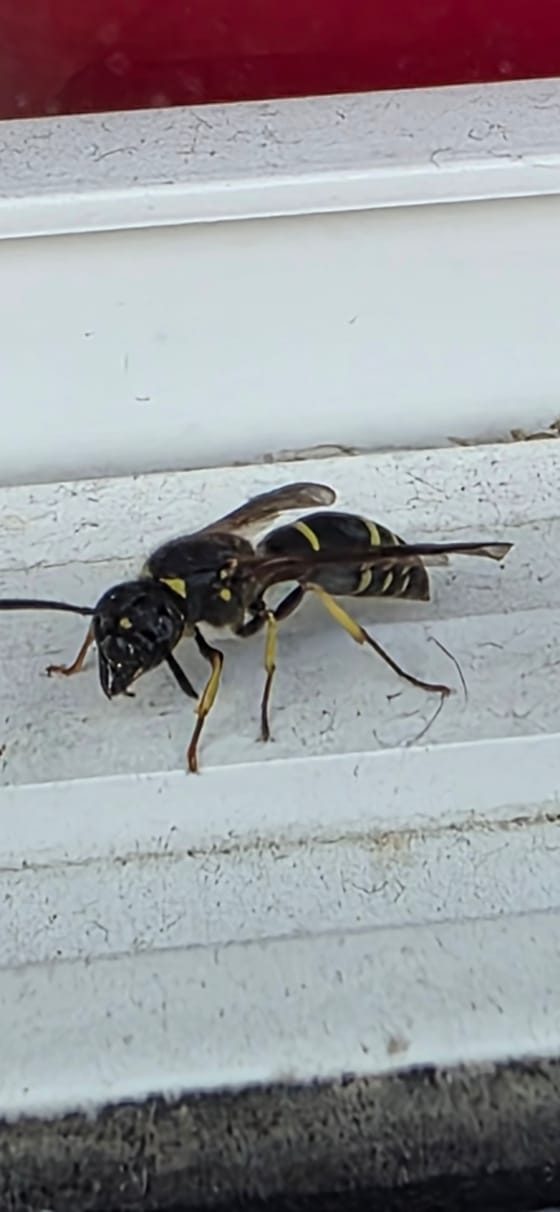
Stand well back, fifteen feet or more, on a warm afternoon. Yellowjackets are about half an inch long, smooth, bright yellow and black, and they fly straight in and straight out without pausing at the hole. Watch for a minute or two. Constant two-way traffic through a single point means an active colony. If the traffic is slow and the insects are fuzzy and golden, think honey bees instead. Use your phone’s zoom for a photo rather than walking up to it.
Why the hole has to stay open
The instinct is to stuff the hole and be done. AgriLife’s guidance for professionals says entrances to yellowjacket nests in walls generally should not be sealed until the colony has been eliminated, because wasps may force their way into the house looking for a new exit. A caulked weep hole can turn into wasps at a light fixture or an outlet inside the house. In the ground, a plugged hole just means a new one a few inches away, and an angrier colony.
What we do
The approach below is the one the owner has always used for yellowjackets, set out in order. The broader stinging-insect service is on our wasp control page.
- Find every entrance. Ground colonies and wall colonies often have a satellite opening, and treating one while missing the other leaves workers with a way out.
- Pick the time. AgriLife recommends treating in the late evening, when most of the colony is home. That is our usual timing.
- Treat into the entrance. A residual dust or aerosol goes directly into the opening. Returning foragers carry it deep into the nest, toward the queen and the brood, which is where a surface spray never reaches.
- Treat the surrounding harborage so stragglers have nowhere close to regroup.
- Deal with the void. For a wall nest, once the colony is dead we make sure the nest is knocked down and the void addressed, so a rotting nest does not draw in other insects.
- Come back and confirm. A follow-up visit checks that the colony is finished before anyone seals or screens the opening.
That work is backed by our 100% Service Guarantee, and the guarantee page lays out the terms.
Stings and who is at risk
Yellowjackets rarely sting far from the nest, but they defend it in numbers, and unlike honey bees they keep their stingers and can sting again. AgriLife notes that serious allergic reactions typically start within 20 to 30 minutes of a sting and can come on faster. Hives spreading over the body, swelling of the face or throat, or any trouble breathing means calling 911 right away. A large red swollen patch around the sting itself is more common and is a different, local reaction.
AgriLife also says nobody with a heart condition or a known venom allergy should try to treat a nest themselves. If that describes anyone in the house, tell us when you call.
When to call
Call when the nest is in a lawn that gets mowed, along a path, near a door or play area, or anywhere inside the structure. Late summer and fall are when colonies are largest and people get stung most, so a nest found in August is not one to leave for a few weeks. A nest at the far back of a large lot that nobody walks past can sometimes be left, as long as everyone knows where it is. Free inspections start at the contact page.
Frequently asked questions
Can I just pour gasoline or boiling water down the hole?
Please do not. Gasoline is a fire and soil contamination hazard, and liquids of any kind tend to soak into the dirt before enough of them reaches the nest. Texas A&M AgriLife notes that dusts work better for ground nests because the wasps track them deep inside.
Will you have to cut open my wall?
In most cases, no. We treat the colony through the opening the wasps already use, so foragers spread the material through the nest. Once the colony is dead we make sure the nest is knocked down and the void dealt with, and we will explain beforehand if a mature nest needs removing.
Do yellowjacket traps get rid of a nest?
No. Traps can lower the number of foragers around a patio or a trash can when they are kept up, but AgriLife is clear that they do not control the colony itself. A nest in the ground or a wall keeps producing workers until it is treated.
Is there ever a case for leaving a yellowjacket nest alone?
Sometimes. AgriLife says a nest well away from where people walk can be left and marked with a warning, since most colonies die back after a hard frost. Around here a hard frost is not guaranteed, so a nest anywhere near a door, a lawn or a play area is better treated.
From the blog
Wasp & Yellowjacket Control in north Houston?
No long-term contracts, and service agreements are backed by our 100% Service Guarantee.
Because we are based in Spring, we can often come out the same or next day for urgent problems. Call before noon, Monday through Friday, for the best chance at next-day service.
Last updated