
Pantry Pest Control in Spring and North Houston
Pantry pests are insects such as Indianmeal moths, flour beetles and weevils that live inside stored dry food. They usually arrive in a package from the store. Control starts with finding and throwing out the infested product, then cleaning and treating the shelf cracks where larvae hide, and storing new food in sealed containers.
Call 281-627-4810 Request a free inspection
Year-round protection plans from $70 Core · Premium · Legendary See the plans

Pantry pests: the job at a glance
| What it covers | Indianmeal moths, flour beetles, sawtoothed grain beetles, drugstore and cigarette beetles, and weevils in kitchens, pantries and food storage |
|---|---|
| Included | Inspection of every dry-goods area, help locating the source product, crack and crevice treatment of shelving, and follow-up |
| Not included | Replacing discarded food, and cleaning out the pantry; the homeowner empties the shelves before treatment |
| How long it takes | One visit to inspect and treat a typical kitchen; a return visit checks for insects hatching from eggs that were missed |
| Best timing | As soon as moths or larvae show up, before they spread from one package to the rest of the shelf |
| What it costs | Free inspection, then a written price; how many cabinets, pantries or storage rooms are affected set it |
What is actually in the flour
“Pantry pest” is a catch-all for several insects that live and breed inside stored dry food. Texas A&M’s urban entomology program publishes a fact sheet on recognizing and controlling insect pests of stored products, and the list it covers lines up with what we find in north Houston kitchens:
Indianmeal moth. The most common by a wide margin. The adult is a small moth with a two-toned wing: tan near the body and coppery toward the tip. The larva is a pale, cream-colored caterpillar about half an inch long when full grown. Texas A&M lists dried fruit, nuts, chocolate, powdered milk, birdseed, dog food and many grain products among its foods.
Flour beetles and sawtoothed grain beetles. Small, slender, reddish-brown to brown beetles that turn up in flour, cereal, cornmeal and mixes.
Drugstore and cigarette beetles. Small, rounded, reddish-brown beetles that hold their heads tucked down. They go after spices, dried herbs, pet food and a surprising range of dry products.
Weevils. Dark beetles with a long snout, usually in whole grains, rice and dried beans.
You do not need to know which one you have before calling. You do need to know that all of them live inside the food, because that changes everything about how the problem gets solved.
Cupboard weevils
“Cupboard weevil” is a household name, not a species. People use it for any small, snouted beetle found in a kitchen cabinet, and in practice it nearly always means one of three grain weevils in the genus Sitophilus: the rice weevil (S. oryzae), the maize weevil (S. zeamais) or the granary weevil (S. granarius).
Iowa State University Extension’s page on rice and granary weevils puts the adults at about an eighth of an inch, brown to reddish brown, with bodies that look pitted, and says the larvae grow inside whole kernels as small white grubs. Its list of where they turn up reads like a kitchen inventory: dried beans and seeds, popcorn, saved garden seed, decorative Indian corn and even bean bags. It adds that finding the adults usually means whole grain or seed is infested somewhere, so the search goes to the popcorn jar and the bag of dried beans before the flour canister. The same page suggests heating grain to 140 degrees F for 15 minutes, or freezing it at 0 degrees F for three days, for anything worth saving.
Granary weevils
The granary weevil is the one of the three that cannot fly. Oklahoma State University Extension’s fact sheet on stored grain insects that feed inside kernels describes Sitophilus granarius as a small, dark beetle about 3/16 of an inch or smaller, with oval or elongated pits on the thorax and no functional wings, so it only walks. Iowa State notes that it is evenly colored with no spots. Oklahoma State gives it a life cycle of about 28 to 35 days and an adult life of seven to 13 months.
Its two cousins differ in ways you can sometimes see. The rice weevil usually carries four reddish or yellowish spots on its wing covers and can fly, though it mostly walks. The maize weevil is slightly larger, generally darker and the strongest flier of the three, and Oklahoma State notes that in the southern U.S. it will infest corn ears still on the stalk. Color varies within all three, so the fact sheet warns that color alone makes them hard to separate. For a household, the species changes little about the fix: the infested package goes, the shelf is cleaned, and new grain goes into sealed containers.
Why north Houston kitchens see so much of it
The honest answer is that pantry pests are not really a regional pest. They ride in from warehouses and stores inside the packaging, and a home anywhere can get them. What a warm Gulf Coast house does is give them no reason to slow down. An insulated pantry next to the oven or the refrigerator’s exhaust stays warm all year, so a package that arrived with a few eggs can produce a second and third generation before anyone opens it again.
The other local factor is bulk buying. Big bags of rice, flour, birdseed, dog food and deer corn stored in a garage, a utility room or a back closet are common in Spring, Tomball and Magnolia households. Those bags get opened slowly, sit for months and are often stored in paper or woven sacks. That is the setup we see behind most of the large infestations.
Not every small moth is a pantry moth
The same Texas A&M fact sheet covers two fabric pests that get mistaken for pantry insects, and the difference matters because the source is in a closet, not the kitchen.
Clothes moths are small, about half an inch across the wings, with a golden sheen. Texas A&M notes that they avoid light and are active mostly at night, so you seldom see them flying around the kitchen the way Indianmeal moths do. Their larvae feed on wool, fur, felt and pet hair.
Carpet beetles are small, round beetles, roughly a sixteenth to an eighth of an inch long, with black or mottled wing covers. The larvae are carrot-shaped and hairy. Texas A&M lists their foods as almost any animal protein: wool, natural-fiber carpet, pet hair, dead insects, and also dried meat and milk or cheese products. That last part is how they end up on pantry calls.
A moth sitting still on a bedroom wall with no food nearby, or holes in a wool sweater, points away from the pantry. We sort that out at the inspection, because treating the kitchen for a closet problem fixes nothing.
The signs, and what each one tells you
Small moths fluttering in the kitchen at night. Adult Indianmeal moths. The source is a food product somewhere within a short flight, most often in the pantry, a cabinet near the stove or the pet food bin.
Silk webbing or clumps in flour, cereal or grains. Larvae are feeding in that product right now. That package is the source or one of them.
Pale larvae on walls, ceilings or the top edge of cabinets. Texas A&M describes full-grown larvae wandering to find a place to pupate, and they often end up on ceilings and countertops. The source is usually directly below or beside where you find them.
Tiny beetles on shelves or crawling out of a spice jar. Stored-product beetles. Check spices, dried peppers, pet treats and decorative items made from dried plants or seeds.
Fine powder or shed skins at the bottom of a container. A long-running infestation in that product.
Moths in a room with no food in it. Look for birdseed, pet food, dried flower arrangements or a forgotten bag of nuts in a closet or garage.
How we handle it
The approach follows the EPA’s integrated pest management principles: identify the pest, find what is feeding it, prevent the next round, and use a pesticide only where it does real work. With pantry pests that order matters more than with almost anything else we treat.
- Inspection. A technician goes through the pantry, the cabinets, the pet food, the garage storage and anywhere else dry goods are kept. We open containers, look at seams and folds in packaging and check the shelf edges and corners where larvae pupate.
- Finding the source. Somewhere there is a product the insects are breeding in. Texas A&M’s guidance is plain that control starts with locating and eliminating that food, and that sometimes removing one old bag is all it takes. We help you find it, along with anything nearby that it has spread to.
- Removal. You decide what to discard, with our advice on what is infested and what is at risk. We do not throw out your groceries for you, but we will tell you plainly which ones have to go.
- Cleaning. The emptied shelves are vacuumed, paying attention to corners, shelf pin holes and the joint where the shelf meets the wall. That debris is where eggs and pupae sit.
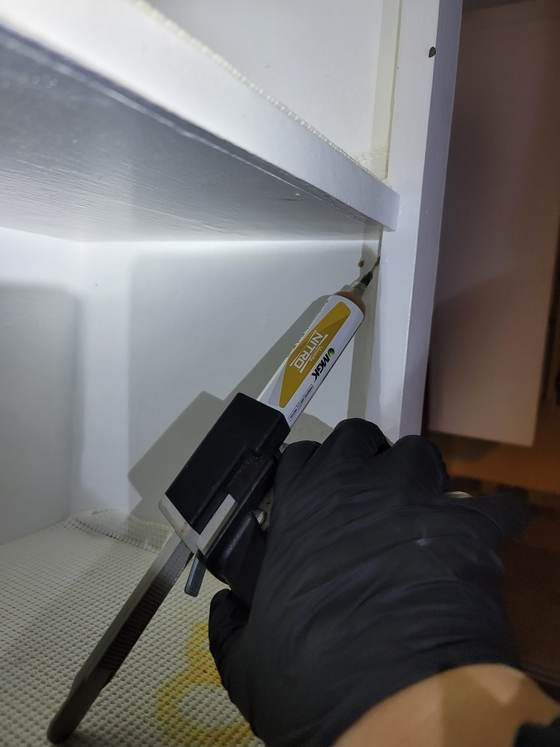
- Treatment. We treat cracks, crevices, shelf edges and voids where larvae hide and adults rest. Treatment is aimed at those protected spots, not at food or open shelf surfaces.
- Follow-up. Eggs that were missed will hatch, so we check back to make sure the life cycle has been broken.
Every service carries our 100% Service Guarantee with no long-term contract. The guarantee terms ask the customer to correct conditions the technician points out, and on a pantry job that means discarding the infested product and keeping new food sealed.
Why it keeps coming back
When someone tells us they have cleaned the pantry three times and the moths are still there, it is almost always one of these:
- A second source. The flour went out, but the birdseed in the garage or the dog food bin in the laundry room is still producing moths.
- Pupae left in the shelf. Larvae crawl into shelf pin holes, the gap behind the trim, or the folds of shelf liner. Wiping the surface does not reach them.
- New groceries. A fresh infested package arrives and starts the cycle over.
- Open storage. Cereal kept in a folded-over bag, or rice in its original paper sack, is easy for adults to lay eggs in.
Each of those has a fix, and finding which one applies is what the inspection is for.
What we will ask you
A few questions save time on a pantry call, so it helps to think about them before the technician arrives:
- Where did you first notice them? The room where the first moths or beetles showed up is usually closest to the source.
- Moths, beetles or worms? Even a rough description narrows the list of products to check.
- Where else is dry food kept? Garage shelves, a second pantry, a hall closet with snacks, the pet food corner, a bag of birdseed by the back door.
- Is there any bulk storage? Large bags of rice, flour, feed or pet food are the first place we look.
- Has anything been bought recently and not opened? New stock is a common source and the easiest one to return.
If you have already thrown things out, that is fine. Tell us what they were and where they sat, because it still points to where the infestation started.
What waiting costs
Pantry pests do not bite and do not damage the house. What they cost is food, and the bill grows quietly. A single infested bag spreads to the open packages around it, then to the next shelf. Bulk products are the expensive ones: a fifty-pound bag of birdseed or dog food that becomes the breeding source can supply moths to the whole house for months.
For a business, the cost is different. Product in a storeroom with visible insects is product that cannot be sold or served, and stored-product insects in a food business are the kind of thing a customer or an inspector notices.
Homes and commercial kitchens
At home, pantry pest control is usually a one-time problem with a clear source. In restaurants, bakeries, warehouses and food processors the source keeps arriving, because product comes in on every delivery. The work there is ongoing: monitoring, receiving inspections, stock rotation and documented treatment of the storage areas. That runs as part of our commercial programs, with records that hold up when someone asks for them.
Prevention you can do yourself
Most of the prevention is in how food is stored and bought. The Texas A&M fact sheet recommends:
- Sealed containers. Screw-top glass, heavy plastic or metal containers for flour, grains, cereal, rice, nuts and dried fruit. Paper, cardboard and thin plastic bags do not stop these insects.
- Use it within a few months. Texas A&M suggests using dried foods within two to four months. Buy staples in amounts you will actually use.
- Seal the pet food. Store dog food, cat food and birdseed in well-sealed buckets or bins, not in the open bag.
- Freeze new bulk products. Texas A&M gives -4°F for at least seven days as enough to kill eggs and larvae. Check your freezer setting, since many home freezers run warmer than that.
- Rotate stock. Older packages go to the front and get used first.
- Check before you shelve. Look for holes, webbing or insects in packages before they go into the pantry, and return anything infested to the store.
- Clean the shelves. Vacuum crumbs and spilled flour from corners and pin holes now and then.
Related work
Small flying insects in the kitchen are not always moths. If they are tiny flies hovering over the fruit bowl or the sink, that is a different job, and our fly and gnat control service has a page on fruit flies in the kitchen as well. Food storage that attracts insects also attracts rodents, and chewed packaging or droppings on a pantry shelf point to rodent control. Roaches in the cabinets are covered on the German cockroaches in the kitchen page.
We work in homes and businesses across Spring, Klein, Cypress, Kingwood, Conroe and the rest of the service area. To book a free inspection, use the contact page.
Frequently asked questions
Where did these bugs come from if my kitchen is clean?
Almost always from a package. Eggs or larvae are often inside flour, rice, cereal, pet food or birdseed before it reaches your house. A clean kitchen does not prevent that; it just means the source is easier to find once you know to look inside the food, not around it.
Do I have to throw out everything in the pantry?
No. You throw out what is infested and anything open that sits next to it. Sealed cans, jars and products in screw-top glass, heavy plastic or metal containers that show no insects can stay. We help you sort through it so you are not guessing.
Can I just spray the shelves?
Spraying without removing the source product does not work. The larvae are inside the food, and new adults keep emerging from it. Treatment of cracks and shelf joints only helps once the infested packages are gone, which is why the inspection comes first.
Why are there small worms crawling on my ceiling?
Those are almost certainly Indianmeal moth larvae. Full-grown larvae leave the food to look for a place to pupate and often climb walls and cross ceilings to do it. They point to an infested product somewhere nearby, usually in the cabinet below.
Are pantry pests a health risk?
They are mostly a contamination and waste problem. Food with insects, webbing or larvae in it should go in the trash. The bigger risk is letting an infestation spread through a pantry, a restaurant storeroom or a pet food bin until a lot of product is lost.
Do you handle pantry pests in restaurants and food businesses?
Yes. Stored-product insects in a commercial kitchen, storeroom or warehouse get the same source-first approach, set inside a documented program with inspection records. Commercial sites usually need regular monitoring, because new product arrives every week.
Our largest service areas
From the blog
Pantry Pest Control in north Houston?
No long-term contracts, and service agreements are backed by our 100% Service Guarantee.
Because we are based in Spring, we can often come out the same or next day for urgent problems. Call before noon, Monday through Friday, for the best chance at next-day service.
Last updated