
Occasional Invader Control in Spring and North Houston
Occasional invaders are silverfish, earwigs, centipedes, millipedes and crickets: outdoor creatures that wander into homes when the weather turns wet, dry or cool. Most die indoors without breeding. Lasting control comes from drying out the beds against the slab, sealing door and weep-hole gaps, changing outdoor lighting, and a targeted perimeter treatment.
Call 281-627-4810 Request a free inspection
Year-round protection plans from $70 Core · Premium · Legendary See the plans

Occasional invaders: the job at a glance
| What it covers | Silverfish, earwigs, house and other centipedes, millipedes, and field crickets in and around homes |
|---|---|
| Included | Inspection for moisture, harborage and entry points; perimeter treatment; crack, crevice and void treatment indoors; follow-up as needed |
| Not included | Plumbing, drainage or gutter repairs, and regrading beds; we point them out, and the homeowner or a contractor fixes them |
| How long it takes | Inspection and treatment in one visit; the moisture and lighting changes you make afterward do most of the long-term work |
| Best timing | Ahead of the late-summer cricket flights, and soon after heavy rain if millipedes or earwigs start coming in |
| What it costs | Free inspection, then a written price; the perimeter length and how much moisture correction the house needs set it |
Five pests, one cause
We group these five together because they come in for the same reasons and leave for the same reasons. Each one is an outdoor animal that lives in soil, mulch, leaf litter or damp corners, and each one ends up inside when the conditions outside push it or the conditions inside invite it.
Texas A&M AgriLife’s publication on centipedes and millipedes puts it in a sentence that applies to the whole group: most of these creatures live in humid, moist places, under rocks, wood and leaf litter, and they are more of a nuisance than a destructive pest. That is the right frame. Nobody’s house is being eaten by millipedes. The problem is waking up to forty of them on the kitchen floor, or a centipede running across the bathroom wall at night.
Each of the five has its own page with the details. This page covers what they share and how we treat them.
What north Houston weather does to them
Houston’s swings between flooding rain and summer drought are exactly the conditions that move these animals around. The AgriLife publication notes that millipedes may move into a home after heavy rainfall or during drought, and that they tend to die quickly once inside for lack of moisture and food. We see both patterns: after a big storm saturates the beds around Spring and Kingwood, and again in late summer when the ground cracks.
Crickets run on their own calendar. Texas A&M’s urban entomology fact sheet on cricket control in the fall places the peak in August and September, with the heaviest mating flights lasting one to two weeks. It also notes that the largest outbreaks tend to follow dry springs and summers.
Silverfish are the indoor half of the story. They need humidity, and a bathroom without a working exhaust fan, a closet against an exterior wall or an attic with a roof leak gives it to them year round.
Most homes here sit on a slab with brick veneer, mulched beds tight against the foundation and sprinklers that water those beds daily. That arrangement keeps the soil along the slab damp, which is ideal for everything on this page.
Telling them apart
Silverfish. Flat, carrot-shaped, silvery-gray, with long antennae and three tail filaments. They run fast and avoid light. You find them in bathtubs, sinks, closets, bookshelves and boxes of paper. Texas A&M AgriLife notes that significant damage from silverfish occurs only when a large population is present for a long time. Details are on the silverfish in a bathroom page.
Earwigs. Brown, slender, half to three-quarters of an inch long, with a pair of pincers at the back end. Texas A&M’s insect field guide describes those pincers as non-poisonous and notes that earwigs release a bad-smelling substance when disturbed and hide under leaves, boards and in cracks by day. AgriLife calls them abundant throughout Texas. See earwigs after rain.
Centipedes. Flattened, with one pair of legs per body segment and front claws that deliver venom to prey. The house centipede reaches about an inch and a half with fifteen pairs of long, thin legs, and hunts insects at night in damp closets and bathrooms. The giant Scolopendra heros can pass nine inches, and Texas A&M’s advice is never to handle any centipede. See house centipedes.
Millipedes. Rounded, cylindrical bodies, two pairs of legs per segment, usually brown, and they curl into a tight spiral when disturbed or dead. They feed mostly on decaying plant matter. See millipedes on the slab.
Crickets. Black field crickets are the ones that pile up around doors and storefront lights in late summer. Texas A&M notes that field crickets do not breed indoors or establish permanent indoor infestations, unlike house crickets. See crickets in late summer.
How we handle it
Our approach follows the EPA’s integrated pest management model: identify the animal, work out what is driving it, correct the conditions, and use a pesticide only where it adds something. With occasional invaders the conditions are most of the job.
- Inspection. A technician walks the foundation, the landscape beds, thresholds, the garage and the rooms where you are finding them. We look for wet mulch against the slab, sprinkler heads soaking the brick, downspouts dumping at the foundation, AC condensate lines, leaky hose bibs, open weep holes and worn door sweeps. Indoors we check bathrooms, closets, the water heater area and, for silverfish, the attic.
- Moisture findings. You get a plain list of what is keeping the perimeter damp and what to do about each item. For silverfish, that includes the humidity in the rooms where they live.
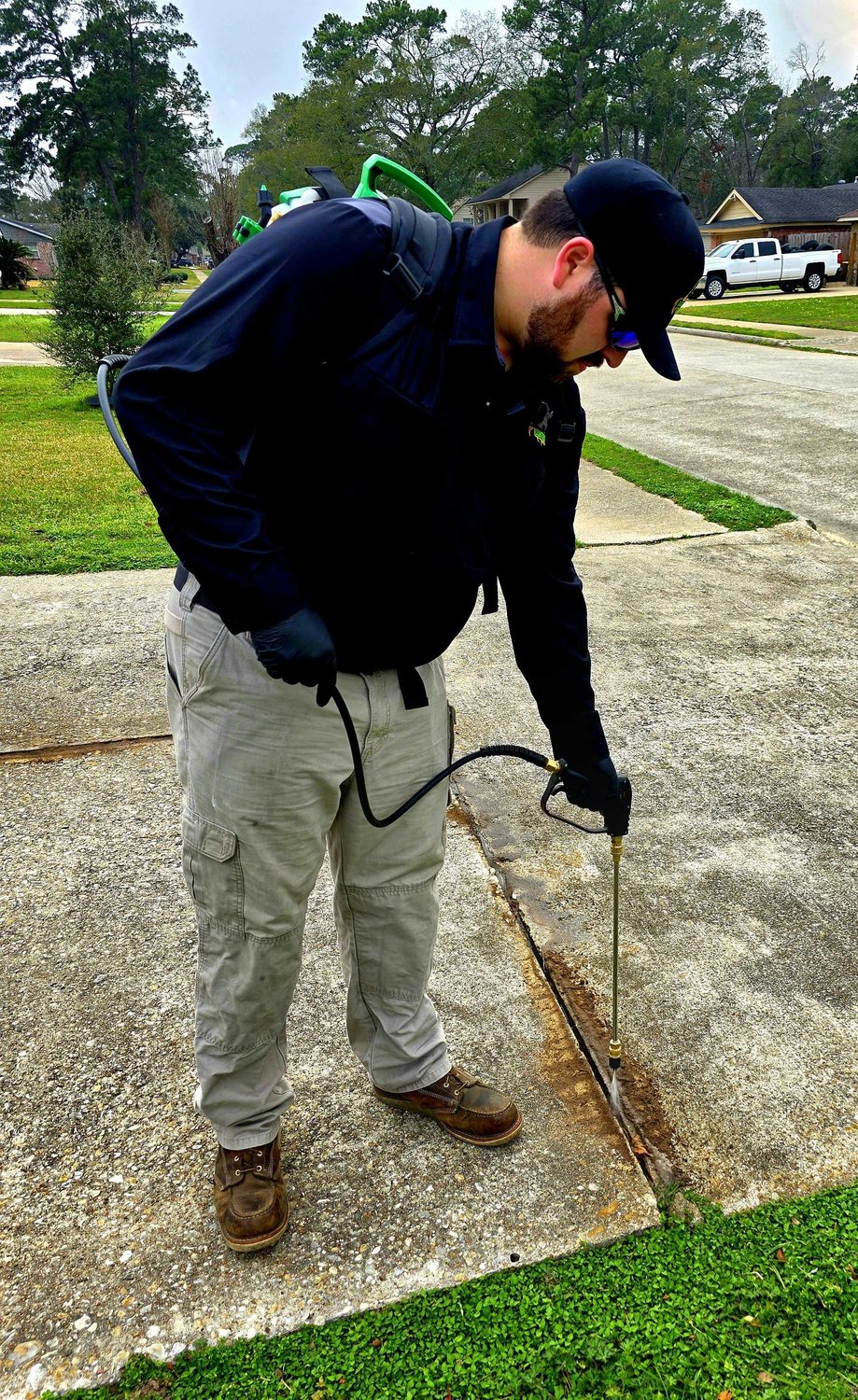
- Exterior perimeter treatment. We treat the foundation line, thresholds, weep holes and the mulch beds and other harborage where these animals collect.
- Interior treatment. We treat cracks, crevices, baseboards, bath traps, utility penetrations and voids where they shelter indoors. For silverfish that includes baits and dusts placed into voids and along their travel routes.
- Sealing. Door sweeps, weatherstripping, foundation cracks and pipe penetrations get noted and sealed where it makes sense. Larger exclusion work goes to our exclusion and repairs crew.
- Lighting. On cricket jobs we walk the exterior lighting with you and talk through which fixtures to change or switch off.
- Follow-up. We return as needed to recheck activity.
The work is backed by our 100% Service Guarantee, and there is no long-term contract. One honest caveat: the guarantee terms ask the customer to correct the conditions the technician identifies. With moisture-driven pests, that clause matters, because a treatment cannot keep up with a bed that is soaked every morning.
When a service visit is worth it, and when it is not
Not every millipede sighting needs a technician. A good rule we give customers on the phone:
- One storm, one wave, then quiet. Sweep them up and pull the mulch back. That is weather, and it passes.
- Every rain brings another wave. The beds against the slab are holding water and the entry points are open. An inspection will find both.
- Silverfish in one bathroom. Run the fan, fix the drip, watch for a few weeks.
- Silverfish in several rooms, the attic or stored papers. A humid space is supporting a population, and baits and void treatment plus moisture work make sense.
- A centipede now and then. It is eating something. If it is one a month, leave it be.
- Centipedes every night. Something is feeding them, and that something is the real problem.
- Crickets in August. Change the lights first. If drifts still build up around the doors, a perimeter treatment and door sealing are worth adding.
We would rather tell you a visit is not needed than sell a treatment that the weather would have handled on its own. When it is needed, the inspection usually turns up a short list of fixable causes.
Signs and what they mean
Millipedes on the driveway, patio and garage floor after rain. Saturated beds. Pull the mulch back and check the drainage.
Earwigs under doormats and in the kitchen after a wet week. Damp harborage right at the threshold, often a mulch bed or a planter beside the door.
Silverfish in the tub, under the sink or in a linen closet. A humid indoor space. Check the exhaust fan, look for a slow plumbing leak and think about what is stored in cardboard.
A house centipede on the wall at night. It is hunting. A steady supply of centipedes points to moisture plus other insects for them to eat, so the question becomes what they are finding.
Crickets massing at the front door or a lit storefront in August. The lights are pulling them in from the surrounding area. Dead ones pile up fast, and Texas A&M notes that the piles cause odors.
What waiting costs
The direct cost is small. Crickets can stain or chew soiled fabrics, earwigs and millipedes leave a smell, silverfish damage paper and fabric over time, and centipedes bring a sting if someone grabs one.
The real cost of waiting is the moisture. The same wet bed against the slab that feeds millipedes and earwigs also invites cockroaches and ants, and a slow leak behind a bathroom wall that supports silverfish is a leak that will cost more to fix the longer it runs. When occasional invaders start showing up every week, we treat that as a sign worth investigating rather than something to spray and forget.
Homes and commercial buildings
This is mostly a residential service, because it depends on landscape beds, sprinklers and household humidity. Crickets are the exception. Retail centers, gas stations, warehouses and schools with bright exterior lighting can collect drifts of crickets every August. On those sites the fix is a lighting plan, door sealing and a scheduled perimeter program, which our commercial service sets up and documents.
Prevention you can do yourself
The AgriLife centipede and millipede publication recommends steps that apply to every pest on this page:
- Move hiding places. Compost piles, firewood and stones away from the house.
- Put a gravel band between beds and the slab. A strip of gravel or similar dry material between the foundation and any flower bed that touches it breaks the damp connection.
- Turn the mulch. If beds against the house are mulched, turn the mulch now and then so it dries out, and keep it thin near the foundation.
- Seal the obvious gaps. Check door and window seals and pipe penetrations.
- Fit weep holes with copper mesh. Steel wool also works but rusts and stains light-colored brick.
- Ventilate. Make sure any crawl space or area under the home has airflow.
Add these for the rest of the group:
- Adjust sprinklers so they wet the lawn and plants, not the brick and the slab edge.
- Run bathroom exhaust fans and fix plumbing drips to take the humidity away from silverfish.
- Store papers and seasonal clothes in sealed plastic bins rather than cardboard boxes.
- Change outdoor bulbs. Texas A&M reports that low-pressure sodium vapor lamps and yellow incandescent bug lights attract fewer crickets than standard bulbs.
- Sweep up, do not stomp. A broom and a dustpan clear crickets and millipedes without smearing millipede fluid on the floor. Wash your hands after touching millipedes.
Related work
Not every swarm calls for treatment: our post on love bugs in Houston explains why those flights are best waited out.
Centipedes and scorpions hunt the same prey, so a house with a cricket problem in the garage often sees both. Our scorpion control page covers that overlap. Damp beds that draw millipedes and earwigs are also where cockroaches shelter outdoors, which is covered under cockroach control. Ongoing perimeter coverage is part of the Core Protection Programs.
We serve homes in Spring, Atascocita, Kingwood, Porter, New Caney and across the service area. For a free inspection, reach us through the contact page.
Frequently asked questions
Are any of these dangerous?
Not really. Silverfish, earwigs, millipedes and crickets do not bite people in any meaningful way. Centipedes can deliver a bee-like sting from their front claws, and the large Texas species can scratch with their legs, so none of them should be handled. Millipedes give off a fluid that irritates the eyes.
Why did hundreds of millipedes show up on my slab after a storm?
Texas A&M notes that millipedes often move into homes after heavy rainfall or during drought. Saturated or baked soil pushes them out of the mulch and leaf litter, and the slab edge and garage are the nearest dry shelter. Most die within days indoors.
Do I need a treatment, or is this just a cleanup?
Sometimes it is just a cleanup. A handful of crickets after one storm does not need a service visit. Repeated activity, silverfish in more than one room, or centipedes showing up week after week usually means a moisture source or entry point we can find and fix with you.
Why do crickets pile up around my garage and storefront?
Lights. Texas A&M research found outdoor lighting to be the single biggest cause of severe cricket problems around buildings. Switching to yellow bug lights or sodium vapor fixtures, or turning lights off during the late-summer flights, does more than any spray.
Will they breed inside my house?
Texas A&M says field crickets do not breed indoors, and millipedes tend to die quickly inside for lack of moisture and food. Silverfish are different, because a humid bathroom, closet or attic can support them for a long time. House centipedes also hang on indoors where they find damp spots and insects to eat.
Our largest service areas
Guides
Occasional Invader Control in north Houston?
No long-term contracts, and service agreements are backed by our 100% Service Guarantee.
Because we are based in Spring, we can often come out the same or next day for urgent problems. Call before noon, Monday through Friday, for the best chance at next-day service.
Last updated