
Asian Lady Beetle Control in Spring and North Houston
The orange beetles crowding north Houston windows in winter are usually multicolored Asian lady beetles, not native ladybugs. They gather on sunny walls in fall, crawl into attics and walls, and wake up on warm days. They can nip and stain, but are mostly a nuisance. Sealing outside gaps works best, with exterior treatment and a vacuum indoors.
Call 281-627-4810 Request a free inspection
Year-round protection plans from $70 Core · Premium · Legendary See the plans

Lady beetles: the job at a glance
| What it covers | Multicolored Asian lady beetles gathering on and overwintering in homes |
|---|---|
| Included | Inspection of gathering walls and entry gaps, sealing around windows, eaves and utility lines, and exterior treatment of entry points |
| Not included | Bug bombs or foggers indoors, and removing beetles already sealed inside wall voids |
| How long it takes | One visit to inspect, seal and treat; timing to the fall gathering does most of the work |
| Best timing | Early fall, before the beetles land on the house; winter calls get vacuum advice and a sealing plan |
| What it costs | Free inspection, then a written price; the sunny walls involved and the gaps to seal around windows and eaves set it |
The beetle in your window
The orange beetles lined up on a north Houston windowsill in January are nearly always multicolored Asian lady beetles, Harmonia axyridis. Texas A&M’s urban entomology program explains that they were brought into the United States in the 1960s and again in the 1990s as part of a USDA effort to control agricultural pests, and they have since spread across the country.
Outdoors they are useful. They eat aphids, and they were imported because they are good at it. The trouble starts in fall, when they look for a place to spend the winter and choose your house.
How to recognize them. Texas A&M describes wing covers that range from yellow to red with varying numbers of spots, sometimes none. The reliable mark is on the white plate just behind the head, where a dark pattern forms an M seen from the front or a W seen from behind. Native lady beetles lack that mark and do not gather indoors by the hundreds.
Why they pick your house
Texas A&M’s account of lady beetle invasions in Texas lists the things that make one house more attractive than another:
- Trees nearby. Homes surrounded by trees and woods are more susceptible. In heavily wooded parts of The Woodlands, Kingwood and Spring, that describes a lot of houses.
- Light or contrasting colors. The beetles are drawn to homes painted in lighter or contrasting shades.
- Sun. The 2022 Texas A&M article notes that they mass on the sunny, southwest sides of buildings and are drawn to light and lit surfaces.
- Gaps. They enter through any available crack or crevice.
The 2017 article also notes that in their native range they spend the winter in rock formations. Here, lacking those, they settle into walls, attics and living spaces.
Why wooded neighborhoods get the worst of it
Plenty of north Houston was built into pine and hardwood forest, and those neighborhoods are where we take the most lady beetle calls. The pattern follows what Texas A&M describes. A house backing onto a greenbelt in The Woodlands, a lot under tall pines in Kingwood or a home at the edge of the woods in Conroe or Magnolia has a large beetle population feeding on aphids in the canopy all summer, right beside it.
Add a pale brick or light siding, a southwest wall that holds the afternoon sun and a few unsealed gaps around the windows, and that house becomes the landmark beetles fly toward when fall arrives. Newer subdivisions with young trees and little canopy see far fewer, which is why two homes a few miles apart can have completely different experiences.
None of that means a wooded lot has to put up with beetles in the bedroom every winter. It means sealing matters more there, and it is worth doing before the first cool front rather than after.
What happens in a Texas winter
North Houston winters are mild and changeable, and that matters more for lady beetles than for almost any other pest. Texas A&M notes that when daytime temperatures outside reach the 80s, attic temperatures can reach the 90s, and the beetles stirring in the attic start moving into the house. That is why a family that saw nothing in December finds dozens on the ceiling during a warm spell in January.
They do not breed indoors over the winter. In spring the survivors leave the way they came, and the cycle starts again the next fall if the gaps are still open.
What they do, and what they do not
According to Texas A&M, the beetles:
- Nip. An occasional bite when they land on skin, more startling than painful.
- Smell. A musty, disagreeable odor when disturbed or crushed.
- Stain. A yellow fluid that can mark walls, curtains, sills and furniture.
- Trigger allergies in some people. Texas A&M cites medical reports of allergies linked to chemicals given off by large indoor aggregations.
They do not damage the structure, they do not eat anything in the house, and Texas A&M states they are not known to be toxic even when eaten. For most households they are a nuisance of numbers and stains, and the plan should match that.
How we handle it
The approach follows the EPA’s integrated pest management principles: identify the insect, find how it gets in, prevent entry, and use a targeted treatment where it helps instead of spraying the house broadly.
- Free inspection. A technician walks the house and finds the walls where beetles gather, usually the sunny southwest faces, and the openings they use: gaps around window frames, eaves and soffits, attic vents, siding seams, fascia and utility penetrations. Inside, we check the attic and the rooms where they appear.
- Exclusion. Texas A&M calls caulking and sealing exterior entry points perhaps the most effective technique against these beetles, and it is the center of our work. We seal gaps around windows, siding, eaves and utility openings, recommend weatherstripping replacements, and pass larger roofline gaps to our exclusion and repairs crew.
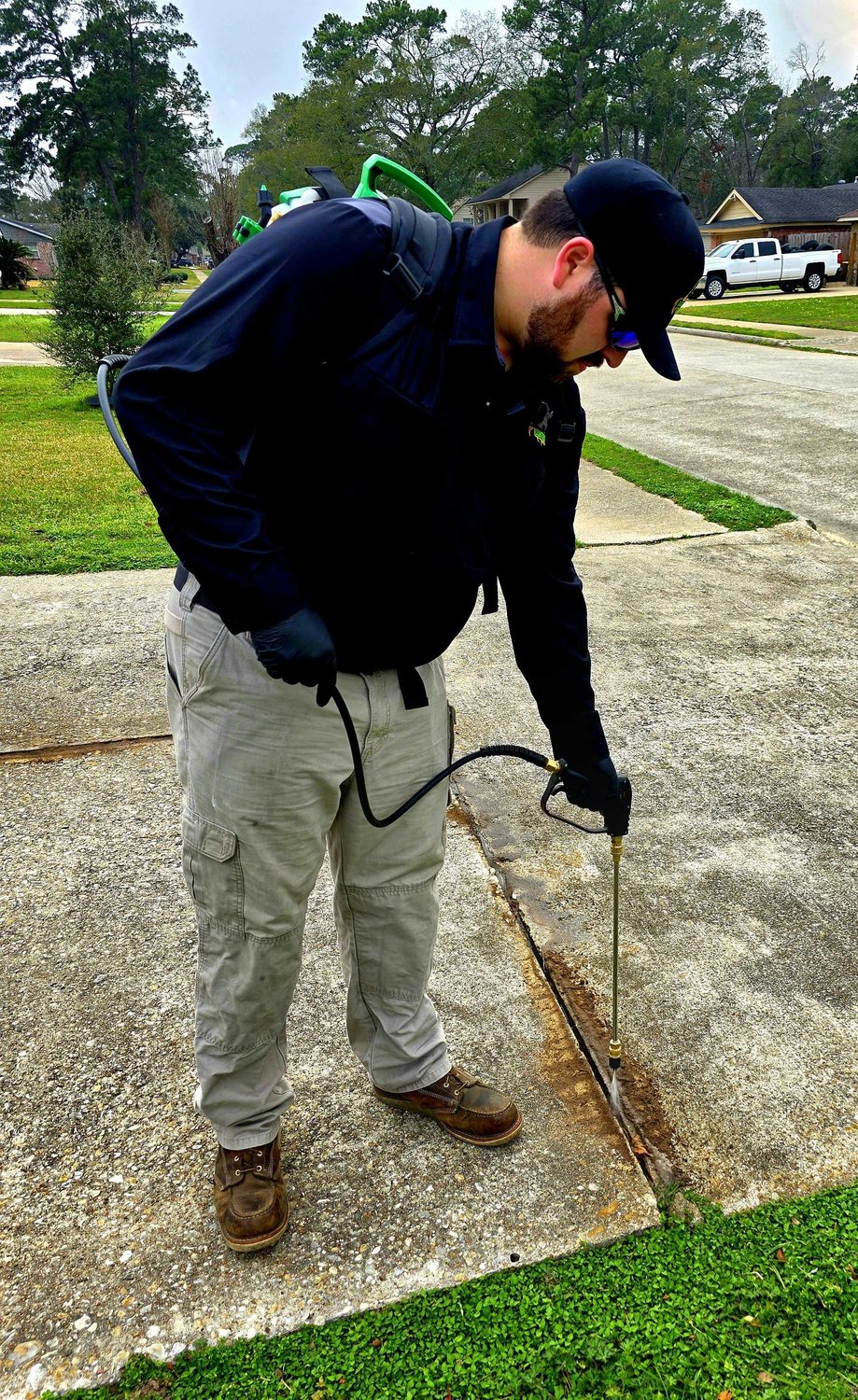
- Exterior treatment. A liquid or aerosol application to the outside surfaces and entry points where beetles land and crawl in, to cut down the number reaching the gaps.
- Seasonal timing. The service is timed to the fall gathering, when it does the most good.
We do not set off foggers or bug bombs indoors for lady beetles. Texas A&M lists them among the methods that fail, and they leave dead beetles in the walls and attic either way.
There is no long-term contract to sign, and the guarantee that covers the work is explained further down this page.
One more note on timing. A visit in late winter or spring still has value, even though the beetles are leaving. The gaps they used are easiest to spot while a few stragglers are still crawling out of them, and sealing them then means the house is ready before the next fall gathering starts.
Signs and what they mean
Beetles clustering on a sunny wall in fall. They are choosing winter shelter. Seal and treat now.
Beetles around windows, eaves and light fixtures. They have found a way in nearby.
Beetles on the ceiling during a warm winter day. The overwintering group in the attic is active. Vacuum them, and mark where they appear for the sealing work.
Yellow spots on curtains, sills or walls. Their defensive fluid. Blot it rather than rub it, and avoid crushing beetles on fabric.
Clusters in the attic. A sign of attic-level entry, often through vents, soffits or roofline gaps.
What waiting costs
There is no structural damage to worry about. The cost of waiting is that once beetles are tucked inside the walls and attic, nothing reaches them well. A call in December gets vacuum advice and a sealing plan for next year. A call in September stops most of them before they get in. Each winter the beetles spend inside also leaves another layer of yellow spotting on sills and curtains, plus a fresh drift of dead beetles in the attic and the light fixtures to clean out in spring.
For anyone in the household with allergies or asthma, waiting has a more personal cost, because large indoor clusters are what Texas A&M links to allergic reactions.
What a good result looks like
It is worth setting expectations plainly. After sealing and an exterior treatment, most homes see a large drop in the number of beetles getting inside. You may still see some on the sunny wall in October, because the beetles do not know the gaps are closed until they try them. A few may still turn up indoors through openings that are hard to reach, such as gaps around attic vents or under roofing.
What should change is the scale: from dozens on the ceiling on every warm winter afternoon to the occasional beetle on a windowsill. If that is not what you see, call us. The 100% Service Guarantee exists for exactly that conversation, and a second look usually finds an opening we missed or a new one.
Cleaning up after them
A vacuum is the tool. To keep the beetles from tumbling into the bag with the dust, some people stretch a knee-high nylon stocking over the end of the hose wand and hold it in place with a rubber band, then tie off the stocking and empty it outdoors. Texas A&M’s urban entomology program describes that trick for fall invader insects in general.
For yellow stains on fabric, blot rather than rub, and test a cleaner on a hidden spot first. Dead beetles collect in light fixtures, window tracks and along attic floors, and clearing those out keeps the odor down. Wear a dust mask if anyone in the house reacts to them, since Texas A&M notes that some people develop allergies around large clusters.
Homes and commercial buildings
Lady beetle calls come almost entirely from homes, especially wooded lots with light-colored siding. Offices, clinics and schools in wooded settings occasionally see them collect at windows and entry doors. On those sites we fold sealing and exterior treatment into a scheduled program through our commercial service.
What you can do yourself
- Seal cracks along windows and eaves and replace worn weatherstripping, both of which Texas A&M recommends. Late summer is the time.
- Screen attic and soffit vents and repair torn window screens.
- Vacuum, do not sweep or crush. Texas A&M says vacuuming is the best indoor control. Use a bag you can remove and seal, or empty the canister outside.
- Skip the bug bombs and light traps. They do not solve the problem.
- Turn down exterior lighting near the gathering walls; the beetles are drawn to lit surfaces.
- Leave them alone outdoors in summer. They are eating aphids in your garden.
Telling them apart from lookalikes
- Native lady beetles, such as the convergent lady beetle, lack the M- or W-shaped mark behind the head. They do not invade houses in large numbers.
- Stink bugs gather on the same sunny walls at the same season, but they are shield-shaped and flatter, and the odor is sharper. They are covered on the stink bug control page.
- Carpet beetles are small, round and dark or mottled rather than orange, and their larvae feed on wool and other animal products.
Related work
The gaps that let lady beetles in also let in stink bugs, wasps and spiders. The stink bug control, wasp and yellowjacket control and spider control pages cover those. Ongoing exterior coverage is included in the Core Protection Programs.
We serve homes in The Woodlands, Kingwood, Spring, Conroe, Klein and the rest of the service area. To have someone look at the walls they keep landing on, request a free inspection through the contact page.
Frequently asked questions
Are these the same as regular ladybugs?
No. The multicolored Asian lady beetle is an imported species that comes in many shades from yellow to red with a variable number of spots. The best clue is a white plate behind the head with a dark M- or W-shaped mark. Native lady beetles do not invade houses in large numbers.
Do Asian lady beetles bite?
Occasionally. Texas A&M calls them occasional nippers, and a bite feels like a pinch rather than anything serious. They also give off a disagreeable smell when disturbed, and their yellow defensive fluid can stain walls, curtains and windowsills.
Are they dangerous to my dog or cat?
Texas A&M's urban entomology program says they are not known to be toxic, even when eaten. The bigger household complaint is allergies: some people develop symptoms around large indoor clusters.
Why are they inside in January?
They were inside since fall, tucked into the attic or walls. On a warm winter day, attic temperatures climb, the beetles become active and they follow the warmth and light into living spaces. It looks like a new invasion, but it is usually the same group moving around.
Will a bug bomb or a light trap get rid of them?
Texas A&M lists bug bombs, light traps and lady bug houses among the methods that do not work. Sealing the exterior entry points is the most effective step, and vacuuming handles the beetles that are already inside.
Our largest service areas
Asian Lady Beetle Control in north Houston?
No long-term contracts, and service agreements are backed by our 100% Service Guarantee.
Because we are based in Spring, we can often come out the same or next day for urgent problems. Call before noon, Monday through Friday, for the best chance at next-day service.
Last updated