
Scorpion Control in Spring and North Houston
The scorpion showing up in north Houston garages, bathrooms and attics is almost always the striped bark scorpion. Its sting hurts and swells, but no Texas scorpion is considered lethal. Control means clearing the debris it shelters under, closing the gaps it climbs through, treating the foundation line and cutting back the insects it hunts.
Call 281-627-4810 Request a free inspection
Year-round protection plans from $70 Core · Premium · Legendary See the plans

Scorpions: the job at a glance
| What it covers | Striped bark scorpions inside and around homes in Harris and Montgomery counties |
|---|---|
| Included | Inspection (often with a UV light), crack and void treatment indoors, a foundation perimeter treatment, and a list of the gaps to seal |
| Not included | Hauling off woodpiles, rock borders or limbs over the roof, and repairing damage of any kind |
| How long it takes | Inspection and first treatment happen in one visit; follow-up is set by what the inspection turns up |
| Best timing | Before cooler weather sends them looking for shelter indoors, and any time one turns up inside |
| What it costs | Free inspection, then a written price; the perimeter, the yard clutter and the gaps to seal set it |
The one scorpion you are likely to meet here
North Houston has one scorpion that matters to homeowners, and it is the striped bark scorpion, Centruroides vittatus. Texas A&M’s insect field guide calls it the most common and widespread scorpion in the state and describes it at roughly two and three-eighths inches long, yellowish to tan, with two broad dark stripes running down its back and noticeably slender pincers and tail.
If the one in your bathtub fits that description, you have your answer. We rarely see anything else in Spring, Klein, Tomball or The Woodlands, and the identification matters less than understanding how this particular animal behaves, because its habits decide the treatment.
Three habits do most of the work:
- It hunts at night and hides by day. Under boards, bark, rocks, landscape timbers and debris outdoors; in shoes, folded towels, closets and storage boxes indoors.
- It climbs. The same Texas A&M entry notes that many household reports come from attics. This is not a burrowing scorpion that stays at ground level.
- It goes where the food is. It eats insects and spiders. A house with a steady supply of crickets, roaches or spiders in the garage is a house with a reason for scorpions to stay.
Are scorpions in Texas poisonous?
Scorpions in Texas are venomous rather than poisonous, and none is considered deadly. Texas A&M AgriLife says most people stung by a Texas scorpion have only a moderate reaction, since the venom does little to the nervous system. The sting hurts sharply and swelling can last days, but it is rarely an emergency.
The wording matters a little. Poisonous describes something harmful to eat or touch; venomous describes an animal that injects a toxin, in this case through the stinger at the tip of the tail. Of the roughly 1,500 scorpion species worldwide, Texas A&M AgriLife’s publication on scorpions (E-362) says only about 20 to 25 are regarded as dangerous. AgriLife’s guide to the venomous animals of Texas states plainly that none of the scorpions in Texas are considered deadly.
Location narrows it further. Texas has 18 scorpion species, but E-362 says the striped bark scorpion is the only one found in the eastern part of the state, and the venomous animals guide says most of the rest are limited to the Big Bend area. For anyone in Houston, that means the scorpion in the bathroom is the same species every time, and its sting is a known quantity.
Known does not mean harmless for everyone. E-362 warns that scorpions with even fairly low venom levels can produce fatal reactions in young children and in adults who are allergic to the toxin, and it advises watching anyone who has been stung for an adverse reaction. Persistent pain or swelling, or any trouble breathing, calls for medical care right away. The striped bark scorpion profile covers identification, and our post on scorpions in Texas homes looks at why they come indoors.
What north Houston houses give a scorpion
Most of the homes we work in across Harris and Montgomery counties are brick-veneer construction on a slab. That combination gives a scorpion a few ready routes.
Weep holes. The small open joints at the bottom of brick veneer exist to let moisture out of the wall cavity. They also let a flat-bodied animal in. The urban IPM program at Texas A&M AgriLife recommends blocking weep holes with copper mesh rather than sealing them shut, so the wall can still drain.
Limbs touching the roof. Wooded lots are common north of Beltway 8, and the same AgriLife article describes scorpions using overhanging branches as bridges onto the roof and into the attic. When a homeowner tells us they only ever find scorpions upstairs, the first thing we look at is the canopy.
Firewood and timbers. A stack of firewood against the garage wall, a border of landscape timbers along the beds or a pile of leftover pavers beside the slab is daytime shelter right where it is most convenient. Wood carried inside can bring a scorpion with it.
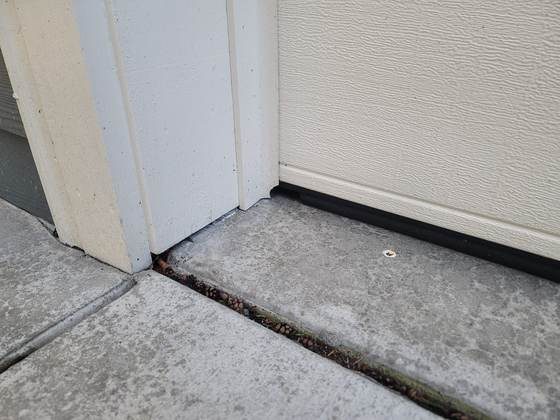
Garage door seals and thresholds. A worn bottom seal on the garage door is one of the most common entry points we find on scorpion calls, because the garage is usually where the prey insects are as well.
Cooler weather matters too. Texas A&M’s urban IPM writers note that these scorpions look for shelter indoors as temperatures drop, which is why some households first notice them in fall rather than in the heat of summer.
Telling it apart from what it is not
A few other animals get called scorpions on the phone.
- Pseudoscorpions are tiny, often smaller than a grain of rice, with pincers but no tail. They are harmless and usually turn up near books or damp spots.
- Whipscorpions, sometimes called vinegaroons, have a long thin whip instead of a stinger and are far less common around Houston homes.
- Earwigs have pincers at the back end, not the front, and they belong on our occasional invaders page.
A scorpion has eight legs, a pair of pincers held forward, and a segmented tail that curls up over the body and ends in a stinger. Texas A&M also notes that the scorpion cuticle glows under ultraviolet light, which is the most useful identification trick of all.
How we handle scorpion control in Houston
The work follows the order the EPA lays out for integrated pest management: identify what is there, find out why, prevent what can be prevented, and then treat with a pesticide where it is actually needed rather than everywhere.
- Inspection. A technician walks the outside of the house and the inside rooms where you have found scorpions. That often includes a pass with a UV light, because a striped bark scorpion along a baseboard or brick ledge lights up blue-green and is easy to spot. We look at weep holes, door thresholds, the garage door seal, utility penetrations, soffits and the tree line over the roof.
- Finding the shelter and the food. We note the timbers, stones, woodpiles and mulch against the slab, and we look for the crickets, roaches and spiders that keep scorpions fed. If prey insects are the real driver, we say so and treat for them too.
- Interior treatment. We treat cracks, voids, garage edges and bath areas where scorpions shelter indoors, using targeted applications rather than broadcast spraying across open floors.
- Exterior perimeter. We apply a perimeter treatment along the foundation, around weep holes, door frames and the other entry points the inspection found.
- Sealing. You get a plain list of the gaps that need closing: weep holes to fit with mesh, door sweeps to replace, utility penetrations to seal. We help with that sealing where it makes sense, and our exclusion and repairs team handles the larger jobs.
- Follow-up. Scorpions do not all appear on one night, so if activity continues after the first treatment, a return visit is booked and the technician rechecks the same spots.
Every visit is covered by our 100% Service Guarantee, and there is no long-term contract to sign. The guarantee terms ask the homeowner to correct conditions we point out, which for scorpions usually means the woodpile and the limbs over the roof.
What a treatment can and cannot do
It helps to be straight about this part. A foundation treatment reduces the number of scorpions that make it from the beds to the inside of the house, and interior void treatment deals with the ones already sheltering in the walls and garage. Neither turns a wooded lot into a place with no scorpions at all. They live in the landscape, they are native, and the lot next door has them too.
What changes the picture is the combination. When the woodpile moves, the limbs come off the roof, the weep holes get mesh and the garage door seals properly, the treatment has far less to do. On most of the homes we revisit, that is the difference between a household that finds a scorpion every week and one that finds an occasional straggler in the garage.
We will also tell you when treatment is not the answer. If the only scorpion you have seen in two years was one under a paver in the backyard, that is a predator doing its job outdoors, and the honest advice is gloves and a flashlight rather than a service visit.
Signs, and what each one means
One scorpion in the bathtub or sink. Usually a wanderer that fell in and could not climb the smooth sides. It still tells you there is a way in near that room, and a bath trap or plumbing gap under the vanity is a common culprit.
Scorpions in the garage at night. Look at the bottom seal of the garage door and at what else lives in the garage. Crickets and roaches in a garage are a scorpion’s grocery store.
Scorpions upstairs or in the attic. Think limbs and soffits before you think foundation.
Scorpions inside shoes, laundry or storage boxes. They are already sheltering indoors. That calls for a closer interior inspection, not just a perimeter treatment.
Several glowing under a UV light along the brick or beds at night. You have an established population in the landscape, and harborage reduction will matter as much as anything we apply.
What waiting costs
Scorpions are not going to damage the house. The cost of waiting is the sting itself: a hand reaching into a dark cabinet, a foot sliding into a shoe, a child sitting on the garage floor. Texas A&M describes the swelling and itching from a sting as lasting several days in some cases.
The other cost is the prey base. If scorpions are finding enough to eat in your garage, the cricket or roach problem underneath is growing at the same time. Treating the scorpions while ignoring the food supply tends to bring the same call back the next season.
Homes and commercial buildings
This page is written for homes, because that is where nearly all of our scorpion calls come from. The same animal does turn up in offices, warehouses, rental units and storage buildings, usually through dock doors and unsealed utility runs. On a commercial site the work becomes part of a documented program with logged inspection points, which is how our commercial service runs.
What you can do yourself
Most of the long-term improvement on a scorpion job comes from the homeowner, and none of it requires a pesticide. The Texas A&M AgriLife urban IPM advice lines up closely with what we see in the field:
- Move the shelter. Pull rocks, bricks, pavers, landscape timbers and firewood away from the slab. Stack firewood off the ground and well away from the walls.
- Trim the trees. Cut back any limb that touches or hangs over the roof. This one change solves more upstairs scorpion problems than anything else.
- Mow and trim. Keep the grass short and shrubs off the siding so the strip along the foundation stays open.
- Fit weep holes with mesh. Copper mesh lets the wall breathe and drain while keeping scorpions out. Steel wool rusts and stains light brick.
- Replace weather stripping and door sweeps. If you can see daylight under a door, a scorpion can get under it.
- Shake out shoes and gloves. Especially in the garage, and especially ones that have sat for a while.
- Bring firewood in only as you use it. Check each piece before it goes inside.
AgriLife also points out that a scorpion outdoors is a predator eating other insects in the yard. The goal is keeping them out of the house, not eliminating every one on the property.
If someone is stung
Wash the area and use a cold pack to bring down the swelling. Texas A&M lists pain, swelling, numbness and discoloration as typical effects. For a young child, an older person, or anyone with a strong reaction, trouble breathing or symptoms that spread beyond the sting site, get medical advice right away. Catching the scorpion in a jar helps with identification but is never worth a second sting.
Related work
Scorpions follow their food, so the problem underneath is often another pest. If crickets are piling up in the garage, the occasional invaders service and its page on crickets in late summer cover that. Roaches in the garage and kitchen point to cockroach control, and webs along the eaves and in the garage corners point to spider control.
Which species actually turn up indoors, and where, is laid out in our post on scorpions in Texas homes.
Homeowners who want the perimeter treated on a schedule rather than one call at a time usually move to one of the Core Protection Programs. We serve homes across Spring, The Woodlands, Tomball, Magnolia and the rest of Harris and Montgomery County. If scorpions are turning up in your house, the contact page is the quickest way to get a technician out for a free look.
Frequently asked questions
Is a striped bark scorpion sting dangerous?
It is painful, and Texas A&M describes swelling, numbness and discoloration that can last from minutes to several days. No scorpion in Texas is considered lethal. A sting on a small child, an older adult or anyone with a history of strong reactions is worth a call to a doctor.
Why do I keep finding scorpions upstairs or in the attic?
This species climbs well. It reaches rooflines by walking across tree limbs that touch or hang over the house, then works into the attic through soffit and eave gaps. Upstairs finds usually point to that route rather than to anything coming up from the slab.
Will spraying the yard get rid of them?
Not by itself. Scorpions shelter under timbers, rocks and stacked wood, and a spray does little while those hiding places sit against the house. We treat the foundation line and the interior voids, but the lasting change comes from removing shelter and sealing the gaps.
Do I need to do anything before the technician arrives?
Nothing major. If you can, note the rooms where you have found scorpions and roughly when. Leave the garage accessible and, if the attic hatch is in a closet, clear a path to it so the technician can look at the roof deck and soffits.
Do you treat scorpions at businesses too?
This service is written around homes, which is where most calls come from. If scorpions are turning up at an office, a warehouse or a rental property, our commercial team handles it as part of a documented program, and the same inspection points apply.
How many kinds of scorpions live in Texas?
Texas A&M AgriLife counts 18 species in Texas, most of them limited to the Big Bend area. The striped bark scorpion is the only one found across the whole state and the only one recorded in East Texas, so it is the scorpion Houston homeowners find.
Our largest service areas
Scorpion Control in north Houston?
No long-term contracts, and service agreements are backed by our 100% Service Guarantee.
Because we are based in Spring, we can often come out the same or next day for urgent problems. Call before noon, Monday through Friday, for the best chance at next-day service.
Last updated