
Tawny Crazy Ants in Spring and North Houston
Huge numbers of small reddish-brown ants that run erratically, form no mounds and swarm into electrical boxes are usually tawny crazy ants. Texas A&M says most baits do not attract them. Control means treating contact barriers around the structure, clearing the debris they nest under, and repeating treatment, because neighboring properties keep resupplying them.
Call 281-627-4810 Request a free inspection
Year-round protection plans from $70 Core · Premium · Legendary See the plans

What to do, in order
- Collect a few ants in a sealed bag or a small jar so the species can be confirmed before any treatment.
- Clear fallen limbs, boards, rocks, pots, leaf litter and anything else sitting on the ground that you do not need.
- Cut back irrigation and fix drainage problems; these ants favor humid, wet ground.
- Check AC disconnects, the electric meter, pool equipment and irrigation controllers for packed ants, without opening live equipment.
- Inspect potted plants, mulch and anything else before moving it from an infested yard to another property.
- Skip store-bought ant baits for these; they are rarely accepted and waste weeks.
- Call us to set up perimeter treatment and a revisit schedule, and talk to the neighbors if the whole street has them.
What it usually turns out to be
The call usually starts the same way: there are ants everywhere, they are not in a line, they do not seem to be coming from anywhere in particular, and spraying them barely dents the numbers. Small reddish-brown ants pour over the patio, up the siding and through the garage, running in quick, random zigzags. A day later they are inside the AC disconnect box.
Texas A&M’s Urban and Structural Entomology program, in its tawny crazy ant profile, describes workers as a uniform eighth of an inch long, reddish-brown, covered in many hairs, and moving rapidly and erratically, which is where the “crazy” comes from. They form loose foraging trails but also wander off-trail. The species, Nylanderia fulva, was once called the Rasberry crazy ant, and it was first found around Houston in 2002.
Colonies can be under or inside almost anything: stumps, soil, rocks, potted plants, gaps in concrete. Nests are mostly outdoors, with workers foraging into houses. The same profile notes large numbers piling into electrical equipment, shorting circuits and clogging switches until the equipment fails, and in heavily infested areas the ants even displace fire ants.
How big are crazy ants?
Tawny crazy ant workers are about an eighth of an inch long, roughly three millimeters, and every worker in a colony is the same size. Texas A&M’s urban entomology program describes them as monomorphic and reddish-brown, with long legs and antennae, though not as long as those of the longhorn crazy ant.
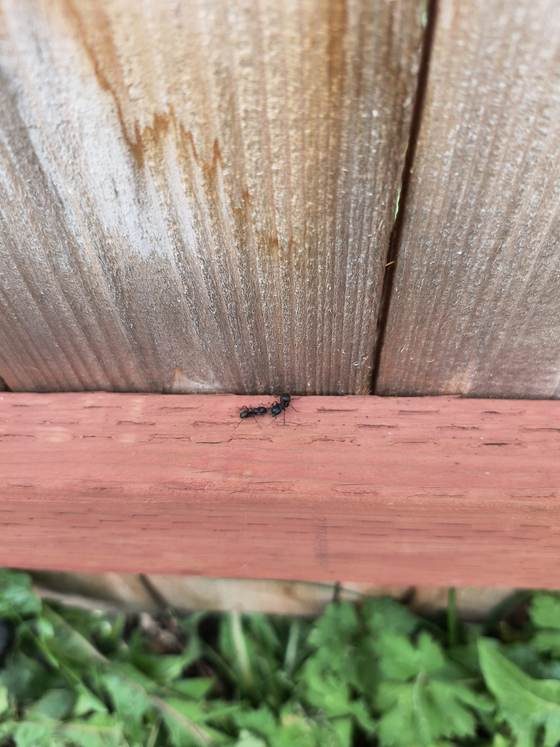
That uniform size is one of the most useful clues in the yard. A fire ant trail mixes tiny workers with much larger ones, while a stream of crazy ants looks like hundreds of copies of the same insect. One ant at an eighth of an inch is easy to overlook; the thousands that build up along a foundation or inside a meter box are not. If you collect a few for identification, a hand lens will show the coarse hairs on the body, which along with the size and the frantic movement points firmly toward Nylanderia fulva.
Where did tawny crazy ants come from in Texas?
Tawny crazy ants are native to northern Argentina and southern Brazil, according to University of Texas researchers. They were first discovered in the United States in 2002, when a pest control operator found them in a suburb of Houston, and Texas A&M now confirms them in 35 Texas counties, Harris and Montgomery among them.
How they keep moving is better documented than how they first arrived. Texas A&M’s urban entomology program says the species has spread largely with human help, and that almost any infested container or material can carry it: garbage, yard debris, compost, potted plants and hay. The University of Texas team adds that the reproductive members of this species do not fly, so a colony cannot seed a new neighborhood on its own the way a fire ant queen can. Left to walk, colonies spread about 200 meters a year. A trailer of debris or a flat of nursery plants can move them miles in an afternoon.
Two decades after that first Houston find, Texas A&M’s confirmed list reaches well beyond the Gulf Coast, as far as Travis, Bexar, Williamson and Hidalgo counties. Closer to home it includes Fort Bend, Brazoria, Galveston, Chambers, Liberty and Walker, which means nearly every direction out of north Houston leads to another infested county.
For a homeowner, the takeaway is to look before you haul. Check potted plants, bagged soil and secondhand outdoor furniture for ants before they go into the yard, and do not move mulch or brush from an infested lot to a clean one. Our ant control service handles confirmed infestations, and the tawny crazy ant profile in our pest library covers identification in more depth.
The lookalikes
- Fire ants build fluffy mounds in the lawn, come in mixed sizes and sting hard. Tawny crazy ants build no mounds and have no stinger. See fire ant mounds in the yard.
- Longhorn crazy ants also run erratically, but Texas A&M says they are often jet black, with much longer legs and antennae and a longer thorax.
- Small kitchen trailing ants move in tidy single-file lines to food. Crazy ants look disorganized and cover far more ground.
- Caribbean crazy ants look nearly identical, and Texas A&M notes that winged males are needed to confirm the species. That is a job for an entomologist, not a phone photo.
How to tell at home
Crouch down where the ants are thickest and watch for a minute. Most household ants settle into an orderly line between a nest and food. Tawny crazy ants keep darting in every direction, with loose trails that break up and re-form. Then look at the ground near the house: no mounds, but ants under every board, pot and pile of leaves you lift. Ants clustered in meter boxes, AC equipment or outdoor outlets add to the picture. If you see all three, collect a few in a bag; a confirmed identification changes the plan.
What we do
Tawny crazy ants are the exception to most ant advice, and we tell people that at the start. The broader service is on our ant control page.
- Confirm the ant. Treating crazy ants like fire ants or kitchen ants wastes time and product.
- Treat the perimeter with targeted contact treatments around the foundation, entry points and the places the ants are coming over.
- Remove harborage with you. Boards, pots, leaf litter, firewood and debris on the ground are where colonies live. Texas A&M lists clearing just about anything sitting on the ground that is not necessary as part of control.
- Address moisture. Overwatered beds and poor drainage keep the ground the humid, wet condition these ants prefer.
- Come back on a schedule. Crazy ants often need monthly visits for a stretch to stay under control, since the barrier wears down and neighboring yards resupply them.
That service is covered by our 100% Service Guarantee, and there is no long-term contract.
What realistic control looks like
Texas A&M is direct that the products that work on these ants are mostly not sold to consumers, and that contact treatments buy a buffer zone that tends to be breached in two to three months. Its figures put natural spread at roughly 20 meters a month in neighborhoods. In practice that means one house on a block can be kept far more livable, but a street where every yard is infested will see ants creeping back from the edges. The best results come when neighbors treat at the same time and everyone clears out the clutter the ants nest under.
When to call
Call as soon as you suspect crazy ants, before they get into the AC unit or the electrical panel. Waiting rarely helps, because colonies grow and spread from yard to yard. If you also have large black ants inside at night, see carpenter ants in the house. For a free inspection, use the contact page.
Frequently asked questions
Do tawny crazy ants sting like fire ants?
No. Texas A&M's Urban and Structural Entomology program says they have no stinger. They can bite, and the bite causes a small pain that fades quickly. The trouble with them is the sheer numbers and what they do inside electrical equipment, not the bite.
Why didn't the ant bait I bought do anything?
Texas A&M says tawny crazy ant workers are not attracted to most bait products. Even the bait that performed best in its testing was not enough on its own and had to be paired with contact treatments. Bait that works well on other ants will often sit untouched.
How long does a treatment hold them back?
Contact treatments create a buffer zone around the house, but Texas A&M notes those barriers are often breached within two to three months. That is why crazy ant work is a schedule of return visits rather than a single treatment, especially when nearby lots are infested.
Are they in Montgomery County too, or just Harris?
Both. Texas A&M lists Harris and Montgomery among the counties with confirmed tawny crazy ant infestations, along with Fort Bend, Brazoria, Galveston, Liberty, Walker and many others. They were first found around Houston in 2002.
Did tawny crazy ants really start in Houston?
They were first noticed here, not born here. University of Texas researchers report that a pest control operator discovered them in a Houston suburb in 2002, the first U.S. record. The species is native to northern Argentina and southern Brazil.
From the blog
Ant & Fire Ant Control in north Houston?
No long-term contracts, and service agreements are backed by our 100% Service Guarantee.
Because we are based in Spring, we can often come out the same or next day for urgent problems. Call before noon, Monday through Friday, for the best chance at next-day service.
Last updated