
Southern Yellowjacket in Spring and North Houston
Vespula squamosa · Stinging insects
The southern yellowjacket is a smooth, half-inch, black-and-yellow wasp that builds an enclosed paper nest underground or inside a wall, reached through one busy hole. By late summer a Texas colony can hold thousands of workers that sting repeatedly to defend it. A nest anywhere people walk, mow or play is worth treating through its entrance.
Call 281-627-4810 Request a free inspection
Year-round protection plans from $70 Core · Premium · Legendary See the plans
We treat this, and finding it usually warrants treating.
Southern yellowjacket at a glance
| Size | About half an inch; queens are larger and more orange |
|---|---|
| Look | Smooth, shiny black with yellow markings on head, thorax and abdomen; clear wings |
| Nest | Paper comb inside a closed envelope with a single entrance hole |
| Nest sites | Mostly underground; also wall voids, eaves, sheds, porches and stored furniture |
| Colony size | In Texas, up to 45 comb levels and 20,000 workers; peak in August and September |
| Diet | Insects and spiders for the larvae; nectar, rotting fruit, carrion and sweet drinks for adults |
| Sting | Sharp, immediate pain; each wasp can sting more than once |
Signs you have them
- A steady stream of wasps flying straight in and out of one hole in the lawn or a flower bed
- Wasps entering a brick weep hole, a gap in siding or a soffit vent
- Yellowjackets crowding trash cans, soda cans and fallen fruit in late summer and fall
- Bare, worn soil around a ground hole where traffic is constant
- A papery, gray, enclosed nest in a shed, under a deck or inside stored furniture
The wasp you find with a lawn mower
Most people discover a southern yellowjacket colony the hard way. The mower passes over a small hole near the fence, or a child steps on it chasing a ball, and a cloud of yellow-and-black wasps comes up out of the ground. Until that moment there was almost nothing to see: a hole the width of a finger, and wasps flying in and out of it so fast that nobody noticed.
That is the essential fact about this species. The nest is hidden, it can be very large, and the colony defends it hard. Texas A&M AgriLife Extension’s publication Paper Wasps, Yellowjackets and Solitary Wasps (E-239) photographs Vespula squamosa at a ground entrance, and Texas A&M AgriLife’s Venomous Terrestrial Animals of Texas gives it its own entry.
Identification
The venomous animals guide describes southern yellowjackets as usually black with yellow markings on the head, thorax and abdomen, with a smooth body and clear wings, about half an inch long. The queen is larger and more orange than the workers. The same guide notes that yellowjackets are often called “hornets,” which adds to the confusion.
Telling it from its neighbors
- Paper wasps are longer and reddish to brown, fly with their legs dangling and build an open, visible comb. E-239 notes yellowjackets are often confused with them.
- Honey bees are fuzzy, golden-brown, carry pollen on their hind legs and leave their stinger behind. A yellowjacket is smooth and shiny.
- Baldfaced hornets are black and white, and their football-shaped nest hangs in a tree.
- Cicada killers are much bigger, about an inch and a half, with a rusty head and thorax, and dig single burrows in sandy soil. E-239 says the males cannot sting and the females seldom do.
The nest settles it. A yellowjacket colony lives inside an enclosed paper envelope with one entrance, usually below ground.
Biology and the Houston season
E-239 describes the year in detail. Queens spend the winter under loose bark, in cracks and crevices and sometimes in attics. In early spring each one builds a small paper nest and raises the first brood herself, feeding the larvae for about 18 to 20 days. Once those first workers emerge, the nest can grow to a foot long or more within days or weeks. Workers forage insects and spiders to feed the larvae and gather nectar, honeydew and other sugars, though unlike bees they store no honey.
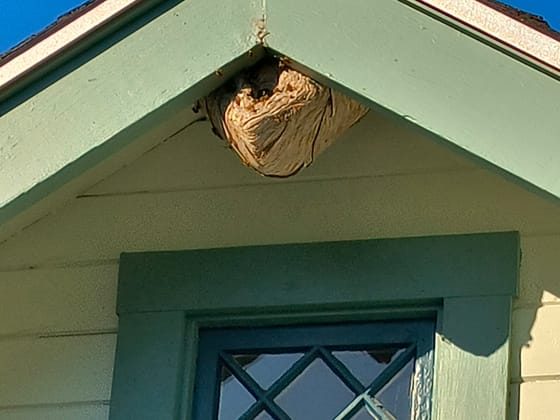
Colonies reach their maximum size in August or September. In October and November the colony produces males and next year’s queens; after mating, the males die and the new queens leave to overwinter. The abandoned nest usually decomposes and is not reused.
The size numbers are what make this species worth respecting. AgriLife says that in Texas a southern yellowjacket nest can range from a few inches to six feet or larger, with up to 45 levels of comb and 20,000 adult workers.
Then there is the Houston twist. E-239 notes that in sheltered sites or during mild winters, the nest may not be abandoned, and a perennial colony can carry on with its queen or queens and workers into the next year. Perennial colonies are larger than annual ones. The venomous animals guide likewise says the nest may be enlarged and reused for many years. A Gulf Coast winter without a hard freeze is exactly the kind of year that allows it.
Where nests show up
E-239 describes yellowjackets as primarily ground nesters, with subterranean nests in gardens, flower beds, pastures and embankments. Aerial nests turn up in trees, under eaves, in the wall voids of buildings, in open garages and sheds, on porches and in abandoned furniture. Around north Houston:
- Old rodent burrows and soft soil in lawns, especially along fences
- Flower beds and mulched areas against the slab
- The air space behind brick veneer, entered through a weep hole
- Soffits, attic vents and gaps in siding
- Under decks and inside stored outdoor furniture and boats
- Sheds and detached garages that sit closed for months
The weep-hole nest is common in brick homes around Spring, Klein and Cypress. Our yellowjackets in the ground or a wall page covers that situation.
Stings and health risk
The venomous animals guide says southern yellowjackets can sting repeatedly. The usual reaction is sharp, immediate pain and local swelling, which subsides within a few days, though itching may continue. E-239 says social wasps rarely sting away from the nest unless trapped or pressed against the skin, but defend the nest vigorously, and that wasps summon reinforcements by chemical signal when a victim stands and swats. Cover your head and get to a car or building.
A reaction beyond the sting site, or many stings, needs medical help right away; call 911. AgriLife says serious allergic reactions usually start within 20 to 30 minutes and sometimes in 10 to 15, and that respiratory reactions account for more than half of sting deaths. People with a known allergy should talk to a physician about carrying epinephrine, and E-239 says anyone with a heart condition or known venom allergy should not attempt to control a nest.
What treatment realistically involves
The verdict here is “treat,” with one honest exception. E-239 says that if a nest is not close to areas of human activity, it can be left alone and the area marked with a warning sign; most nests die after the first hard frost. That is reasonable for a nest at the far edge of a large rural lot. For a nest in a lawn, a bed, a wall or under a deck, where people walk and mow, treatment is the sensible call, especially in a year without a freeze.
AgriLife’s guidance shapes how it is done:
- Dust beats liquid for ground nests. Dusts are tracked deep into the nest by wasps coming and going, while liquids poured on the ground tend to soak into the soil before reaching the colony.
- Treat when the colony is home. Late evening, when foragers have returned.
- Leave wall entrances open until the colony is dead. Sealing too early can drive wasps into the house.
- Traps reduce foragers, not colonies. AgriLife says commercial traps can thin numbers somewhat but do not control a colony.
Our wasp and yellowjacket control service works like this: find every entrance, plan the approach around where the nest is, treat into the entrance with a residual dust or aerosol at the right time of day, make sure a wall nest is finished, and come back to confirm. Recurring service is covered by our 100% Service Guarantee. For businesses with patios, canopies or dumpster areas, see commercial service.
Prevention
- Walk the lawn and beds in spring and early summer and watch for steady traffic at any hole.
- Fill abandoned rodent burrows and low spots in the lawn.
- Keep outdoor garbage cans closed tight and, as AgriLife suggests, emptied daily when yellowjackets are foraging.
- Cover sweet drinks at cookouts and check cans before drinking from them.
- Pick up fallen fruit under trees in late summer.
- Screen brick weep holes rather than caulking them, and only when no colony is active.
- Hang yellowjacket traps away from seating areas in early season, knowing they will not end a colony.
Related reading
Each stinging insect here calls for a different answer: see paper wasps, mud daubers, the honey bee and the eastern carpenter bee, or the full pest library. If you have a busy hole in the lawn or a weep hole with traffic, keep everyone back and contact us.
Frequently asked questions
Should I pour gasoline or water into a yellowjacket hole?
No. Gasoline is a fire and contamination hazard, and Texas A&M AgriLife notes that liquid sprays poured on ground nests often soak into the soil without reaching the colony. Dusts work better because returning wasps carry them deep inside.
Can I just plug the hole?
Not while the colony is alive. AgriLife warns that if a nest in a wall is not fully eliminated, the wasps may force their way into the home looking for another exit. In the ground they simply dig a new one. Plugging comes after the colony is dead.
Why are yellowjackets so aggressive in the fall?
The colony is at its largest. AgriLife says colonies reach maximum size in August or September, and Texas A&M's guide to venomous animals notes yellowjackets can be aggressive when foraging, especially in fall, when they scavenge sweets and rotting fruit.
Do yellowjacket nests die in winter here?
Usually, but not always. AgriLife says most nests are abandoned after the queens leave in fall, but that in sheltered sites or mild winters a colony may survive into the next year as a perennial nest, which grows larger than an annual one.
Sources
- Texas A&M AgriLife Extension — Paper Wasps, Yellowjackets and Solitary Wasps (E-239) — read October 5, 2026
- Texas A&M AgriLife Extension — Venomous Terrestrial Animals of Texas — read October 5, 2026
Next scheduled review of this page against its sources: October 5, 2027.
Pest problem in north Houston?
No long-term contracts, and service agreements are backed by our 100% Service Guarantee.
Because we are based in Spring, we can often come out the same or next day for urgent problems. Call before noon, Monday through Friday, for the best chance at next-day service.
Last updated