
Wasp Sting Care: What to Do After a Wasp Gets You
First aid for a wasp sting starts with getting away from the nest, then washing the sting with soap and water and applying wrapped ice, per CDC and MedlinePlus. Wasps do not leave a stinger behind. Trouble breathing, swelling of the face or mouth, throat tightness, weakness or fainting are signs of anaphylaxis and mean calling 911 immediately.
Call 281-627-4810 Request a free inspection
Year-round protection plans from $70 Core · Premium · Legendary See the plans
If someone who has been stung has trouble breathing, swelling of the face, lips or tongue, throat tightness, weakness, fainting or a rash spreading over the body, call 911 right away. Those are signs of a severe allergic reaction, called anaphylaxis, and they need emergency care. If the person carries an epinephrine auto-injector, help them use it.
This post is general first-aid information drawn from public health sources, not medical advice; for any concern about a sting, contact a doctor or emergency services.
What to do when bit by a wasp
Strictly speaking, a wasp stings rather than bites, but the steps are the same. Get away from the nest, then wash the sting with soap and water and apply ice wrapped in a cloth. Have someone stay with the person for a while afterward to watch for signs of an allergic reaction, and do not scratch the site.
Those basics come from CDC’s National Institute for Occupational Safety and Health page on insects and scorpions at work and from MedlinePlus, the National Library of Medicine’s guide to insect bites and stings. Each step is explained below.
Step one: get away from the nest
Most people are stung near a nest, not out in the open. Texas A&M AgriLife Extension’s wasp publication E-239 says vespid wasps rarely sting away from the nest unless trapped or pressed against the skin, and that people who stand still and swat keep getting stung as the wasps signal others to join in.
Texas A&M’s Venomous Terrestrial Animals of Texas notes that a short sprint is often enough to get away from bees and wasps, and suggests pulling a shirt up over the head to protect the head and neck. CDC’s advice for a swarm is to move indoors or into shade. Once inside or well away, check for wasps caught in clothing or hair.
Step two: check for a stinger
Wasps and yellowjackets usually keep their stingers, which is why they can sting more than once. E-239 says that unlike honey bees, wasps do not leave a stinger in the skin. If you do find one, it was most likely a honey bee.
CDC advises removing a stinger by wiping gauze over the area or scraping a fingernail across it, and never squeezing it or using tweezers. MedlinePlus suggests scraping with the edge of a credit card and explains that tweezers may squeeze the venom sac.
Step three: wash, cool and leave it alone
- Wash the sting with soap and water. CDC and MedlinePlus both list this step, and the Texas A&M guide repeats it.
- Cool it. MedlinePlus suggests ice wrapped in a washcloth for 10 minutes, then off for 10 minutes. CDC says ice helps reduce swelling.
- Take off rings and tight items on a stung hand or arm before it swells, as the Texas A&M guide recommends.
- Do not scratch. CDC warns that scratching can increase swelling, itching and the risk of infection.
- Antihistamines or an anti-itch cream may help with itching, according to MedlinePlus. CDC notes that antihistamines can cause drowsiness and to follow the package directions.
MedlinePlus also lists two things not to do: do not apply a tourniquet, and do not give the person stimulants, aspirin or other pain medicine unless a health care provider has prescribed it.
Signs that mean 911
MedlinePlus says to call 911 or the local emergency number if someone who has been stung has:
- trouble breathing, wheezing or shortness of breath;
- swelling anywhere on the face or in the mouth;
- throat tightness or difficulty swallowing;
- weakness;
- turning blue.
It adds that anaphylaxis can come on quickly and affect the whole body, with signs that can include chest pain, abdominal pain or vomiting, fainting or lightheadedness, and a rash or flushing. Texas A&M’s E-239 says anaphylaxis typically begins within 20 to 30 minutes of a sting, that it can happen faster, and that stings around the head, eyes and neck are especially serious.
If you already know you are allergic
E-239 advises anyone who knows they are allergic to bee or wasp venom to ask their doctor whether they should carry an epinephrine emergency kit. CDC adds that people with a history of severe reactions should carry one and wear a medical identification bracelet or necklace. MedlinePlus says to use the person’s own emergency kit if they have one.
Keep the auto-injector where it will actually be used: in the bag that goes to the soccer field, the glove box, the tackle box. A kit in a kitchen drawer does not help at the far end of the yard.
Fire ants are a different sting
Around Houston, a “sting” in the yard is often fire ants rather than a wasp. CDC advises brushing fire ants off briskly, because they hold on with their jaws, and seeking emergency care right away for severe chest pain, nausea, heavy sweating, loss of breath, serious swelling or slurred speech. The Texas A&M guide says a fluid-filled pustule often forms within a day or two, and that secondary infection is common. Our guide to stinging insects of Texas explains how to tell the common stingers apart.
After the sting: dealing with the nest
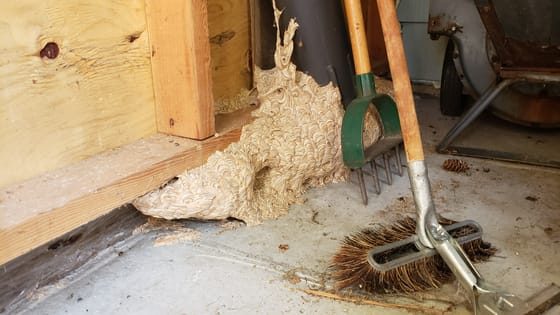
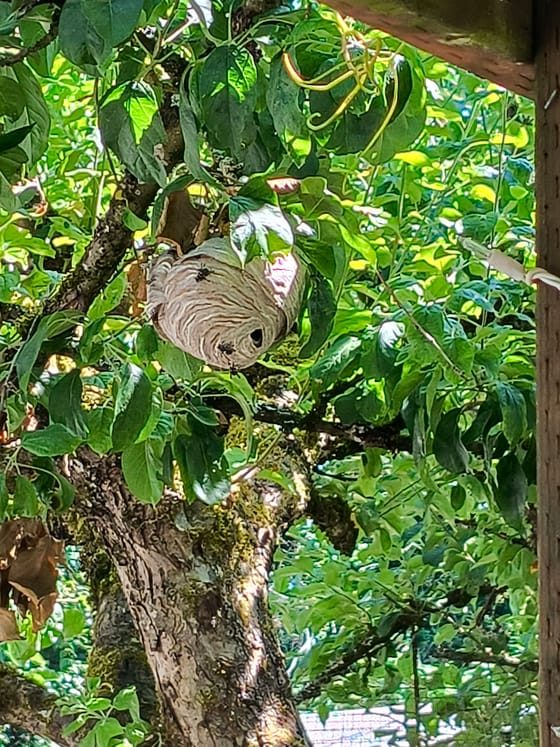
Once everyone is safe, the nest is still there. E-239 says wasp control is dangerous and should not be attempted by anyone with a heart condition or a known venom allergy, and it says the entrance to a yellowjacket nest in a wall generally should not be sealed until the colony has been eliminated. Keep children and pets away from the area, skip mowing near a ground hole, and do not spray a nest at close range.
Our wasp control page explains how paper wasp and yellowjacket nests are found and treated around north Houston homes. If someone in the household has a known sting allergy, mention it when you reach out so the nest near them can be handled first.
Avoiding the next sting
- Wear light-colored, smooth-finished clothing outdoors and skip perfumed soaps, shampoos and deodorants, as CDC suggests.
- Keep food and sweet drinks covered and trash lidded; CDC notes that social wasps are drawn to discarded food.
- Look over eaves, porch rails, grills and playsets in spring, while nests are small.
- Walk the lawn before mowing and watch for wasps going in and out of a hole.
- Stay calm and still around a single wasp, and move away calmly rather than swatting.
Frequently asked questions
How long does a normal wasp sting hurt?
Texas A&M AgriLife describes wasp stings as intensely painful at first, with redness and swelling at the site. For paper wasps, its venomous animals guide says the reaction should settle within a few hours to a few days. Itching can outlast the pain, and scratching it raises the chance of infection, according to CDC.
Is a big swollen area around the sting an allergic reaction?
Not necessarily. Texas A&M's E-239 calls swelling and pain that spread more than two inches from the sting a large local reaction. A systemic reaction is different: symptoms show up elsewhere in the body, such as hives far from the sting, wheezing or a swollen face. Those whole-body signs are the emergency.
How soon after a sting does anaphylaxis start?
Texas A&M AgriLife's E-239 says anaphylaxis typically occurs within 20 to 30 minutes of a sting, and that shock can come on in as little as 10 to 15 minutes. That is why CDC suggests having someone stay with a person who has been stung, to watch for a reaction.
Should I take a picture or keep the wasp?
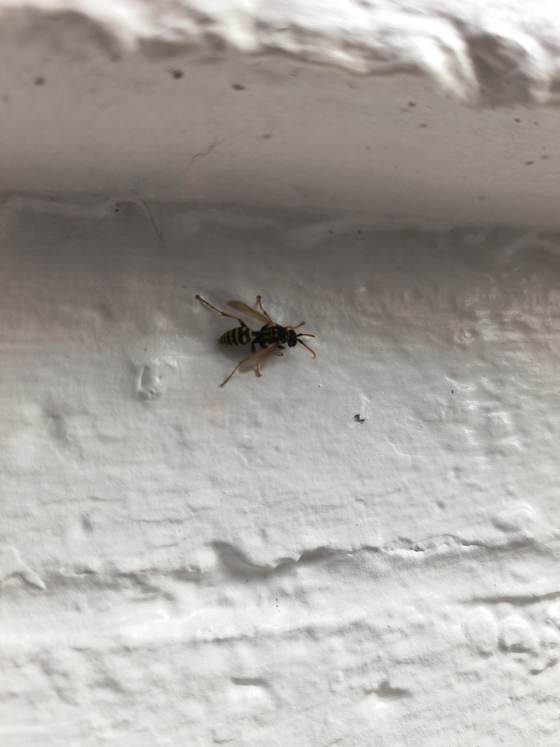
If it is safe, yes. Texas A&M's venomous animals guide suggests capturing the insect without risking more stings and taking it along if you seek medical attention. A clear photo of the insect or the nest helps a doctor, and later helps a pest professional decide how the nest should be handled.
Sources
- CDC NIOSH — Insects and Scorpions at Work, read November 11, 2026
- MedlinePlus (U.S. National Library of Medicine) — Insect bites and stings, read November 11, 2026
- Texas A&M AgriLife Extension — Paper Wasps, Yellowjackets and Solitary Wasps (E-239), read November 11, 2026
- Texas A&M AgriLife Extension — Venomous Terrestrial Animals of Texas, read November 11, 2026
Related posts
- Weevils: The Tiny Troublemakers Hiding in Your Pantry
- What Houston Landlords Must Know About Pest Control Responsibilities in Texas
- What Is Integrated Pest Management (IPM) and Why It Matters in Houston
- What Is Rodent Exclusion and Why Houston Homes Need It
- What Pests Are Common in Houston, Texas? A Complete Seasonal Guide
- Flying Termites: When Termites Swarm in Texas and Around Houston
Pest problem in north Houston?
No long-term contracts, and service agreements are backed by our 100% Service Guarantee.
Because we are based in Spring, we can often come out the same or next day for urgent problems. Call before noon, Monday through Friday, for the best chance at next-day service.
Last updated