
Stinging Insects of Texas: What Stings Around a Houston Home
The stinging insects most Houston families meet are paper wasps (including the red wasp), southern yellowjackets, honey bees, bumble bees, mud daubers, red imported fire ants and the red velvet ant, or cow killer. Yellowjackets and fire ants cause the most trouble because they defend nests in numbers. Mud daubers rarely sting, and male velvet ants cannot.
Call 281-627-4810 Request a free inspection
Year-round protection plans from $70 Core · Premium · Legendary See the plans
Most stings in a north Houston yard come from a short list of insects, and each one has its own habits, nest and level of risk. Learning to tell them apart is the quickest way to know whether you are looking at something to leave alone or a nest that needs handling. Everything below is drawn from Texas A&M AgriLife Extension’s guide Venomous Terrestrial Animals of Texas and its wasp publication E-239.
Which stinging insects in Texas cause the most trouble?
Around Houston homes, southern yellowjackets and red imported fire ants cause the most trouble, because both defend a hidden nest with many workers at once. Paper wasps and honey bees come next. Mud daubers, cicada killers and bumble bees seldom sting unless handled or disturbed, and male velvet ants cannot sting at all.
The difference comes down to colony life. Social insects such as yellowjackets, paper wasps, honey bees and fire ants defend a shared nest, so one disturbance brings many stingers. E-239 explains that social wasps use the stinger mainly for defense, while solitary wasps use it to subdue prey and rarely turn it on people.
Paper wasps and the “red wasp”
Paper wasps are the long-legged wasps that hang an open, gray comb from a single stalk under eaves, porch ceilings and playset rails. The AgriLife guide puts them at three-quarters of an inch to an inch, reddish brown or brown with yellow markings, with cloudy wings folded lengthwise at rest. It also settles a common question: the red wasp people talk about across Texas is a paper wasp.
Colonies stay small, usually 20 to 30 wasps at one time, and the wasps work in daylight. The guide describes the sting as immediate, with the reaction fading over a few hours to a few days.
Southern yellowjackets
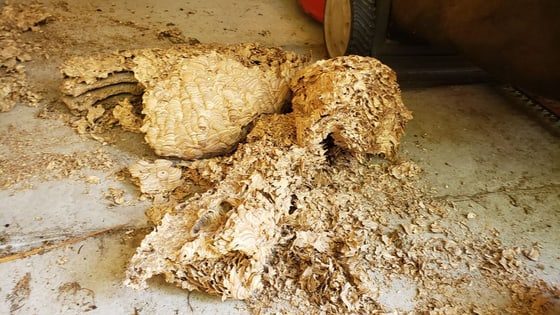
The southern yellowjacket is a smooth, half-inch wasp, black with yellow markings, that most often nests underground and sometimes inside walls. AgriLife says yellowjackets may be aggressive while foraging, especially in fall, and that southern yellowjackets can sting repeatedly. The guide adds that the paper carton nest may be enlarged and reused for many years, and that Texans often call yellowjackets “hornets.”
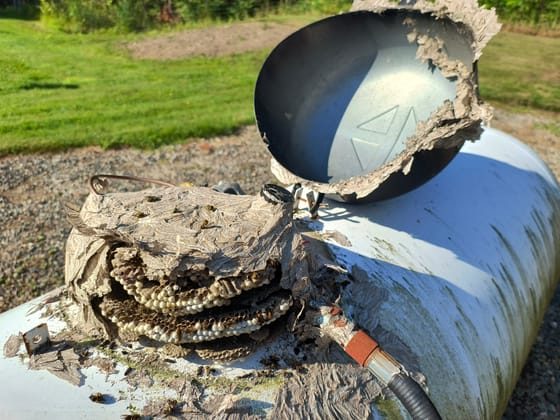
A yellowjacket colony is the classic stinging emergency in a yard: a mower or a child’s foot over the entrance hole, and the defenders come out together. Our page on yellowjackets in the ground or a wall covers that situation.
Honey bees
Honey bees are about half an inch long, light brown to black mixed with yellow, with a banded abdomen and a hairy thorax. AgriLife notes that only females sting, that colonies can hold 20,000 to 90,000 bees, and that new colonies form when bees swarm to a new spot. The Africanized strain is in Texas and is hard to tell from managed honey bees by sight.
The honey bee sting stands out from the rest of this list in one way: the stinger and venom sac stay in the skin, and the worker bee dies. The guide advises scraping them out quickly with a fingernail or a knife edge. Honey bees in a wall or a meter box are a separate kind of job, explained on our bee control page.
Bumble bees
Bumble bees are large, husky and fuzzy, about three-quarters of an inch, with black and yellow or black and orange hair. AgriLife describes small colonies, usually fewer than 2,000 bees, started each spring by a fertilized queen that survived the winter. They nest in the ground, in clumps of dry grass, in old bird nests and rodent burrows, even in discarded cushions. A sting brings sharp pain and local swelling, and a disturbed colony may attack in a group.
Eastern carpenter bees look similar but have a shiny, mostly bare abdomen. The guide notes that male carpenter bees may dive at people defending a territory but cannot sting.
Mud daubers and cicada killers
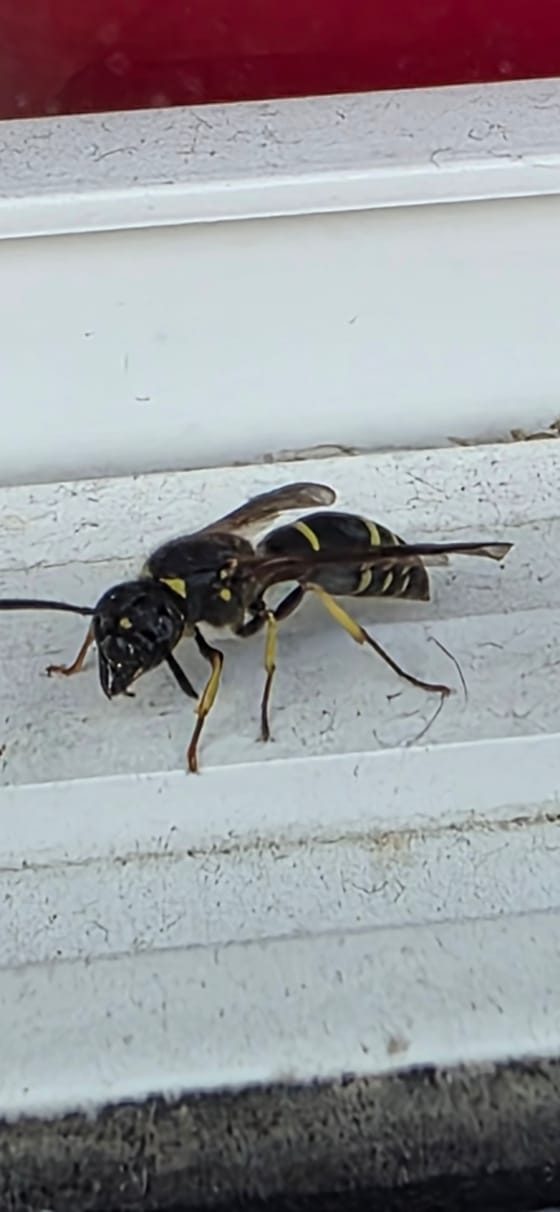
Mud daubers are the thread-waisted wasps, dull black, blue-black or black and yellow, that build mud tubes on walls and under eaves and pack them with paralyzed prey. AgriLife calls them beneficial, generally solitary and relatively mild-tempered, and says most of their “attacks” are bluffs.
Cicada killers are the giants, up to an inch and a half, with a dark red head and thorax and a black abdomen marked with yellow. They dig burrows in sandy soil in summer. The guide says females can sting but are rarely aggressive, while the males that buzz people cannot sting at all.
Red imported fire ants
The red imported fire ant is the one insect on this list that piles its nest up as a visible mound of soil. AgriLife says it is found mainly in the eastern two-thirds of the state, which includes all of greater Houston, and that a colony can hold more than 200,000 ants. Many workers sting at once in response to an alarm chemical.
The sting burns immediately, and a fluid-filled pustule often forms within a day or two and can last a week or more. The guide warns that secondary infection is common and that hypersensitive reactions are possible. CDC’s NIOSH page on insects and scorpions at work advises brushing fire ants off briskly, since they hold on with their jaws. Mound treatment and yard baiting are covered on our ant control page and the fire ant mounds page.
The red velvet ant, or “cow killer”
The red velvet ant is not an ant. AgriLife describes it as a wingless wasp about three-quarters of an inch long, covered in black and orange-red hair, that looks like a fuzzy ant as it runs across bare ground. Females invade the nests of ground-nesting bees and other insects to feed their young. Their sting is considered extremely painful, which is where the nickname comes from. Males have wings and cannot sting.
There is no colony and no nest to treat. A velvet ant crossing the yard is a reason to wear shoes, not to call anyone.
Quick comparison
| Insect | Nest | Lives in a colony? | Typical temperament |
|---|---|---|---|
| Paper wasp / red wasp | Open comb under eaves | Yes, 20 to 30 at a time | Defends the nest |
| Southern yellowjacket | Paper carton, mostly underground | Yes | Defensive, worse in fall |
| Honey bee | Wax comb in a cavity | Yes, tens of thousands | Defends the colony |
| Bumble bee | Ground, grass clumps, old burrows | Yes, usually under 2,000 | Group attack only if disturbed |
| Mud dauber | Mud tubes | No, solitary | Mild, mostly bluffs |
| Red imported fire ant | Soil mound | Yes, can pass 200,000 | Many sting at once |
| Red velvet ant | None | No, solitary | Runs, squeaks when cornered |
When a sting turns serious
AgriLife lists trouble breathing or swallowing, weakness, dizziness, vomiting, rashes and unconsciousness as signs of an allergic reaction that needs medical help quickly. E-239 adds that stings around the head, eyes and neck are especially serious. Call 911 for any of those signs. Our post on wasp sting care covers first aid for an ordinary sting.
Keeping stingers away from the house
- Look over the eaves, porch ceiling, mailbox and playset in early spring, while new paper wasp nests are still small.
- Walk the lawn before mowing and watch for steady traffic into a single hole.
- Keep outdoor trash lidded and drinks covered; CDC notes that social wasps are drawn to discarded food.
- Wear shoes on bare ground and in the grass, for fire ants and velvet ants alike.
- Give a honey bee swarm plenty of room rather than trying to move it.
For nests near doors, walkways or play areas, our wasp control page explains how paper wasp, yellowjacket and mud dauber nests are handled across north Houston.
Frequently asked questions
Is a red wasp different from a paper wasp?
No. Texas A&M AgriLife's venomous animals guide says the common red wasp is a type of paper wasp. It builds the same open, umbrella-shaped comb under eaves and porch ceilings, and it gets the same treatment. Color varies by species, from reddish brown to brown with yellow markings.
Is the cow killer really dangerous to cattle?
The name exaggerates. The red velvet ant is a wingless wasp, not an ant, and Texas A&M says it earned the nickname because its sting is considered extremely painful. Only the females sting. The males have wings and no stinger, and both sexes can squeak when cornered.
Which Texas stinging insects can sting more than once?
Wasps and yellowjackets keep their stingers and can sting repeatedly; Texas A&M notes southern yellowjackets in particular can do so. A worker honey bee leaves its stinger and venom sac in the skin and dies afterward. Fire ants grip with their jaws and often sting several times from one spot.
Are bumble bees aggressive?
Not usually, but a bumble bee colony that is disturbed may attack in groups, according to Texas A&M AgriLife. Colonies are small, typically under 2,000 bees, and sit in the ground, in clumps of dry grass, old bird nests or abandoned rodent burrows, so a mower can find one before you do.
Sources
- Texas A&M AgriLife Extension — Venomous Terrestrial Animals of Texas, read November 11, 2026
- Texas A&M AgriLife Extension — Paper Wasps, Yellowjackets and Solitary Wasps (E-239), read November 11, 2026
- CDC NIOSH — Insects and Scorpions at Work, read November 11, 2026
Related posts
- The Complete Guide to Spider Control in Houston, TX
- The Complete Spring Pest Prevention Checklist for Houston and Harris County Homeowners
- The Houston Homeowner’s Complete Guide to Pest Prevention
- Types of Cockroaches in Houston: Which Roach Is in Your House?
- Wasps vs. Yellowjackets in Houston, TX: How to Tell Them Apart and Stay Safe
- Beehive Exterminator Near You
Pest problem in north Houston?
No long-term contracts, and service agreements are backed by our 100% Service Guarantee.
Because we are based in Spring, we can often come out the same or next day for urgent problems. Call before noon, Monday through Friday, for the best chance at next-day service.
Last updated