
Types of Cockroaches in Houston: Which Roach Is in Your House?
Most roaches in Houston homes are one of four species Texas A&M lists as the state's most common: the German, American, smokybrown and oriental cockroaches. The Asian and brownbanded cockroaches turn up less often. The German lives only indoors and needs baiting inside; the large outdoor species need work around the foundation, roofline and drains.
Call 281-627-4810 Request a free inspection
Year-round protection plans from $70 Core · Premium · Legendary See the plans
Not every roach in a Houston house is the same animal, and the difference decides where the problem lives and how it gets fixed. A small roach in the silverware drawer and a big one on the garage wall are different species with different habits, and treating one like the other is the most common reason roach control disappoints.
Types of roaches in Houston: the short list
Texas A&M AgriLife’s ENTO-037, Cockroach Biology and Management, names the four most common roach species in Texas: the American, German, oriental and smokybrown cockroaches. It splits them by lifestyle. The German cockroach spends its whole life indoors. The other three live mostly outside and come in looking for food or water.
Two more show up in Texas A&M’s material: the Asian cockroach, which the same publication says may be found outdoors in some areas of the state, and the brownbanded cockroach, an indoor species profiled by Texas A&M’s Urban and Structural Entomology Program.
| Roach | Size | Look | Where it lives |
|---|---|---|---|
| German | About 1/2 to 5/8 inch | Light brown, two dark stripes behind the head | Indoors only: kitchens, baths |
| American | Up to 2 inches | Reddish brown, pale yellow band behind the head | Outdoors, sewers, drains, garages |
| Smokybrown | About 1 1/4 to 1 1/2 inches | Uniform dark brown to black | Trees, mulch, gutters, soffits, attics |
| Oriental | About 1 to 1 1/4 inches | Glossy dark brown to black, short wings | Cool, damp, ground-level spots |
| Asian | German-sized | Nearly identical to the German | Outdoors in leaf litter and grass |
| Brownbanded | About 1/2 to 5/8 inch | Two pale bands across wings and abdomen | Indoors, in drier, higher spots |
The German cockroach: the one in the kitchen
ENTO-037 describes German cockroach adults as light brown with two dark stripes on the pronotum, the shield behind the head. Both sexes have wings, but they do not fly. The publication calls the species the most prolific of the indoor cockroaches, able to turn over a generation in about 100 days, and one of the most widespread public health pests in homes, apartments and restaurants, associated with allergies and asthma.
The critical fact for Houston homeowners is ENTO-037’s plain statement that German cockroaches do not live outdoors in Texas. They arrive in boxes, grocery bags and used appliances. If this is your roach, the fix is indoor baiting and patience, not a perimeter spray. The German cockroach profile covers it in depth.
The American cockroach: the palmetto bug
ENTO-037 calls the American cockroach the largest roach in Texas, up to two inches long, reddish brown with a tan to light yellow band around the pronotum, and notes it also goes by waterbug and palmetto bug. It is more common in commercial buildings and is one of the most common cockroaches in sewer systems. Floor drains are a usual way in, which is why a dry P-trap in a guest shower can let them into the house. See the American cockroach profile.
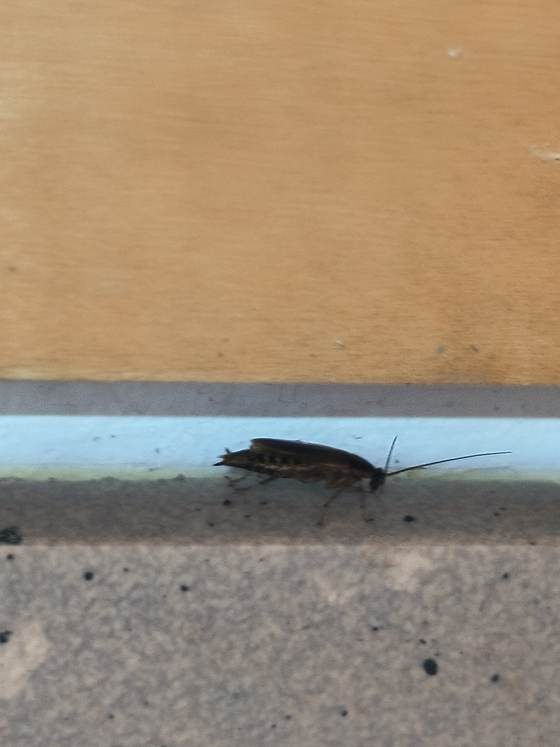
The smokybrown cockroach: the tree roach
The smokybrown is the big, uniformly dark roach of wooded neighborhoods. ENTO-037 says it is common outdoors in the more humid parts of Texas, prefers protected, moist, warm spots away from moving air, and lives in ground cover, mulch, palm fronds, soffits, attic eaves and tree holes. In Spring, Klein and The Woodlands it is often the roach behind the “tree roach” name. Read the smokybrown cockroach profile and our Texas tree roach page for how it gets into attics.
The oriental cockroach: short wings, ground level
ENTO-037 lists the oriental cockroach among the four most common in Texas. The Texas A&M oriental cockroach page describes it as glossy dark brown to black, with females nearly an inch and a quarter long and males about an inch. Males have wings covering most of the body, while the female’s are reduced to small lobes, and neither can fly. It moves slowly, cannot climb slick surfaces, and favors cool, damp areas; indoors it turns up under refrigerators, sinks and washing machines. The same page says it usually gets in through foundation cracks, along sewer pipes or under doors.
The Asian cockroach: a German lookalike that flies
The Asian cockroach is the roach most likely to be misidentified. Texas A&M’s Asian cockroach page says that for practical purposes it looks identical to the German cockroach, and that even experts can struggle to separate dead specimens. Its behavior is the giveaway. It is an accomplished flier that lives outdoors in leaf litter and grassy areas, and at dusk adults are drawn to light reflecting off pale walls, doors and windows, sometimes following it inside.
As for Texas, ENTO-037 states that the Asian cockroach looks very similar to the German and may be found outdoors in some areas of the state. The Texas A&M page adds that indoor insecticide treatments have not been effective against it, because only a few individuals come inside at night, while scatter baits outdoors have controlled populations.
So a small, German-looking roach that flies to the porch light, and does not seem to be breeding in the kitchen, is worth a closer look before anyone starts baiting cabinets.
The brownbanded cockroach: high and dry
The brownbanded cockroach is a smaller indoor species. Texas A&M’s brown-banded cockroach page gives a body length of about a half to five-eighths of an inch, light gold to glossy dark brown, with yellow bands across the base of the wings and abdomen that show more strongly on nymphs. Unlike the German cockroach, it prefers drier places and starchy foods. Look for it on ceilings in dim rooms, behind picture frames, in light switches, high in cabinets and closets, and in furniture. The page notes it is more likely in homes, apartments, hotels, nursing homes and hospitals than in restaurants.
Types of roaches in house vs. outside: why it matters
Sorting the types of roaches in a house into “lives here” and “visiting” is the useful first step.
- Breeding indoors: German and brownbanded. Treatment goes inside, with baits placed where they shelter, and store sprays stay away from the bait.
- Living outside, coming in: American, smokybrown and oriental. Work goes to the foundation, drains, doors, soffits and attic.
- Outdoor fliers drawn to light: the Asian cockroach. Outdoor baiting and lighting changes help more than anything inside.
ENTO-037’s advice for the outdoor species is consistent: use sticky cards to see where roaches enter, keep P-traps full, check door seals, screen soffits, scatter granular bait lightly in mulch, and place bait stations along walls by doors.
Getting the roach species right
Our cockroach control service starts by confirming which roach species it is, then follows the matching plan: indoor gel bait and growth regulator work for German cockroaches, or an exterior-focused treatment for the large outdoor roaches. The German cockroaches in the kitchen and American cockroaches problem pages walk through both. If you are not sure which one you have, a clear photo next to a coin goes a long way, and a technician can confirm it during a free inspection.
Frequently asked questions
What is the most common roach in Houston houses?
Inside the kitchen, it is usually the German cockroach, a small tan roach with two dark stripes behind the head. Around the garage, drains and yard, the big American and smokybrown cockroaches are far more common, and they are the ones people call palmetto bugs or tree roaches.
Do Asian cockroaches live in Texas?
Texas A&M's cockroach publication says the Asian cockroach, Blattella asahinai, may be found outdoors in some areas of the state. It looks almost identical to the German cockroach but lives outside, flies well, and is drawn to lights at dusk.
Is a roach that flies at my porch light a German cockroach?
Probably not. Texas A&M says German cockroaches do not fly and do not live outdoors in Texas. A small, German-looking roach flying to a light outdoors is more likely an Asian cockroach, and a large one is usually a smokybrown or American cockroach.
Which roach species need professional treatment?
Any German cockroach population does, because it breeds indoors and grows quickly. The large outdoor species need treatment when they are living in the attic, garage, walls or drains, rather than showing up now and then after a storm.
Sources
- Texas A&M AgriLife Extension ENTO-037 — Cockroach Biology and Management, read November 11, 2026
- Texas A&M Urban and Structural Entomology Program — German cockroach, read November 11, 2026
- Texas A&M Urban and Structural Entomology Program — Asian cockroach, read November 11, 2026
- Texas A&M Urban and Structural Entomology Program — Brown-banded cockroach, read November 11, 2026
- Texas A&M Urban and Structural Entomology Program — Oriental cockroach, read November 11, 2026
Related posts
- Wasps vs. Yellowjackets in Houston, TX: How to Tell Them Apart and Stay Safe
- Beehive Exterminator Near You
- Dealing with Wasp Stings: Essential Tips from Sasquatch Pest Control
- Wasp Sting Care: What to Do After a Wasp Gets You
- Weevils: The Tiny Troublemakers Hiding in Your Pantry
- What Houston Landlords Must Know About Pest Control Responsibilities in Texas
Pest problem in north Houston?
No long-term contracts, and service agreements are backed by our 100% Service Guarantee.
Because we are based in Spring, we can often come out the same or next day for urgent problems. Call before noon, Monday through Friday, for the best chance at next-day service.
Last updated