
American Cockroach in Spring and North Houston
Periplaneta americana · Cockroaches
The American cockroach, the palmetto bug or water bug, is the largest cockroach in Texas. It lives mainly outdoors, in sewers, drains, mulch and tree bark, and wanders indoors through drains, doors and soffits. An occasional one after a storm is expected. Repeated sightings indoors warrant treatment aimed at the outside and the plumbing.
Call 281-627-4810 Request a free inspection
Year-round protection plans from $70 Core · Premium · Legendary See the plans
We treat this, and finding it usually warrants treating.
American cockroach at a glance
| Adult size | About one and a half to two inches |
|---|---|
| Color | Reddish-brown, with a pale yellow band around the edge of the shield behind the head |
| Wings | Fully developed in both sexes; mostly glides rather than flies |
| Nymphs | Grayish brown when young, turning reddish brown after a few molts |
| Lifespan | About 600 days to adulthood, then one to two years as an adult |
| Other names | Palmetto bug, water bug |
| Habitat | Sewers, drains, mulch, tree bark and leaf litter; warm utility areas indoors |
Signs you have them
- Large reddish-brown roaches in the garage, laundry room or bathroom at night
- Roaches coming up out of a floor drain, shower drain or a dry sink trap
- Big roaches on the driveway, patio or around the water meter after dark
- More sightings indoors right after heavy rain
- Roaches near the water heater, furnace or air handler in a utility closet
The biggest roach in Texas, mostly living outside
Periplaneta americana is the insect most Houstonians mean when they say “palmetto bug.” Texas A&M’s Urban and Structural Entomology Program, in its American cockroach profile, calls it the largest and one of the most common cockroaches in Texas, native to Africa and spread by commerce. Despite the name, it is not American at all.
Texas A&M AgriLife’s ENTO-037, Cockroach Biology and Management, places it with the oriental and smokybrown roaches as species that live mostly outdoors but may come inside for food or water, and notes it is more common in commercial buildings and is one of the most common cockroaches in sewer systems.
That shapes the answer to “do I need treatment?” One roach on the kitchen floor the morning after a storm is the Gulf Coast being itself. Regular sightings, roaches in more than one room, or nymphs indoors mean there is a population close by, often in the plumbing.
Identification
The Texas A&M profile gives adults a body length of one and a half to two inches, reddish-brown with a light yellow band around the edge of the pronotum, the shield behind the head. ENTO-037 describes that band as tan to light yellow. Young nymphs are grayish brown and turn reddish brown after the first few molts.
Both sexes have well-developed wings. ENTO-037 says both can fly; the Texas A&M profile says they seldom fly and are capable of gliding. In practice, that means a roach that launches off a garage wall and sails toward the floor.
Lookalikes
- Smokybrown cockroach. Similar size, one and a quarter to one and a half inches, but uniformly dark brown to black with no pale band on the pronotum. More often in trees, gutters and attics than in drains.
- German cockroach. Much smaller, tan, with two dark stripes behind the head, and found in kitchen cabinets rather than garages and drains. Small American nymphs are sometimes mistaken for it, but they have no stripes.
- Oriental cockroach. ENTO-037 describes it as dark brown to black, about an inch and a quarter, with short wings and a preference for cool, ground-level sites.
Biology and the Houston calendar
ENTO-037 says American cockroaches are long-lived, reaching adulthood and sexual maturity in an average of 600 days and usually living one to two years as adults. Like most cockroaches, they hide by day and forage at night.
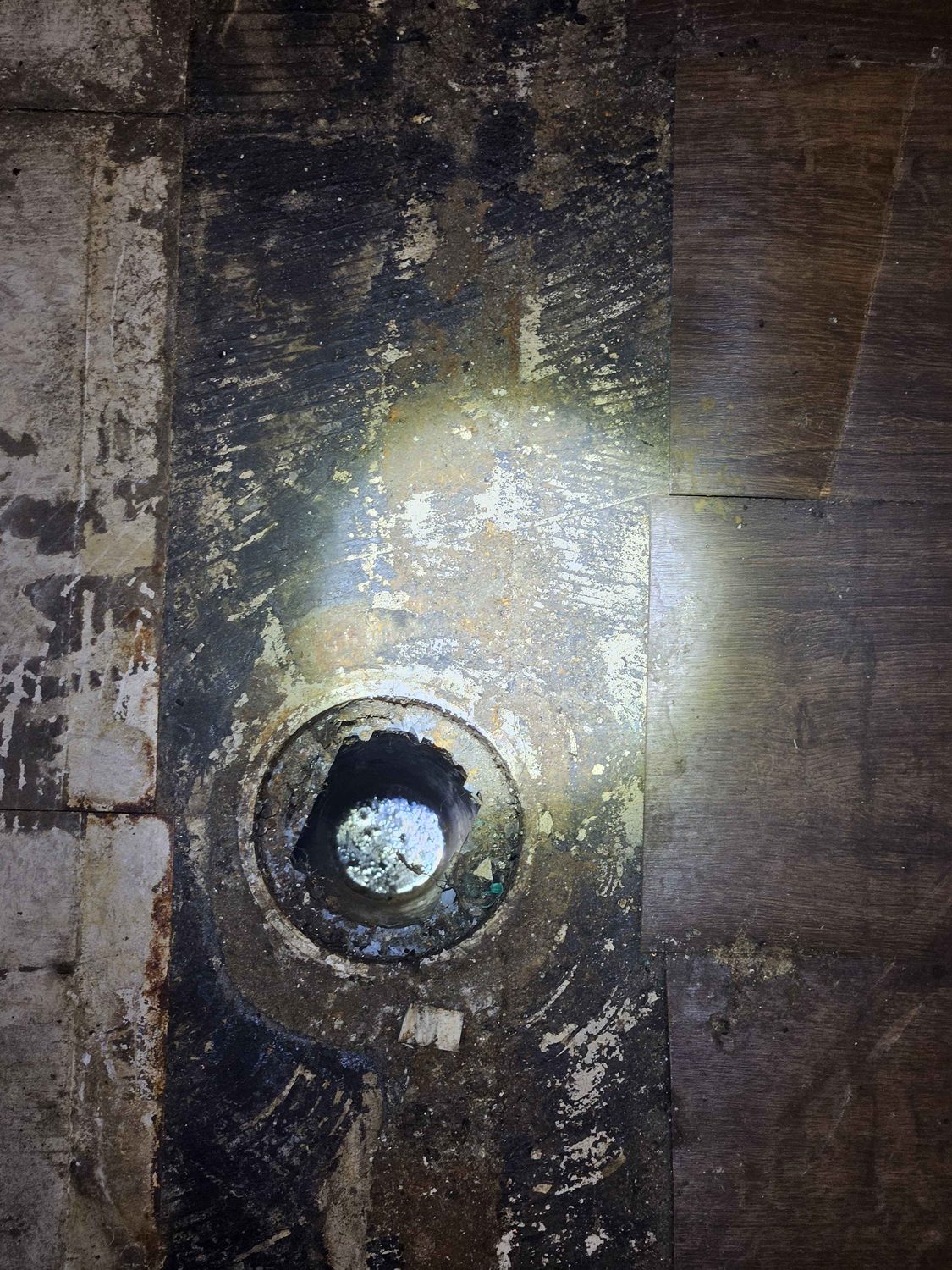
Houston’s climate suits them. The Texas A&M profile says they prefer high humidity and are commonly found outside under tree bark and leaf litter, while sewer systems let them spread through campuses and cities. Inside buildings, it notes, they live near furnaces and heating ducts.
Put those two habitats together and the pattern after a Houston downpour makes sense: the sewers and the leaf litter are where these roaches live, and both are exactly what a heavy rain floods.
Where it shows up
Outdoors, ENTO-037 lists compost piles, ground cover, hollow trees, mulch, old stumps, palm fronds, woodpiles, sewer manholes and underground water meters. Around north Houston properties that means:
- thick mulch and ground cover against the slab
- palms, ivy beds and leaf piles
- water meter boxes, irrigation valve boxes and cleanouts
- storm drains and the sanitary sewer
Ways in, from ENTO-037: poorly sealed doors, roof soffits and floor drains. The Texas A&M profile adds that adults and nymphs travel through sewer pipes into kitchens and bathrooms through drainage pipes. Common indoor spots are:
- garages, laundry rooms and utility closets
- around the water heater and HVAC equipment
- bathrooms, especially near a rarely used shower or floor drain
- restaurant floor drains, grease traps and back-of-house areas
Health risk
ENTO-037 notes cockroaches may transfer disease-causing organisms and are especially troublesome wherever food is prepared or served. An American cockroach that has come up from a sewer and walked across a counter is the scenario that matters. For restaurants and other food businesses, they are a sanitation issue in their own right; those properties are covered under commercial.
What treatment realistically involves
Because the population is outside or in the plumbing, the work moves outward. ENTO-037 recommends sticky cards to find where roaches enter, granular baits in ground cover and mulched beds, containerized bait stations along walls near doors and entry points, and insecticide sprays on building perimeters, doors, soffits and water boxes. It also recommends keeping P-traps full of water, checking threshold seals under doors, and screening roof soffits.
Our process on the cockroach control page and the American cockroaches problem page does the same: confirm the species, then shift to an exterior treatment around the foundation, dust in wall voids and drain lines, bait at entry points and moisture zones, and a list of the gaps worth sealing. A follow-up visit checks that the outside work is holding. Gaps at doors and soffits can be sealed under exclusion and repairs. The work is covered by our 100% Service Guarantee.
Garages, utility rooms and bait around pets
Most American cockroach sightings in a north Houston house happen in the garage or laundry room, and ENTO-037 has advice specific to those spaces.
Monitor first. Sticky cards along walls and cabinet edges in utility rooms and near exterior doors show where the roaches come from, and for low numbers of the larger species the publication says the cards also provide some control on their own.
Bait outdoors carefully. Granular cockroach and cricket baits work well outdoors in ground cover and mulched beds, sprinkled lightly according to the label. ENTO-037 warns against leaving visible mounds of bait, which can attract dogs and cats.
Stations at the doors. Containerized bait stations for large cockroaches belong against walls, especially near doors and other likely entry points.
Sprays in the right places. In garages and utility rooms, the publication advises spraying room edges and places unlikely to be contacted by children or pets.
Drains. ENTO-037 identifies floor drains as a common entry point for American and oriental cockroaches and says to keep P-traps filled to create a barrier between the sewer and the building. A guest bathroom shower that nobody uses for a month is a classic open door.
Restaurants and commercial kitchens
ENTO-037 says American cockroaches are more common in commercial buildings and in sewer systems. Restaurants, grocery stores and apartment complexes have more floor drains, grease traps, dumpsters and warm mechanical rooms than any house, and those are exactly the places this roach uses. Commercial accounts run through our commercial program.
Prevention
- Run water in rarely used drains every week or two so the P-trap does not dry out.
- Keep tight-fitting stoppers or covers on floor drains in garages and utility rooms.
- Replace worn door sweeps and threshold seals.
- Pull mulch back from the foundation and thin out dense ground cover near doors.
- Keep firewood, lumber and leaf piles away from the house.
- Fix leaks and condensate drips around the water heater and AC.
Related pages
- Cockroach control
- American cockroaches (palmetto bugs)
- German cockroaches in the kitchen
- Gaps under the garage door
- For a free inspection, use the contact page.
Frequently asked questions
Is a palmetto bug the same as an American cockroach?
Yes. Texas A&M lists palmetto bug and water bug as common names for the American cockroach. People also use 'palmetto bug' for the smokybrown cockroach, which is darker and slightly smaller.
Does one big roach mean my house is infested?
Usually not. ENTO-037 says American cockroaches live mostly outdoors and move indoors looking for food or water. A single one after a storm is normal in Houston. Several a week, or nymphs indoors, points to a source in the drains or walls.
Can they really come up through the drains?
Yes. Texas A&M's urban entomology program says sewer systems are excellent habitat for them and that adults and nymphs move through sewer pipes into kitchens and bathrooms through drainage pipes. Keeping water in every P-trap is the fix ENTO-037 recommends.
Do American cockroaches fly?
They have well-developed wings. Texas A&M's profile says they seldom fly and are capable of gliding, which is usually what people see when one launches off a wall.
Sources
- Texas A&M AgriLife Extension ENTO-037 — Cockroach Biology and Management — read October 5, 2026
- Texas A&M Urban and Structural Entomology Program — American cockroach — read October 5, 2026
Next scheduled review of this page against its sources: October 5, 2027.
Pest problem in north Houston?
No long-term contracts, and service agreements are backed by our 100% Service Guarantee.
Because we are based in Spring, we can often come out the same or next day for urgent problems. Call before noon, Monday through Friday, for the best chance at next-day service.
Last updated