
Rodent Control in Kingwood, Texas
Most rodent work in Kingwood is roof rats. The canopy behind the Livable Forest name puts branches over a great many roofs, and in ZIP 77339 more than half the homes were built before 1990, so roofline seams have had decades to open. Flooding along the San Jacinto and its creeks adds a second round of rodent trouble.
Call 281-627-4810 Request a free inspection
Year-round protection plans from $70 Core · Premium · Legendary See the plans
Kingwood, TX on the map
Rodents in Kingwood: at a glance
| Jurisdiction | City of Houston (annexed 1996), Harris County; a few Kingwood-named sections such as Kings Manor reach into Montgomery County |
|---|---|
| Housing age (Census ACS 2024) | ZIP 77339 median year built 1988, with 56% of homes older than 1990; ZIP 77345 median year built 1993 |
| Main rodent | Roof rats nesting in attics, reaching the roof along overhanging limbs; house mice in garages are second |
| Creeks and drainage | Bens Branch, Taylor Gully, Sand Branch and Green Tree Ditch thread through the villages as wooded drainage strips |
| After floods | CDC warns that rats and mice may get into homes after a hurricane and that damaged buildings may be infested |
| Price | The inspection is free, and sealing, traps and follow-up visits are quoted in writing before work starts |
Kingwood earned its nickname honestly. The City of Houston’s Super Neighborhood 43 page calls it “The Livable Forest”, counts about 100 miles of greenbelts, and notes that Kingwood grew east from US 59 during the 1980s before Houston annexed it in 1996. For people that means shade and trails. For roof rats it means mature trees over aging roofs, which is about as good as it gets. This page covers how that plays out village by village. The full method is on our rodent control page, and the general picture of the area is on our Kingwood page.
Why Kingwood is roof rat country
Texas A&M AgriLife’s rodent IPM training describes the roof rat as an animal that prefers mature vegetation, vines and trees for harborage, nests above ground more often than not, and eats seeds, nuts, fruit, insects, pet food and bird seed. That reads like a description of a Kingwood back yard. The same training puts a typical roof rat family group at about ten animals.
They also tolerate each other. AgriLife’s leaflet on rats and mice says 100 or more roof rats often live together without trouble, while forty Norway rats would already be a heavy population. In practice, an attic that has been quiet for months can turn out to hold more than one generation once we get up there with a light.
Food is rarely the limit. A bird feeder hanging from an oak limb, a bowl of pet food on the patio and the fruit dropped by a backyard tree all fit the diet AgriLife lists. Moving feeders away from the house and bringing pet food in at night will not end a roof rat problem on its own, but it takes away the reason the rats keep visiting the same corner of the yard.
Rooflines from the 1980s
Census figures back up the history. In ZIP 77339, the median home was built in 1988 and 56 percent of homes predate 1990. In ZIP 77345, the eastern side, the median year built is 1993.
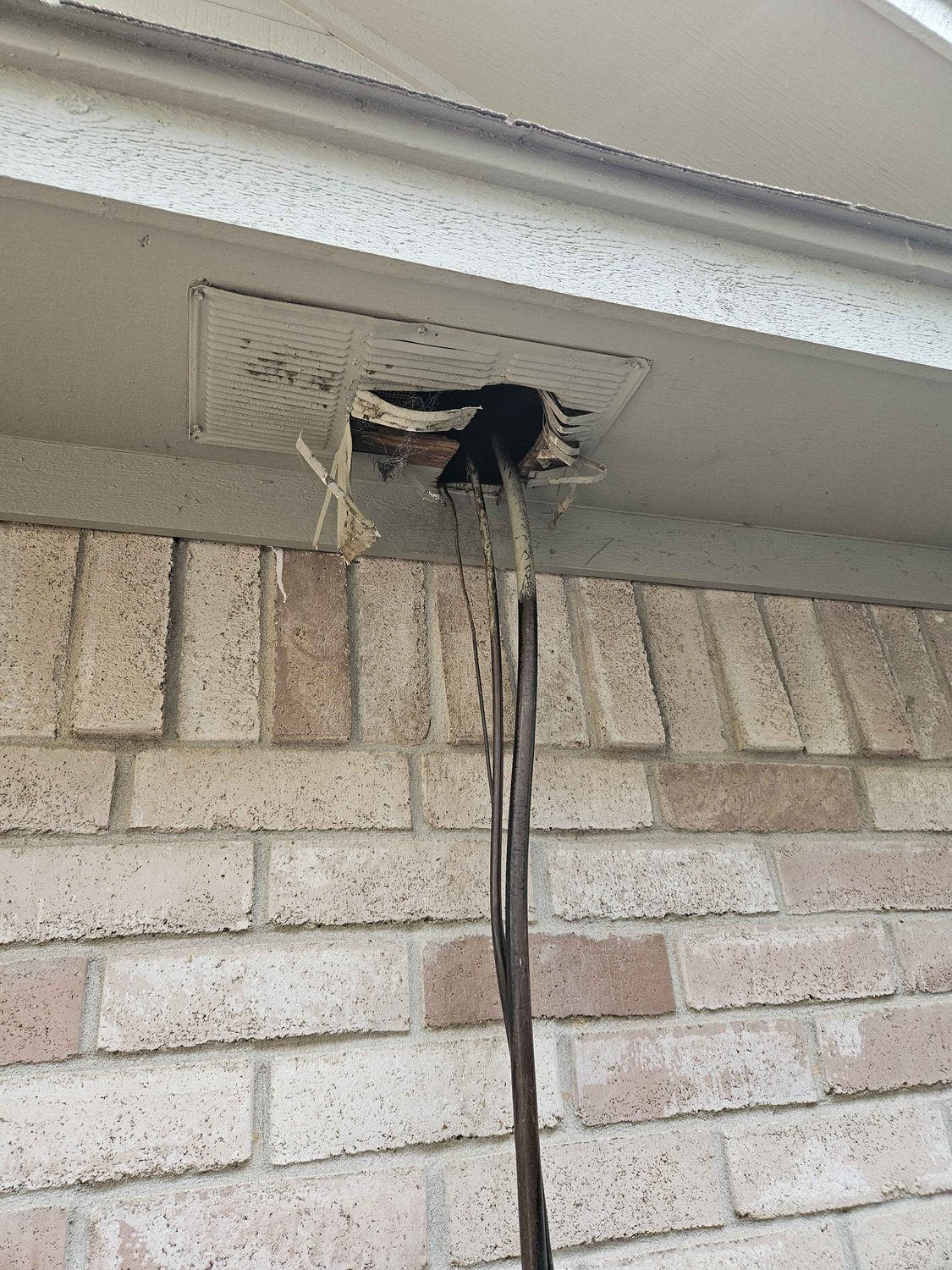
A roof that age has seen several hurricane seasons and a lot of wet summers. Fascia rots where gutters overflowed, soffit vents lose their screens, and the flashing at roof-to-wall joints pulls loose. Those are the openings we find rats using most. Our page on roofline and soffit gaps shows what to look for from the ground, and roof rats in the attic covers the signs inside.
Greenbelts and creek corridors
The greenbelts follow drainage. OpenStreetMap traces Bens Branch starting on the Montgomery County side and running south through Kingwood’s Harris County villages, and smaller channels such as Taylor Gully, Sand Branch and Green Tree Ditch do the same. Each one is a wooded strip that links back fences together. A rat that is pushed out of one yard has cover all the way to the next.
After the water goes down
Kingwood flooded badly during Harvey in 2017, and plenty of homes here were gutted and rebuilt. CDC’s guidance on protecting yourself from animals after a disaster warns that rats and mice may get into homes after a hurricane and that damaged or abandoned buildings may be infested. It advises closing holes in walls, storing food in thick plastic, glass or metal containers with tight lids, clearing debris quickly and using snap traps for rodents already inside. Rodent droppings in a flooded garage are their own cleanup job; see droppings in the garage.
Texas DSHS adds a disease angle. Its flea-borne typhus page names the Greater Houston area among newer areas where the disease has become established, spread by fleas carried on rats, opossums, cats and dogs. If opossums are using the deck as well as rats using the attic, treating pets and the yard with flea control belongs in the conversation.
What differs between Kingwood villages
- Greentree has about 1,750 lots on fairly compact ground, so rats move fence to fence and roof to roof. Sealing one house while the neighbor’s stays open slows the problem without ending it.
- Kingwood Greens wraps around a golf course on large, heavily shaded lots where limbs often touch the shingles. Tree access is the first thing we address there.
- Elm Grove sits along Taylor Gully, and many homes were rebuilt after flooding. New framing meeting old is where we look for gaps.
- Kings Manor straddles the Harris and Montgomery county line on patio-home lots, so the focus shifts to slab edges and shared side yards.
- Royal Brook is the newest village, beside the wooded Mills Branch reserve. The houses are young, so the gaps we find are usually ones builders left at the garage and utility entries rather than worn roof seams.
Getting a Kingwood job started
Each job begins with a free inspection, then sealing, traps on the runways and tamper-resistant stations outside, followed by check-ups until activity stops. Larger roofline repairs go under exclusion and repairs. Ongoing monitoring fits into our Core Protection Programs, and the work is backed by the 100% Service Guarantee. Kingwood is part of our Harris County territory; to set up a visit, use the contact page.
Frequently asked questions
Our Kingwood house dates from the 1980s. Where do roof rats usually get in?
High up, most of the time. We check where a lower roof meets a second-story wall, the soffit returns, gable and ridge vents, and the gaps around plumbing stacks. On a forty-year-old roof one or two of those have usually opened, and the limb over the roof shows us which side to look at first.
Can we just cut the branches back and skip the sealing?
Trimming helps, but roof rats also climb walls, downspouts, utility lines and fences, and the rats already inside will not leave because the limb is gone. Cutting branches back and sealing the openings together is what keeps a Kingwood attic clear for the long run.
We flooded in Harvey and rebuilt. Could rodents be living in the new walls?
It is worth checking. Rebuilt houses often have fresh gaps where new drywall, baseboards and plumbing cutouts meet older framing, and CDC notes that damaged buildings can be infested after a storm. We look at the lower walls, the garage and the attic on the same visit.
Kingwood is a long way from your office. Will follow-up visits still happen?
Yes. Distance does not change the plan: follow-up checks are put on the calendar when the job is set up rather than squeezed in later. The first check-up comes about a week after setup, and the schedule after that depends on how much activity we are still finding.
We back onto a greenbelt. Will the rats just keep coming back?
The greenbelt will always hold some rodents, so the goal is a house they cannot enter. Once the openings are sealed with materials they cannot chew, exterior stations along the fence side catch the ones that keep trying, and monitoring visits tell us whether anything has found a new gap.
Rodent Control in Kingwood?
No long-term contracts, and service agreements are backed by our 100% Service Guarantee.
Because we are based in Spring, we can often come out the same or next day for urgent problems. Call before noon, Monday through Friday, for the best chance at next-day service.
Last updated