
Pigeons on a Roofline in Spring and North Houston
Pigeons that line the same roof ridge, parapet or solar array every day are using it to loaf, roost or nest, usually near a food source. Because rock pigeons are not federally protected, nests can be cleared. The lasting fix is a physical barrier fitted to the exact perch, such as spikes, bird wire, netting or solar mesh.
Call 281-627-4810 Request a free inspection
Year-round protection plans from $70 Core · Premium · Legendary See the plans
What to do, in order
- Confirm they are pigeons and not doves or grackles before removing any nest; the rules differ.
- Note where they sit at midday and where they sleep at dusk; those can be different spots.
- Look under solar panels and inside gable vents for nesting material.
- Stop any feeding nearby, including spilled birdseed and open trash.
- Wet dried droppings before cleaning and wear a dust mask; never dry-sweep or leaf-blow them.
- Skip the plastic owls and ultrasonic boxes and plan a physical barrier for each perch.
What it usually turns out to be
When a row of gray birds sits on the same ridge cap or parapet every afternoon, it is almost always rock pigeons. Texas A&M AgriLife’s leaflet on controlling feral pigeons notes they were domesticated in Europe, brought to this country, and escaped to form feral flocks, and that city shelter gives them plenty of places to live and breed. On north Houston homes, the favorites are a sunny ridge line, the top of a chimney chase, the ledge over a garage, and above all the shaded gap under rooftop solar panels.
Get the identification right first, because the law depends on it:
- Rock pigeons. Chunky, mostly gray, often with two dark wing bars and an iridescent neck. Not protected.
- Mourning doves and white-winged doves. Slimmer and brown-gray, usually in pairs. Both are native birds.
- Grackles. Glossy black with yellow eyes and long tails, noisy in big flocks. Native and protected.
- European starlings and house sparrows. Smaller, nesting in vents and gaps. Not protected.
What the law allows
The U.S. Fish and Wildlife Service’s depredation permit FAQ is clear on pigeons: nonnative species including rock (feral) pigeons, European starlings and house sparrows are not protected under the Migratory Bird Treaty Act. Nearly every native bird is, with its nests and eggs. The same FAQ says no federal permit is needed simply to scare or harass birds, except eagles and listed species, and that an inactive nest without eggs or chicks can be destroyed without a permit.
In practice, that means a pigeon nest under a solar array can be cleared as part of the job. A dove nest found in the same spot stays until it is empty.
How to tell what the birds are using the roof for
A pigeon problem is really three different problems, and they often sit on different parts of the same building.
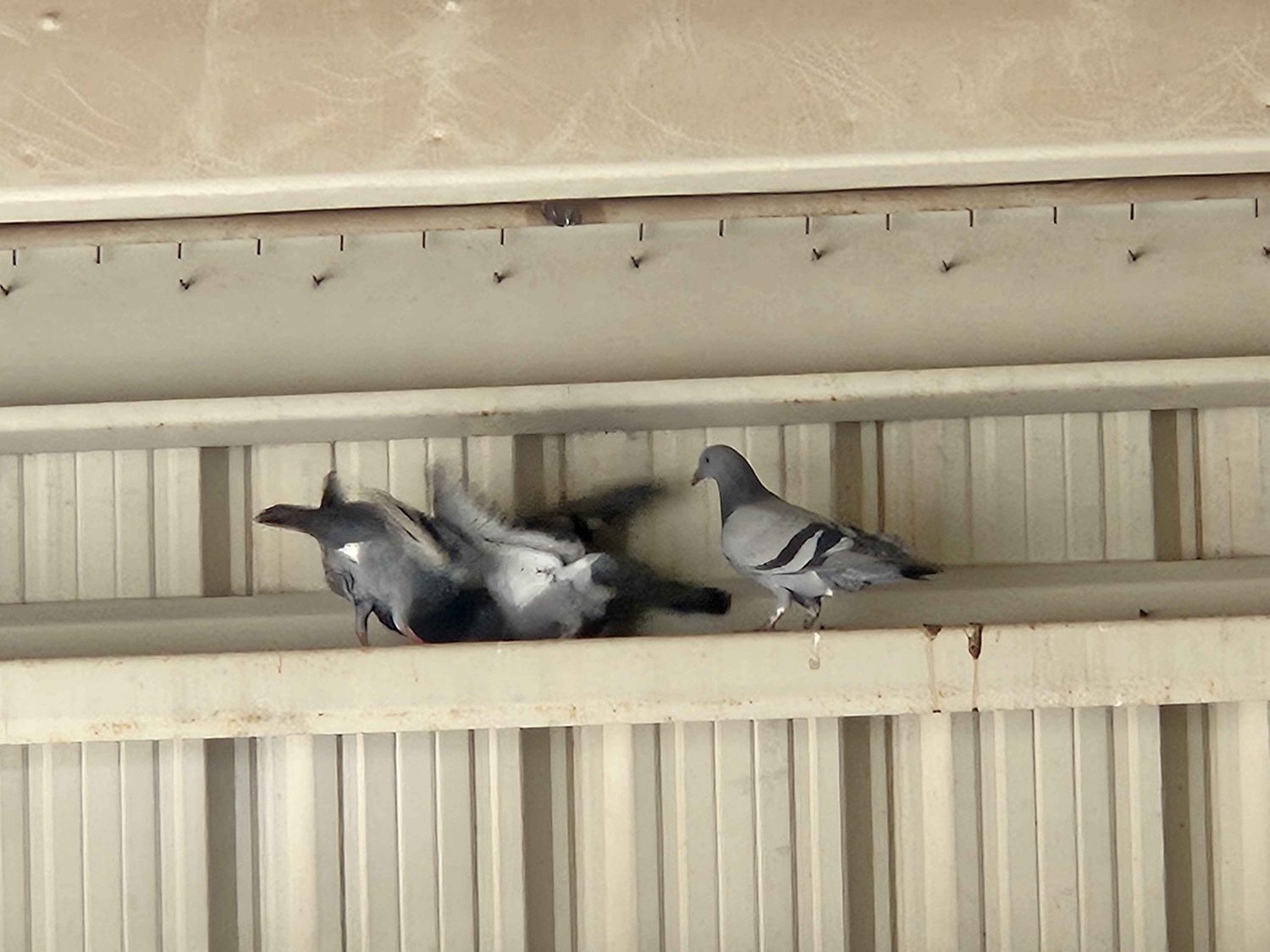
- Loafing. Birds perched in the day on a ridge, ledge or sign. You see them, and white streaks run down the wall below.
- Roosting. Birds sleeping in the same place at night, often a sheltered ledge, the underside of a canopy or a beam. Look at dusk.
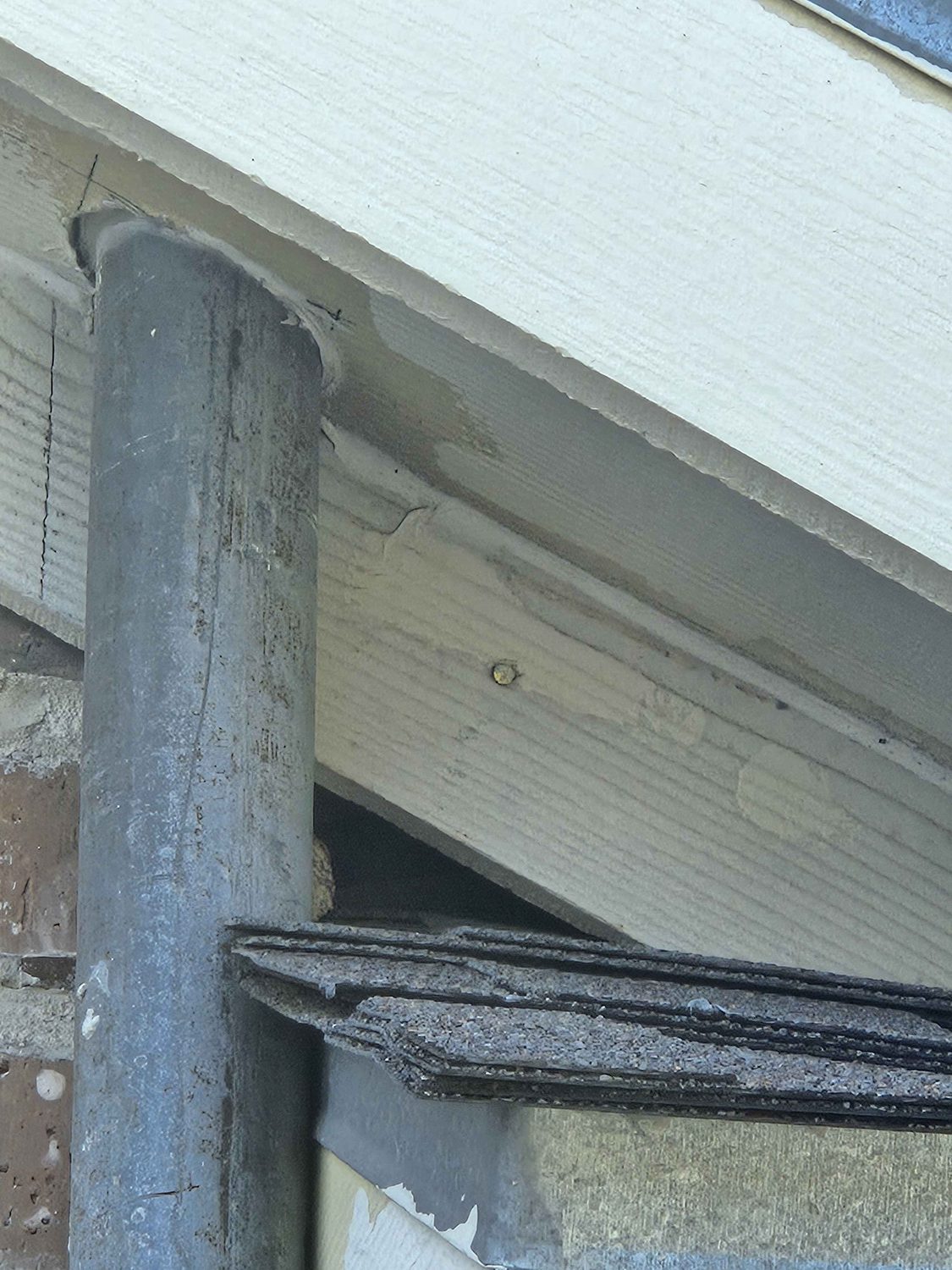
- Nesting. A loose platform of twigs and droppings in a protected spot: under solar panels, inside a gable vent, on top of an AC unit tucked against a wall. Cooing from under the panels in the morning is the giveaway.
Mapping all three before anything is installed is what keeps the birds from moving three feet down the roof.
What we do about it
Our bird work follows one process: inspection, a custom plan, installation, and prevention, with no long-term contract. It is non-lethal.
- Inspection. Identify the species and find the loafing, roosting and nesting spots, plus any vents or gaps the birds are getting into.
- A plan for that roof. The barrier is matched to the perch and the surface.
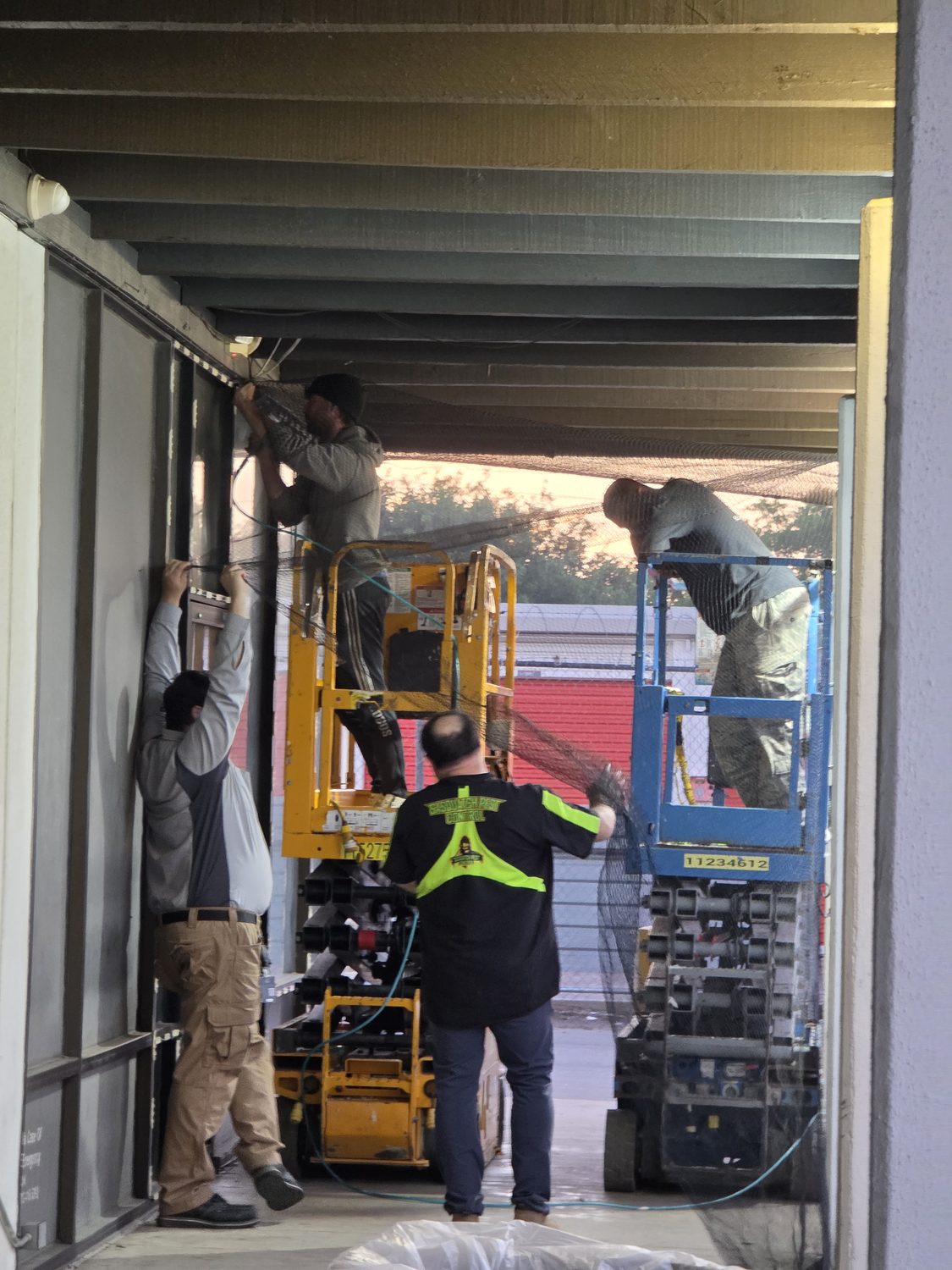
- Installation. Spikes on ledges and ridge lines, bird wire on narrow edges, netting for open structures, exclusion mesh around solar panels, and sealing of vents and gaps.
- Prevention. Advice on food sources and follow-up where it is needed.
AgriLife backs the physical approach. Its pigeon leaflet recommends covering openings to attics and eaves with hardware cloth, wood, masonry or metal, and calls sharp metal prongs on sills, ledges and rooflines costly but effective. It describes noise devices as usually ineffective with pigeons and calls the effectiveness of ultrasonic units questionable.
We do not clean droppings off roofs or walls. We tell you what needs cleaning and how, and that is done by you or a cleaning contractor.
When to call
Call when birds use the same spot daily for more than a week or two, or as soon as you find nesting under panels or in a vent. Pigeons tend to stay in the same feeding and roosting areas, AgriLife notes, so a flock that has settled rarely leaves by itself. On commercial buildings, where droppings near doors and docks can become an audit finding, our commercial program handles the documentation.
Related problems
For the full range of bird work, including grackles, sparrows and swallows, see bird control. If the gap the birds use is in a soffit or vent that needs repair, our page on roofline and soffit gaps covers it. Something flying out of the roofline at dusk instead of in daylight points to bats in the attic. Bird work carries our 100% Service Guarantee. For a free inspection, contact us.
Frequently asked questions
Are pigeons protected like other birds?
No. The U.S. Fish and Wildlife Service lists rock pigeons, European starlings and house sparrows as nonnative birds not protected under the Migratory Bird Treaty Act. Texas A&M AgriLife adds that pigeons are not protected in Texas and their nests and eggs may be destroyed.
Will a fake owl scare them off?
Not for long. AgriLife says decoy hawks and owls, balloons and streamers have limited use, and that city pigeons are used to loud noise. Pigeons soon work out that a plastic owl never moves.
Why do pigeons pick my roof and not the neighbor's?
Usually something on your roof suits them better: a flat ledge out of the wind, a warm solar array, a gable vent with a gap behind it, or food nearby. Once a few birds settle, others join them, so a busy roofline tends to stay busy.
Is pigeon droppings a health concern?
It can be when dried droppings are disturbed in enclosed spaces. The CDC says the fungus behind histoplasmosis spreads in bird and bat droppings mixed in soil and is caught by breathing in spores. Wet the droppings before cleanup and use dust protection.
Guides
Bird Control in north Houston?
No long-term contracts, and service agreements are backed by our 100% Service Guarantee.
Because we are based in Spring, we can often come out the same or next day for urgent problems. Call before noon, Monday through Friday, for the best chance at next-day service.
Last updated