
Grackle Control in Houston
Great-tailed grackles are protected under the Migratory Bird Treaty Act. A federal depredation order lets property owners control them without a permit when they cause a health hazard or structural damage, but only after trying nonlethal methods first and with an annual report. Our grackle work is non-lethal: exclusion on the building and advice on the roost.
Call 281-627-4810 Request a free inspection
Year-round protection plans from $70 Core · Premium · Legendary See the plans

What a grackle roost looks like
Anyone who has parked at a north Houston grocery store on a winter evening knows the scene: an hour before dark the trees over the lot fill with long-tailed black birds, the noise rises, and by morning the cars and pavement under the trees are spattered. Those are great-tailed grackles, often mixed with European starlings.
A Texas A&M study, Salmonella surveillance among great-tailed grackles in eastern Texas, describes the species as highly adapted to cities and notes that its night roosts are frequently in the trees of large, well-lit parking lots. The authors add that grackles gather near grocery stores, restaurants and gas stations. Texas A&M AgriLife’s leaflet on controlling roosting birds in urban areas explains the season: grackles, starlings and blackbirds flock together through fall, winter and early spring and can form huge roosts in town.
Where grackles cause trouble
- Parking lots. Droppings under roost trees damage car finishes and coat curbs, islands and walkways. AgriLife says roost droppings also kill grass and ornamental plants.
- Retail centers. Sign tops, canopy edges and light fixtures become daytime perches over entrances and sidewalks.
- Restaurants. Patios, drive-through lanes and the area around dumpsters draw birds to food, which puts droppings close to where people eat.
- Noise. AgriLife calls grackles noisy birds that often make an obnoxious racket, and a roost of thousands at dusk is hard to ignore.
What the law actually says about grackle control
This is the part most bird ads get wrong in one direction or the other.
Federal. The great-tailed grackle (Quiscalus mexicanus) appears on the list of birds protected by the Migratory Bird Treaty Act in 50 CFR 10.13. It is also one of the species named in the depredation order for blackbirds, cowbirds, crows, grackles and magpies, 50 CFR 21.150, which was renumbered from 21.43 in 2022. Under that order a private citizen does not need a federal permit to control these birds when they cause serious injury to crops or livestock feed, when they cause a health hazard or structural property damage, or to protect certain listed species. The order comes with strings:
- each calendar year, nonlethal methods such as netting must be tried before any lethal control;
- anyone acting under the order must file an annual report on FWS Form 3-2436, due January 31 of the following year;
- wildlife officers must be allowed access to the site; and
- any control must also comply with state, tribal and local law.
State. Texas Parks and Wildlife’s protected wildlife page says a permit is not required to control grackles, cowbirds and several blackbirds when they are a nuisance or a public health hazard, and that no bird may be controlled by a means that local city or county ordinance makes illegal.
Nests. The U.S. Fish and Wildlife Service’s depredation permit FAQ says inactive nests may be destroyed without a permit, while destroying an active nest, one with eggs or chicks, requires one.
Where Sasquatch stands. We do not do lethal grackle control and we do not remove active nests. Our grackle control is exclusion and deterrence, which needs no permit and no report. The wider legal picture, including how grackles compare with pigeons and sparrows, is on our guide to bats, birds and wildlife law in Texas. It summarizes the published rules and is not legal advice.
Our part: the building
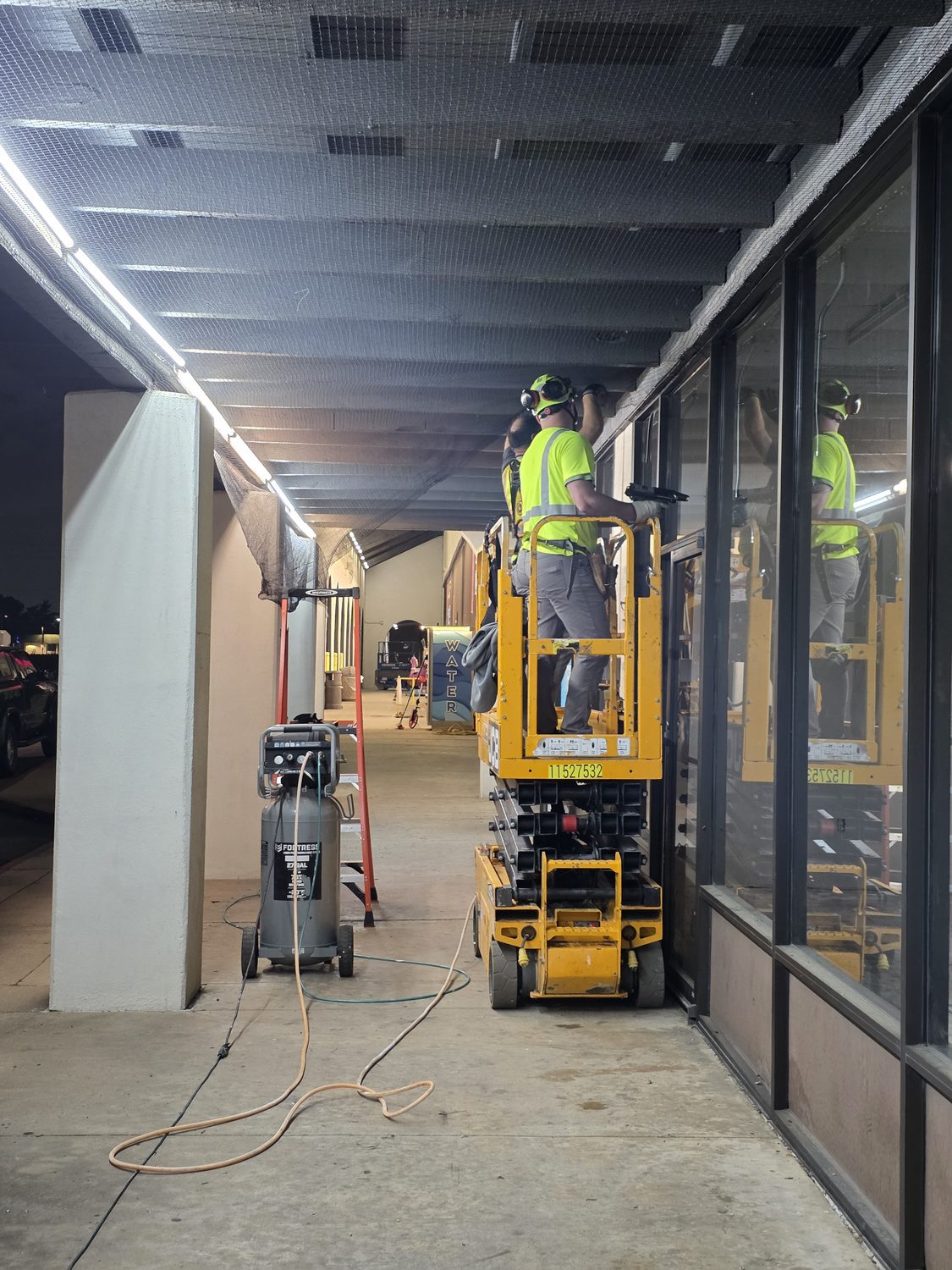
Grackles split their time between the roost trees and the building around them. The building side is where bird control does its work. After an inspection that identifies the species and maps where the birds perch, we fit:
- spikes along sign tops, parapet caps and ledges over entrances;
- bird wire on narrow edges such as canopy fascias and railings;
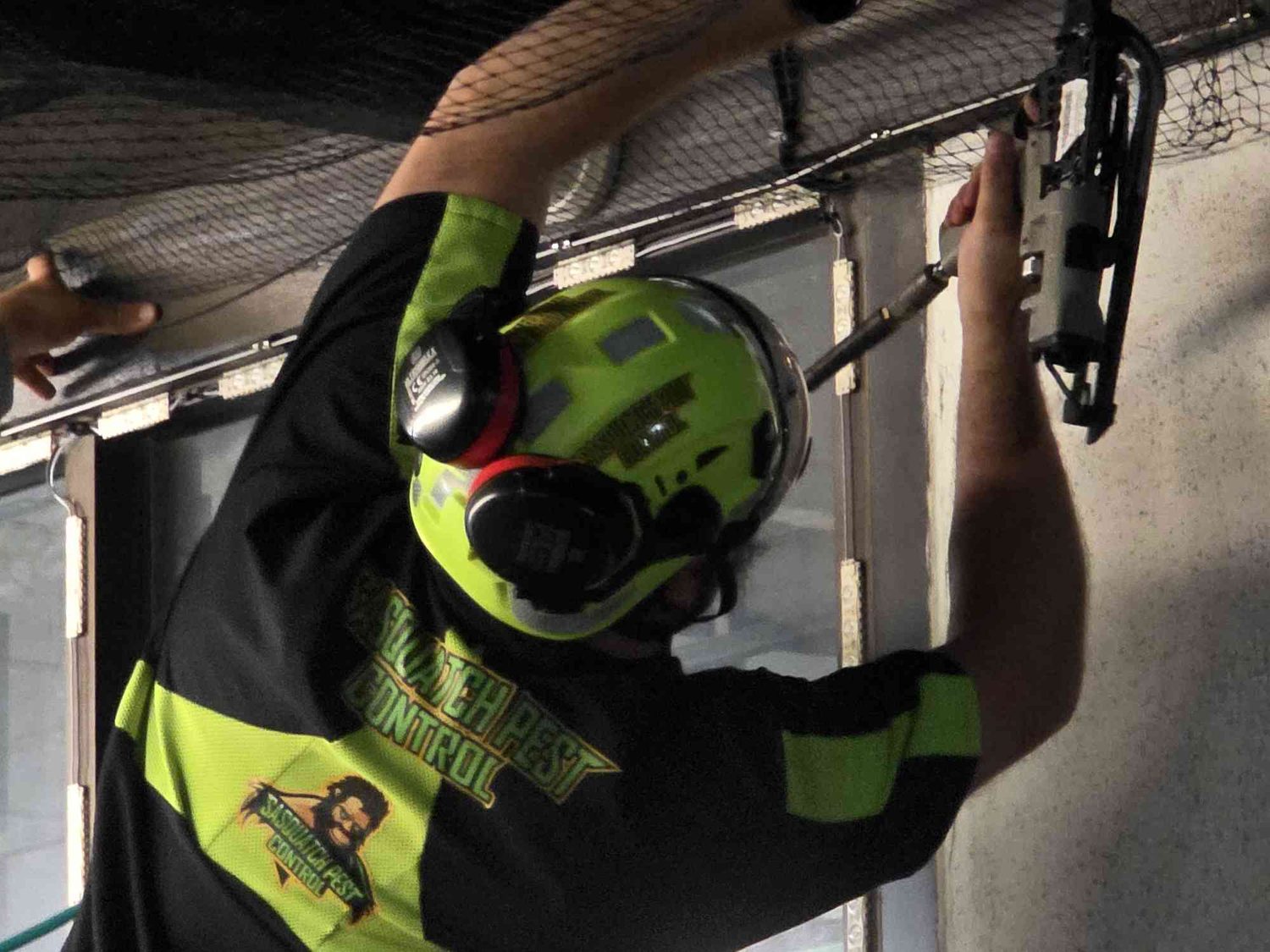
- netting under canopies and across drive-through and dock structures where birds sit on the steel;
- sealing of gaps and cavities that birds use for shelter.
Commercial accounts get monitoring and re-inspection visits and a written record of what was installed.
The trees and the food: advice for your team
The roost trees themselves are a landscaping question. AgriLife says thinning the roost vegetation often gives longer-lasting results than scare devices, ideally done after the birds have moved off, and warns that a single thinning is not a permanent fix; it takes a regular vegetation maintenance program. The same leaflet stresses timing: act when the birds first start gathering, because an established roost is very hard to shift.
AgriLife also describes noise and pyrotechnic harassment at dusk, but notes that most cities have ordinances against noise-making devices and that police and neighbors should be told first. We do not run pyrotechnics. What we can do is tell you which trees and which food sources are holding the flock: open dumpsters, spilled fries in a drive-through lane, or seed and crumbs around outdoor tables.
Droppings under the roost
The A&M study found Salmonella in 2 of the 76 grackles it sampled in Brazos County parking lots, and AgriLife notes that histoplasmosis is among the diseases that can spread from droppings accumulated under a roost. Pressure-washing a crusted island or sidewalk throws that material into the air. Our bird droppings cleanup page sets out how to clean it safely; the cleaning itself is done by your staff or a cleaning contractor.
Related pages
The bird itself, including how to tell it from a crow or starling, is on our great-tailed grackle profile. Pigeons on the same retail roof are covered under pigeon control, and sparrows in the sign cabinets under sparrow control. Multi-site retail and restaurant accounts can be handled through our commercial program. To have a roost looked at before it settles in, contact us for a free inspection.
Frequently asked questions
Are grackles protected in Texas?
Yes, federally. The great-tailed grackle is on the Migratory Bird Treaty Act list in 50 CFR 10.13. A federal depredation order, 50 CFR 21.150, allows control without a permit in set situations, and Texas Parks and Wildlife says no state permit is needed when grackles are a nuisance or health hazard.
Why do grackles pick shopping center parking lots?
A Texas A&M study of grackles in Brazos County notes that the birds roost communally at night, often in the trees of large, well-lit parking lots. Shade trees, lights, spilled food and open trash put everything a winter flock wants in one place.
When is the best time to deal with a grackle roost?
As early as possible. Texas A&M AgriLife's leaflet on roosting birds says to start as soon as the birds begin to form a roost, because a well-established roost is very hard to move. These roosts build through fall and winter and into early spring.
Will you remove grackle nests from our trees or building?
Not active ones. Federal guidance says destroying an active nest of a protected bird, one with eggs or chicks, requires a permit. Empty nests can be removed. We work on the perches and openings so the birds have less reason to use the building in the first place.
Can grackles carry disease?
They can. A Texas A&M study found Salmonella in 2 of 76 great-tailed grackles sampled in retail parking lots in Brazos County. AgriLife also notes that diseases such as histoplasmosis can spread from the droppings that build up under a roost.
Bird Control in north Houston?
No long-term contracts, and service agreements are backed by our 100% Service Guarantee.
Because we are based in Spring, we can often come out the same or next day for urgent problems. Call before noon, Monday through Friday, for the best chance at next-day service.
Last updated