
Virginia Opossum in Spring and North Houston
Didelphis virginiana · Wildlife
The Virginia opossum is North America's only marsupial and a regular night visitor to north Houston yards. One passing through needs no treatment, only secured trash and pet food. An opossum denning under a deck, shed or house, or in a garage or attic, is worth removing and excluding, partly because its fleas can carry flea-borne typhus.
Call 281-627-4810 Request a free inspection
Year-round protection plans from $70 Core · Premium · Legendary See the plans
Sometimes worth treating, sometimes not — it depends on what is below.
Virginia opossum at a glance
| Size | Roughly cat-sized: 24 to 34 inches long, 4 to 15 pounds |
|---|---|
| Face and ears | Long, pointed white face; round, hairless dark ears |
| Tail | Long, scaly and nearly hairless; can grip branches |
| Coat | Grizzled gray, ranging from near-black to light gray |
| Young | Born after about 12 days, finish developing in the pouch; two litters a year |
| Lifespan | Usually about two years in the wild |
| Texas status | Furbearer under Texas Parks and Wildlife rules |
Signs you have them
- A gray animal with a white face caught in the porch light or on a doorbell camera at night
- Pet food bowls emptied and water bowls tipped overnight
- A gap under a deck, shed or slab step with smoothed dirt and bits of leaves dragged in
- A strong musky smell under a deck or in a garage corner
- Droppings and nesting debris in a garage, storage room or attic edge
The marsupial in the porch light
Every few nights, a doorbell camera somewhere in Tomball or Atascocita records a gray, white-faced animal with a bare tail ambling across the driveway. It is almost always Didelphis virginiana. Texas A&M AgriLife’s leaflet L-1907, Controlling Opossum Damage, calls it the only marsupial, or pouched mammal, in North America. TPWD’s opossum species page says it occurs statewide except the arid Trans-Pecos and the Llano Estacado, which means everywhere in Harris and Montgomery counties.
This is a profile where the honest answer is often “leave it alone.” Opossums roam, scavenge and move on. They become a pest problem when they stop moving on and set up a den in or under a building.
Identification
TPWD describes a cat-sized mammal with a pointed snout, grayish fur, small ears and a long, scaly tail it can use to hang from branches, and paws with opposable “thumbs.” Males are larger than females. L-1907 gives adult weight as 4 to 15 pounds and total length as 24 to 34 inches, with fur from black to light gray, a pointed face, round hairless ears, short legs and a rat-like tail.
What people confuse it with
- Raccoon. Masked face, ringed bushy tail, heavier build. Raccoons pry and tear their way into roofs; opossums use openings that already exist.
- Norway rat. A big rat glimpsed at night has the same naked tail, but even a young opossum dwarfs any rat and has a white face.
- A neighborhood cat under the deck, at a distance, in the dark. The tail settles it.
Biology and the local year
TPWD says opossums are active only at night and are solitary. Females usually have two litters a year. The young are born after just 11 to 12 days of gestation, about the size of a honeybee, and crawl into the pouch unaided, where they stay attached until about seven weeks old. Many die in their first year, and adults usually live only about two years in the wild. L-1907 adds that litters average seven or eight, can reach thirteen, are born year-round, and are weaned at about four months.
TPWD notes scientists call opossums “living fossils” because they have survived largely unchanged for at least 50 million years.
The diet is what puts them in yards. TPWD lists rodents, young rabbits, birds, insects, crustaceans, frogs, fruit, berries and vegetables. L-1907 adds that in towns they eat pet food, fruit from trees, pecans, bird seed and garbage, and that their primary food is animal matter such as insects, earthworms, snails and small rodents.
Because L-1907 records births year-round, there is no month in north Houston when a female under the deck can be assumed to have no young with her.
Where it shows up around homes and businesses
TPWD lists hollow trees and logs as the preferred shelter, but also woodpiles, rock piles, crevices, abandoned burrows, spaces under buildings and attics. L-1907 adds garages and chimneys. The usual north Houston den sites are:
- under wood decks and porches, especially with lattice skirting
- under garden sheds on blocks or skids
- beneath slab steps or a patio where soil has washed out
- in garages with a door left open or a damaged seal
- in attics reached by a tree limb or a roofline gap
- in the gap between a hot tub or AC pad and the ground
On commercial properties, dumpster corrals and storage yards attract them.
Health and damage risk
Opossums do little structural damage on their own. The problems are odor, droppings and nesting debris under or inside the building, raided pet food, and occasionally a dead opossum in a space nobody can reach.
The health questions people ask most:
- Rabies. L-1907 says opossums can transmit rabies but appear very resistant to the disease. They salivate heavily, which leads people to assume they are rabid. An opossum hissing with its mouth open is putting on a defensive show.
- Flea-borne typhus. Texas DSHS’s flea-borne typhus page lists opossums, along with rats and domestic cats, among the animals that may transmit the disease, and identifies the Greater Houston area as one of its newer areas of endemicity. L-1907 likewise names murine typhus and says pet owners where opossums are common should be diligent with flea control.
- Other. L-1907 notes opossums can transmit several diseases in general.
Texas rules
L-1907 and TPWD agree that opossums are classified as furbearers in Texas. TPWD’s nuisance fur-bearing animal rules let landowners or their agents take nuisance furbearers on their own land at any time without a trapping license. Capturing and relocating one requires authorization from the department and from the owner of the release property. The animal and its pelt cannot be kept outside the open trapping season.
What AgriLife says about do-it-yourself removal
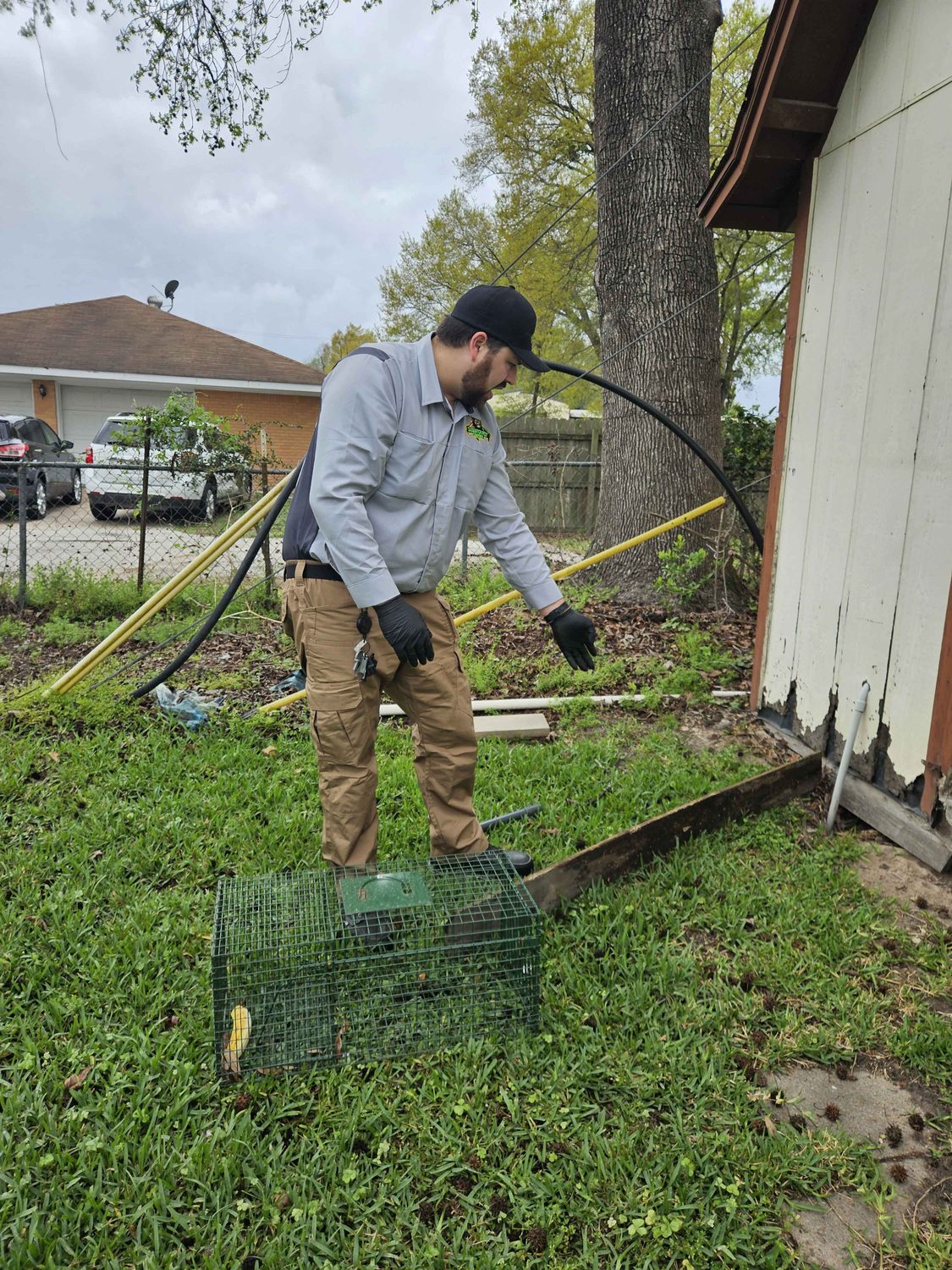
Some owners of larger properties prefer to handle an opossum themselves, and L-1907 speaks to that. In urban areas it rates cage traps as the most effective method and the one with the least risk to others, recommends a trap at least 10 by 12 by 36 inches, and notes that baiting with fruit such as apples, pears or bananas lowers the chance of catching a small dog or cat. Shooting and leghold traps are rural options only.
Two cautions go with that. First, the TPWD relocation rule above applies: moving a captured opossum to another property needs department authorization and the release landowner’s consent. Second, removing the animal without closing the den simply vacates a good home for the next one. On a north Houston lot with a creek or a greenbelt behind it, the next one is never far away.
A mother opossum may also be carrying young in her pouch or on her back, and young left behind under a deck do not survive on their own. That is a reason to confirm what is in the den before anything is closed off.
When it warrants treatment
- Passing through the yard: no treatment. Remove the food and it moves on.
- Denning under a deck, shed, porch or slab: yes. The den will be reused by this opossum or the next.
- Inside a garage, wall or attic: yes, and the entry needs repair.
What the work realistically involves
L-1907 notes that no toxicants, fumigants or repellents are registered for opossums. The work is removal and exclusion.
Our opossum control process begins with a free inspection to find den sites, the way in, any young, and the attractants drawing opossums to the property. The animal and any young are removed from the space, and how they are handled afterward is explained at the inspection within Texas rules. The opening is then sealed. Under decks, sheds and porches that usually means screening the open sides with mesh set into the ground so it cannot be pushed under, with the last section closed only once the space is confirmed empty. Den entries in a garage or attic may fall under exclusion and repairs. The work is covered by our 100% Service Guarantee.
Prevention
L-1907’s environmental control advice, which matches what works here:
- Keep lids on trash cans.
- Feed pets in the morning, pick up leftovers right away, and take water bowls in at night.
- Screen attic and foundation vents.
- Put bird feeders on tall metal poles away from trees.
- Pick up fallen fruit and pecans, and keep compost in a closed bin.
- Close in the open space under decks and sheds before something moves in.
Related pages
- Opossum removal and exclusion
- Raccoon removal and exclusion
- Exclusion and repairs
- Flea control, for pets in a yard opossums visit
- For a free inspection, use the contact page.
Frequently asked questions
Does an opossum in my yard mean I need to do anything?
Usually not. Opossums wander widely at night looking for food. Take away the easy meals, such as pet food, open trash and fallen fruit, and it will typically move on. A den under or inside a structure is the point where removal and exclusion make sense.
Do opossums carry rabies?
Texas A&M AgriLife's opossum leaflet says opossums can transmit rabies but appear very resistant to it. Heavy drooling and hissing are a defensive display and often mistaken for rabies. Any animal that bites someone should still be reported to local animal control.
Are opossums connected to typhus in Houston?
Texas DSHS lists opossums, along with rats and cats, among animals involved in flea-borne typhus, which has become established in the Greater Houston area. The risk comes through their fleas, so flea control on pets matters where opossums are common.
Can I just trap it and drive it to a park?
TPWD rules let landowners take nuisance furbearers, including opossums, on their own land, but relocating one requires department authorization and the release-site owner's consent. Removal without sealing the den opening also just leaves room for the next opossum.
Sources
- Texas Parks and Wildlife Department — Virginia opossum — read October 5, 2026
- Texas A&M AgriLife Extension Wildlife Services L-1907 — Controlling Opossum Damage — read October 5, 2026
- Texas Department of State Health Services — Flea-borne typhus — read October 5, 2026
- Texas Parks and Wildlife Department — Nuisance fur-bearing animals — read October 5, 2026
Next scheduled review of this page against its sources: October 5, 2027.
Pest problem in north Houston?
No long-term contracts, and service agreements are backed by our 100% Service Guarantee.
Because we are based in Spring, we can often come out the same or next day for urgent problems. Call before noon, Monday through Friday, for the best chance at next-day service.
Last updated