
Rock Pigeon in Spring and North Houston
Columba livia · Wildlife
The rock pigeon is the feral pigeon of rooflines, parking garages and signs. It is not native, and federal migratory bird protection does not cover it. A few birds on a wire need nothing. A roost or nest on a building warrants physical exclusion, because droppings damage finishes, foul HVAC equipment and can carry histoplasmosis spores.
Call 281-627-4810 Request a free inspection
Year-round protection plans from $70 Core · Premium · Legendary See the plans
Sometimes worth treating, sometimes not — it depends on what is below.
Rock pigeon at a glance
| Look | Stocky, usually blue-gray with two dark wing bars and an iridescent neck; many color variants |
|---|---|
| Origin | Not native; domesticated abroad and escaped to form feral flocks |
| Diet | Mainly grain and seed, including handouts and spilled feed |
| Roosts | Ledges, sills, rooflines, beams, signs, attics, steeples and parking structures |
| Federal status | On the USFWS list of non-native species not protected by the Migratory Bird Treaty Act |
| Texas status | Feral pigeons may be taken at any time, and nests and eggs destroyed |
| Habit | Stays in the same feeding and roosting areas day after day |
Signs you have them
- White droppings streaking a wall, sign or storefront below a ledge
- Flat, untidy stick-and-feather nests on beams, ledges or AC units
- Cooing and wing-claps from a roofline or under solar panels
- Feathers and droppings piled on a balcony, patio cover or parking garage beam
- Birds going in and out of a gable vent or gap in the eaves
A city bird that is not from here
Columba livia, also called the rock dove or feral pigeon, is so common on buildings that most people assume it belongs. Texas A&M AgriLife’s leaflet L-1919, Controlling Feral Pigeons, corrects that: pigeons are not native to the United States. They were domesticated in Europe, brought here, and some escaped to form feral populations that thrive on the shelter cities provide.
Around north Houston they gather where grain and shelter meet: shopping center rooflines, parking garages, highway overpasses, warehouses, feed stores, schools and older homes with open gable vents. Residential calls are fewer than commercial ones, but a pair nesting on top of a two-story porch or under a row of solar panels in Spring or Kingwood can be just as persistent.
Identification
Most rock pigeons are blue-gray with two dark bars across each wing, a dark tail band and an iridescent green-purple sheen on the neck, but feral flocks include checkered, white, reddish and nearly black birds. They are stocky, short-tailed and walk with a bobbing head. They roost and nest in groups.
Why identification comes first
Pigeon control is legal in a way most bird control is not, so getting the species right is the first step on any job.
The U.S. Fish and Wildlife Service’s 2005 notice of the final list of non-native bird species identified 125 introduced species exempt from the Migratory Bird Treaty Act, with the rock pigeon named among the well-known ones. Native doves and most other native birds are a different matter and are protected. A slim, long-tailed bird on the fence is not automatically a pigeon, and a nest on a light fixture may belong to a species nobody may disturb.
That is why this profile carries no lookalike links: the birds it is most likely to be confused with are not pests in this library, and many are protected.
Biology and season
L-1919 describes pigeons as primarily grain and seed eaters, especially common around grain elevators, dumps and parks where people feed them. They are creatures of habit: the leaflet notes they remain in the same feeding and roosting areas, which is why a flock on a building tends to stay until the building changes.
Because a flock keeps returning to the same ledges, a site that held a nest in spring tends to hold birds again later in the year unless something about the ledge changes.
Where it shows up
L-1919 lists lofts, steeples, attics and eaves as indoor roosts, and sills, ledges and rooflines as outdoor ones. On north Houston properties:
- flat ledges and parapets on retail and office buildings
- beams and ledges inside parking garages and covered loading docks
- sign cabinets and channel letters
- under solar panels on residential roofs
- gable vents and open eaves on older homes
- rooftop HVAC units and the gaps under them
Damage and health risk
Property. L-1919 says pigeon droppings damage the finish on cars and kill grass and ornamental plants. On buildings they stain masonry and storefronts, clog gutters and roof drains, and pile up around rooftop equipment. Nesting material packed into a vent or under panels blocks airflow and drainage.
Disease. The leaflet lists a long series of diseases pigeons play a part in transmitting, including histoplasmosis, cryptococcosis, salmonellosis, toxoplasmosis and ornithosis. The CDC’s histoplasmosis page explains the main mechanism: the fungus lives in soil and spreads in bird and bat droppings mixed into it, and people are infected by breathing the spores. It does not pass from person to person. L-1919 advises a face mask with a dust filter when working in enclosed pigeon roosts.
For a business, droppings at an entrance or over a walkway are also a slip and sanitation problem.
What the law allows
TPWD’s protected wildlife page states that European starlings, English sparrows and feral pigeons may be killed at any time and their nests and eggs destroyed. L-1919 says the same: pigeons are not protected in Texas.
Legal is not the same as recommended, though. L-1919 notes that poison grain baits for pigeons are restricted-use pesticides and generally not recommended in urban areas because of the danger to people and pets, and that city ordinances usually rule out shooting.
Trapping, gels and water: what else AgriLife describes
L-1919 covers more than barriers, and it is worth knowing what the other methods involve before choosing one.
- Repellent gels. Sticky chemical repellents applied to a roosting surface discourage pigeons for several months, the leaflet says, though they are messy to apply.
- Water. Spraying roosting pigeons with water can make them relocate, but only if it is done consistently for several days until every bird is gone.
- Traps. Because pigeons keep to the same feeding and roosting areas, they can be trapped there. L-1919 describes loft traps built from an attic or unused story, funnel traps of welded wire, and bob-type traps. It notes that captured pigeons wearing leg bands belong to someone and should be released or returned.
- Masks. Anyone working inside an enclosed roost should wear a dust-filtering mask because of histoplasmosis.
Trapping and baiting reduce the number of birds without changing the building, which is why a flock tends to rebuild on the same ledge. Our service sticks to physical exclusion for that reason.
When it warrants treatment
- Birds passing over, or a couple on a power line: no.
- A flock roosting on the same ledge, sign or garage beam: yes.
- Pigeons nesting in a vent, attic or under solar panels: yes, and the opening needs closing.
What control realistically involves
L-1919 favors physical methods. It recommends blocking access to indoor roosts with hardware cloth, wood, masonry, glass or metal, and fitting sharp metal prongs, often called porcupine wire, to sills, ledges and rooflines, which it describes as costly but effective. It calls noise devices usually ineffective, decoy hawks and owls of limited use, and ultrasonic devices questionable.
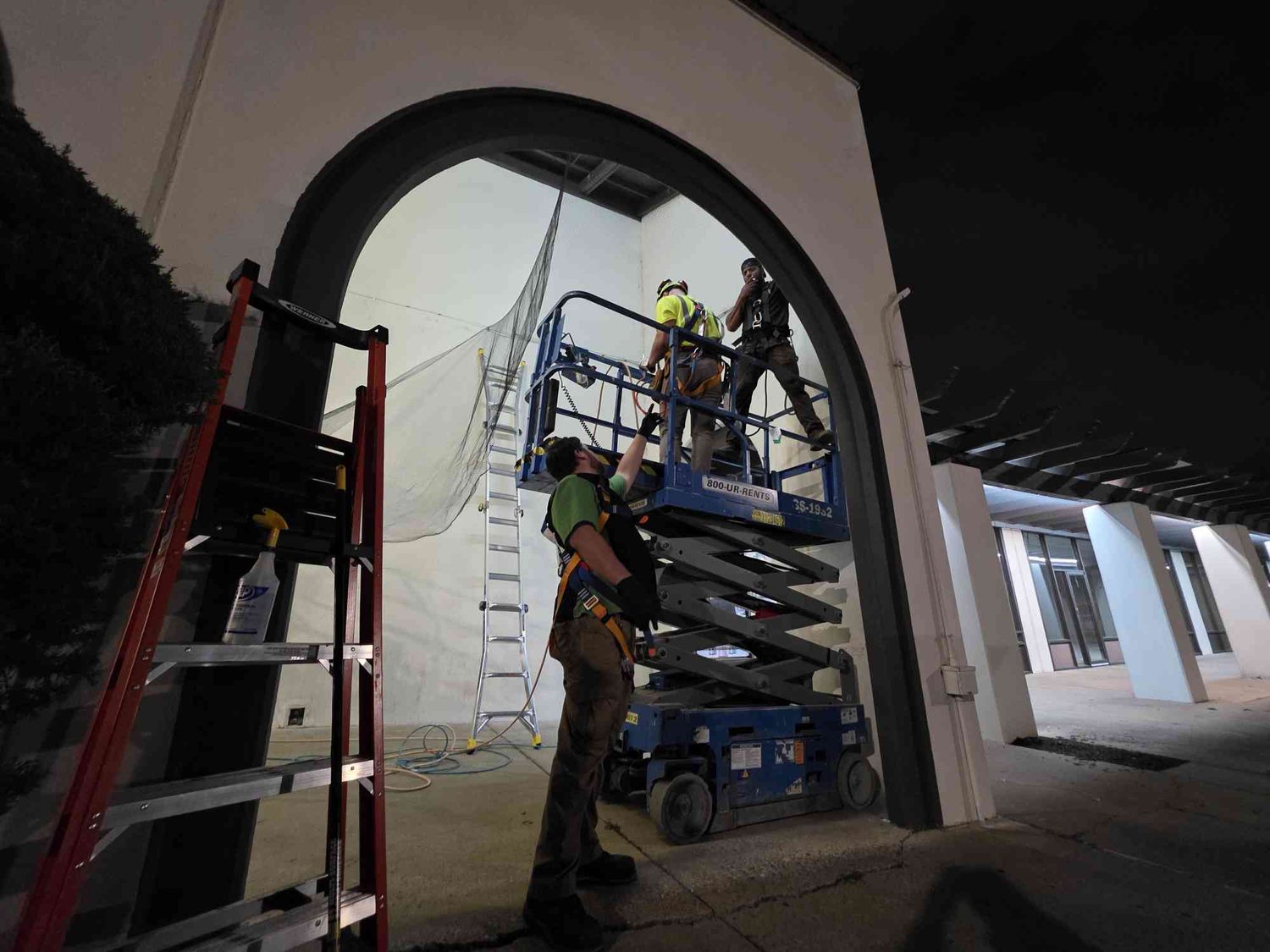
Our bird control service follows the same line and is entirely non-lethal. An inspection identifies the species, the roosting and nesting areas, and the entries into vents and attics. The plan matches the barrier to the bird and the surface: spikes on ledges and rooflines, bird wire on narrow perches, netting across open structures and garage bays, exclusion mesh around solar panels, and sealing of vents and gaps. Commercial accounts get monitoring and re-inspection. The pigeons on a roofline problem page goes through the typical residential and storefront cases. The work is covered by our 100% Service Guarantee.
Prevention
- Do not feed pigeons, and ask neighbors and tenants not to.
- Clean up spilled bird seed and pet food on patios and loading docks.
- Keep gable vents and soffit openings screened with sturdy mesh.
- Install panel guards when solar panels go on, before pigeons find the gap.
- Remove nests from ledges early, before a flock adopts the site.
- On commercial roofs, add roof drains, gutters and rooftop units to the routine maintenance list so droppings and nest material are cleared before they block anything.
Related pages
- Bird control
- Pigeons on a roofline
- Roofline and soffit gaps
- Retail, warehouse and parking structures: commercial
- For a free inspection, use the contact page.
Frequently asked questions
Are pigeons protected like other birds?
No. USFWS published a list of non-native species excluded from the Migratory Bird Treaty Act, and the rock pigeon is on it. In Texas, AgriLife's pigeon leaflet and TPWD both state that feral pigeons are not protected and may be taken at any time, along with their nests and eggs.
How do I know it is a pigeon and not a protected dove?
Pigeons are heavier and stockier, usually gray with dark wing bars, and gather in flocks on buildings. Doves are slimmer with longer tails. Because most native birds are federally protected, the species is confirmed before any control work starts.
Do the plastic owls and noise devices work?
Texas A&M AgriLife's pigeon leaflet says noise devices are usually ineffective because city pigeons are used to noise, that decoy owls and similar devices have limited use, and that ultrasonic devices are of questionable value.
Are pigeon droppings a health hazard?
They can be in quantity. The CDC says the fungus that causes histoplasmosis spreads in bird and bat droppings mixed with soil, and is caught by breathing spores. AgriLife advises wearing a dust-filtering mask when working around pigeon roosts in enclosed areas.
Sources
- Texas A&M AgriLife Extension Wildlife Services L-1919 — Controlling Feral Pigeons — read October 5, 2026
- U.S. Fish and Wildlife Service — Service publishes final list of non-native bird species — read October 5, 2026
- Texas Parks and Wildlife Department — Protected wildlife — read October 5, 2026
- CDC — About histoplasmosis — read October 5, 2026
Next scheduled review of this page against its sources: October 5, 2027.
Pest problem in north Houston?
No long-term contracts, and service agreements are backed by our 100% Service Guarantee.
Because we are based in Spring, we can often come out the same or next day for urgent problems. Call before noon, Monday through Friday, for the best chance at next-day service.
Last updated