
Mouse vs Rat: Telling Them Apart in a Houston Home
A house mouse weighs under an ounce, has a long thin tail and big ears, and leaves droppings about an eighth to a quarter inch long. Rats weigh five ounces or more and leave droppings half an inch or longer. Mice slip through dime-sized holes; rats need quarter-sized ones, and they avoid new traps longer.
Call 281-627-4810 Request a free inspection
Year-round protection plans from $70 Core · Premium · Legendary See the plans
Something chewed a corner off the bread bag, and there are small dark pellets behind the toaster. The first question is not how to get rid of it. The first question is what it is, because a mouse and a rat are close enough to confuse and different enough that the wrong guess wastes weeks.
Around Spring and north Houston there are three likely suspects: the house mouse, the roof rat and the Norway rat. All three are introduced Old World species that live alongside people. Here is how to sort them out from what you can actually see.
Mouse vs rat at a glance
| Clue | House mouse | Roof rat | Norway rat |
|---|---|---|---|
| Adult weight | Half an ounce to an ounce | 5 to 10 ounces | 7 to 18 ounces |
| Length with tail | 5 to 8 inches | 12 to 18 inches | 11 to 19 inches |
| Tail | Thin, nearly hairless, about as long as the body | Longer than head and body | Shorter than head and body |
| Ears | Large for the head | Big enough to reach the eyes when folded | Small; do not reach the eyes |
| Snout | Pointed | Pointed | Blunt |
| Droppings | 1/8 to 1/4 inch, pointed at both ends | Rat-sized, 1/2 inch or more | Rat-sized, 1/2 inch or more |
| Nests | Small and tidy, close to food | High: attics, walls, vines, trees | Low: burrows by slabs and sheds |
The weights and lengths come from Texas A&M AgriLife’s leaflet Controlling Rats and Mice (L-1916). The ear and snout details are from the University of California’s rat Pest Notes, and the droppings sizes are from the University of Arizona’s commensal rodents bulletin.
Size, and the young-rat problem
Weight is the cleanest split. An adult house mouse rarely tops an ounce. Even a lean roof rat weighs five times that, and a big Norway rat can push past a pound.
The catch is a half-grown rat, which can be mouse-sized. Arizona’s bulletin gives the tell: a young rat carries a head and feet that look too big for its body, and its tail is shorter than its head and body combined. A mouse is built in proportion, small head, small feet, tail running about the same length as everything in front of it. If what you saw looked clumsy and big-footed, assume a rat until proven otherwise.
Tail, ears and face
Tails separate the two rats from each other more than from mice. The roof rat’s tail runs longer than its body and is uniformly dark. The Norway rat’s is shorter than its body, dark on top and pale underneath.

Ears and noses help too. UC IPM describes roof rat ears long enough to cover the eyes when folded forward, paired with a pointed muzzle and large eyes. Norway rats have small ears that fall short of the eyes, and a blunt, heavy face. House mice, per UC’s house mouse Pest Notes, have relatively large ears and small black eyes on a small, pointed head.
Droppings tell you most of the time
Most people never get a clean look at the animal, so droppings carry the identification. Mouse pellets are tiny, an eighth to a quarter of an inch, and pointed at both ends. Rat droppings are a different scale, half an inch to a full inch, and blunt at one end, according to Arizona’s bulletin.
Where they turn up matters as much as the size. Mouse droppings scatter through drawers, along shelf backs and under sinks. Rat droppings tend to collect along runways: the top plate of an attic wall, the length of a garage shelf, the edge of a garage floor. Wear gloves, and wet droppings with disinfectant before wiping them up. Sweeping and vacuuming put the dust in the air.
Behavior: the curious one and the cautious one
Texas A&M AgriLife’s rodent IPM training sums up the difference in a few words. Mice are curious. Rats are smart, cautious and afraid of new things.
That shows up in daily life. A mouse investigates a new box in the pantry the night it arrives. A rat may walk around a new trap for days. UC IPM adds that this wariness of new objects seems stronger in roof rats than in Norway rats.
Range differs as well. The same training puts a mouse’s usual travel at 10 to 30 feet from the nest, while a Norway rat may roam up to 450 feet from its burrow. Mice can go without drinking daily and get much of their water from food; rats need roughly an ounce of water every day. A rat problem therefore often traces back to a leaking hose bib, a pet bowl or a pool, and a mouse problem to a pantry shelf a few feet from the nest.
Sounds and timing give clues. L-1916 notes mice squeal in their nests, while rats run and squeal even when nothing alarms them. Activity overhead after dark, especially in the two hours or so after sunset, points toward roof rats; see scratching in the walls at night for how to read those noises.
Entry gaps: dime versus quarter
The rodent IPM training puts entry sizes in coins. For a mouse, a dime-sized hole is enough, and so is a door with a quarter-inch gap underneath. For a rat, the threshold is a quarter-sized hole or a half-inch crack. UC IPM’s house mouse notes put it slightly differently, a gap a quarter inch tall or an opening three-eighths of an inch wide, which lands in the same place.
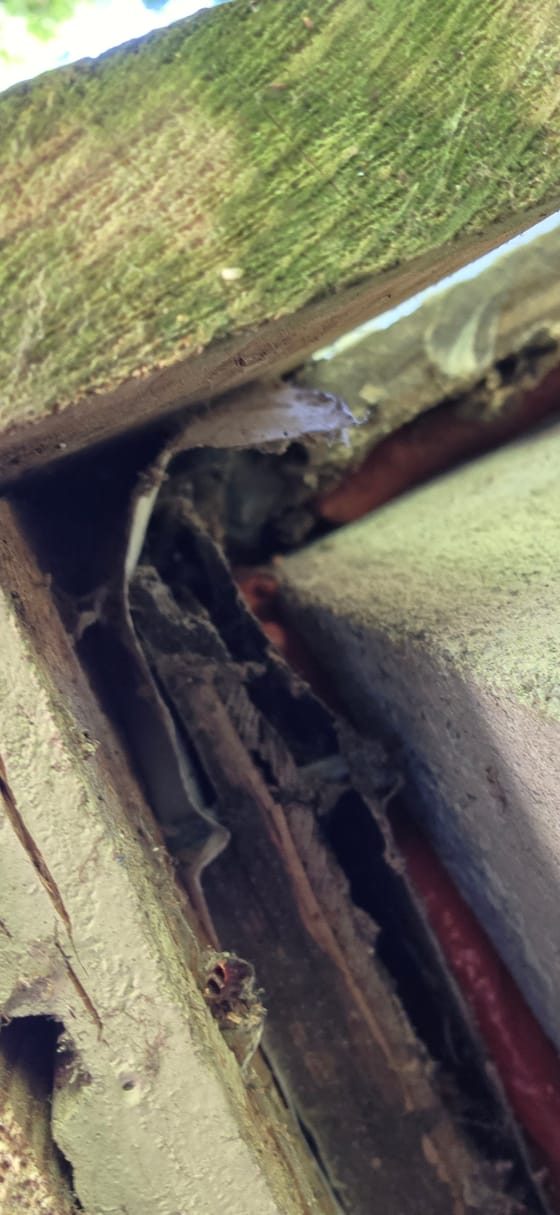
On a north Houston house, that means mice tend to come in low, through worn door sweeps, the garage door seal and the slots where pipes and lines enter. Roof rats come in high, through roofline and soffit gaps reached from live oaks, pines and fence tops. A gap that would never pass a rat can still be an open door for mice, so sealing for one is not the same job as sealing for the other.
Why the answer changes the fix
This is where mouse vs rat stops being trivia.
- Trap size. UC IPM warns that mice and young rats often will not trip a rat-sized snap trap, which is why it stresses knowing the animal before buying the trap.
- Trap timing. For mice, the rodent IPM training suggests many traps, about six per mouse and at least three feet apart, which can be set right away. For rats, it recommends leaving traps unset with food for one to two weeks so cautious animals learn to trust them.
- Trap height. UC IPM advises setting traps both on the ground and above it for roof rats, because they travel along shelves, rafters and pipes.
- Sealing scale. Mouse-proofing means quarter-inch gaps along the bottom of the house. Rat-proofing reaches the roofline, with hardware cloth and metal where edges get gnawed.
- Where to look. A nest high up is usually a roof rat, and one underground is almost always a Norway rat, according to L-1916. That tells you whether to start in the attic or along the slab.
Our rodent control service starts with that identification. A technician inspects inside and out, seals the gaps the inspection finds, sets traps along active runways, places tamper-resistant bait stations outside and comes back to check activity. For overhead noise specifically, the roof rats in the attic page goes further, and the roof rats in Houston post covers the season. If you want a deeper read on the three species, the profiles for the house mouse, roof rat and Norway rat are in the pest library.
Frequently asked questions
Is it a baby rat or an adult mouse?
Look at the head and feet. University of Arizona extension notes a young rat has a head and feet that are large for its body, and a tail shorter than its head and body. An adult house mouse looks dainty, with a tail about as long as the rest of it.
Can rats and mice live in the same house?
They can share a property, but Texas A&M's rodent leaflet points out that the two rat species rarely occupy the same building. In practice, a north Houston home usually has one main problem: mice in the kitchen and garage, or roof rats overhead.
Why do mouse traps not catch rats?
Size and caution. UC IPM says mice and small young rats often fail to trip a rat-sized snap trap, so a trap sized for the wrong animal can sit beside fresh droppings and catch nothing. Rats are also wary of new objects, so a trap may sit untouched for days before they will cross it.
How small a hole can a mouse get through compared with a rat?
Texas A&M AgriLife's rodent IPM training uses coins: a mouse can use a dime-sized hole or a door with a quarter-inch gap under it, and a rat can use a quarter-sized hole or a half-inch crack.
Are rat droppings more dangerous than mouse droppings?
Treat both the same way. Rodent waste of either kind can carry disease, and nobody can tell species apart from droppings alone well enough to judge risk. Ventilate the space, wear gloves, soak the droppings with disinfectant and wipe them up rather than sweeping.
Sources
- Texas A&M AgriLife Extension — Rodent IPM (Janet Hurley), read November 11, 2026
- Texas A&M AgriLife Extension Wildlife Services L-1916 — Controlling Rats and Mice, read November 11, 2026
- University of Arizona Cooperative Extension — Commensal Rodents (Bulletin 12), read November 11, 2026
- UC IPM Pest Notes — Rats, read November 11, 2026
- UC IPM Pest Notes — House Mouse, read November 11, 2026
Related posts
- Pest Trends in Greater Houston: Year in Review and What’s Coming Next
- Pigeon and Bird Problems: Why Houston Commercial Buildings Need Professional Bird Control
- Preventative Pest Control in Houston, TX: Why Getting Ahead Beats Reacting
- Raccoons, Opossums, and Squirrels in Houston: What Every Homeowner Needs to Know
- Rats vs. Mice in Houston: How to Tell Them Apart and What to Do About It
- Roof Rats and Rodent Control in Spring and Tomball, TX
Pest problem in north Houston?
No long-term contracts, and service agreements are backed by our 100% Service Guarantee.
Because we are based in Spring, we can often come out the same or next day for urgent problems. Call before noon, Monday through Friday, for the best chance at next-day service.
Last updated