
Mole Control for Lawns in Spring and North Houston
Moles in a north Houston lawn are eastern moles, the only species in Texas, and they are hunting earthworms and grubs, not eating your grass. We map which runs are active, then trap or bait along those runs with a product made to look like the earthworms moles eat, and follow up with trap checks until the tunneling stops.
Call 281-627-4810 Request a free inspection
Year-round protection plans from $70 Core · Premium · Legendary See the plans
Moles: the job at a glance
| What it covers | Eastern moles tunneling in residential lawns, flower beds and landscaped areas across Harris and Montgomery counties |
|---|---|
| Included | Mapping active runs, trapping or baiting placed along them, and follow-up trap checks |
| Not included | Lawn repair, regrading or re-sodding, and fixing sprinkler lines the tunneling disturbed |
| How long it takes | Depends on how many active runs there are and how many moles are using them; follow-up checks continue until activity stops |
| Best timing | At the first ridges, especially in spring and fall when moles are most active on damp, cloudy days |
| What it costs | Free visit to count the active runs, then a written price before trapping or baiting begins |
What is digging up your lawn
There is exactly one mole in Texas. Texas A&M AgriLife Extension’s guide to managing mole damage identifies it as the eastern mole, Scalopus aquaticus: about seven inches long, around four ounces, gray-brown, with broad, shovel-like front feet webbed to the base of the claws. Most people never see one. They see what it leaves behind.
Moles are insectivores. Our approach starts from the same point the extension makes: understanding what a mole eats is the key to getting rid of it, and what it eats is mainly earthworms, with grubs, beetles and other larvae on the side. AgriLife puts their daily intake at 70 to 100 percent of body weight, which is the reason one animal can cover so much ground. A mole that needs to eat close to its own weight every day keeps digging.
Why north Houston lawns attract moles
The things that make a Spring or Tomball lawn look good are the same things a mole likes. Irrigated St. Augustine over moist soil, mulched beds kept damp by drip lines, and the heavy organic layer under a mature lawn all support earthworms, and earthworms bring moles. After a wet spell the soil softens and worms move up toward the surface, so surface tunneling often shows up a day or two after rain or a heavy watering cycle.
AgriLife notes that moles are most active on damp, cloudy days in spring and fall. That matches what homeowners report here: a burst of fresh ridges in March and April, a quieter stretch in the hottest, driest part of summer when worms go deeper, and a second round when fall rains return.
Telling a mole from a gopher or a vole
Getting the animal right matters, because the methods differ.
- Moles leave raised ridges just under the turf, plus round, volcano-shaped mounds of loose soil pushed up from deeper tunnels. There is no open hole.
- Pocket gophers leave fan- or crescent-shaped mounds with a soil plug on one side. Surface ridges are rare. They eat roots and plants, which moles do not.
- Voles make shallow runways on top of the soil, under the grass, and often leave small open holes. They feed on plants and bark.
- Armadillos dig shallow, cone-shaped holes while rooting for grubs, usually overnight, and do not leave ridges.
AgriLife’s guide describes the two kinds of mole tunnel. Surface runways are feeding tunnels made as the mole hunts. Deeper tunnels, three to twelve inches or more down, are the travel routes and living space, and the mounds are the soil pushed up from digging them. Some surface runs are used once and abandoned; the main travel routes are used again and again.
How we handle moles
Our method is built around one idea: work the runs that are active, not the whole yard.
- A free look at the lawn. The first visit is about counting active runs and figuring out where the moles are traveling. That tells us how many animals we are likely dealing with and where to focus.
- Find the active runways. Ridges are pressed flat and checked later. AgriLife’s guidance is that active runways are raised again by the next morning. The ones that come back are where the work goes.
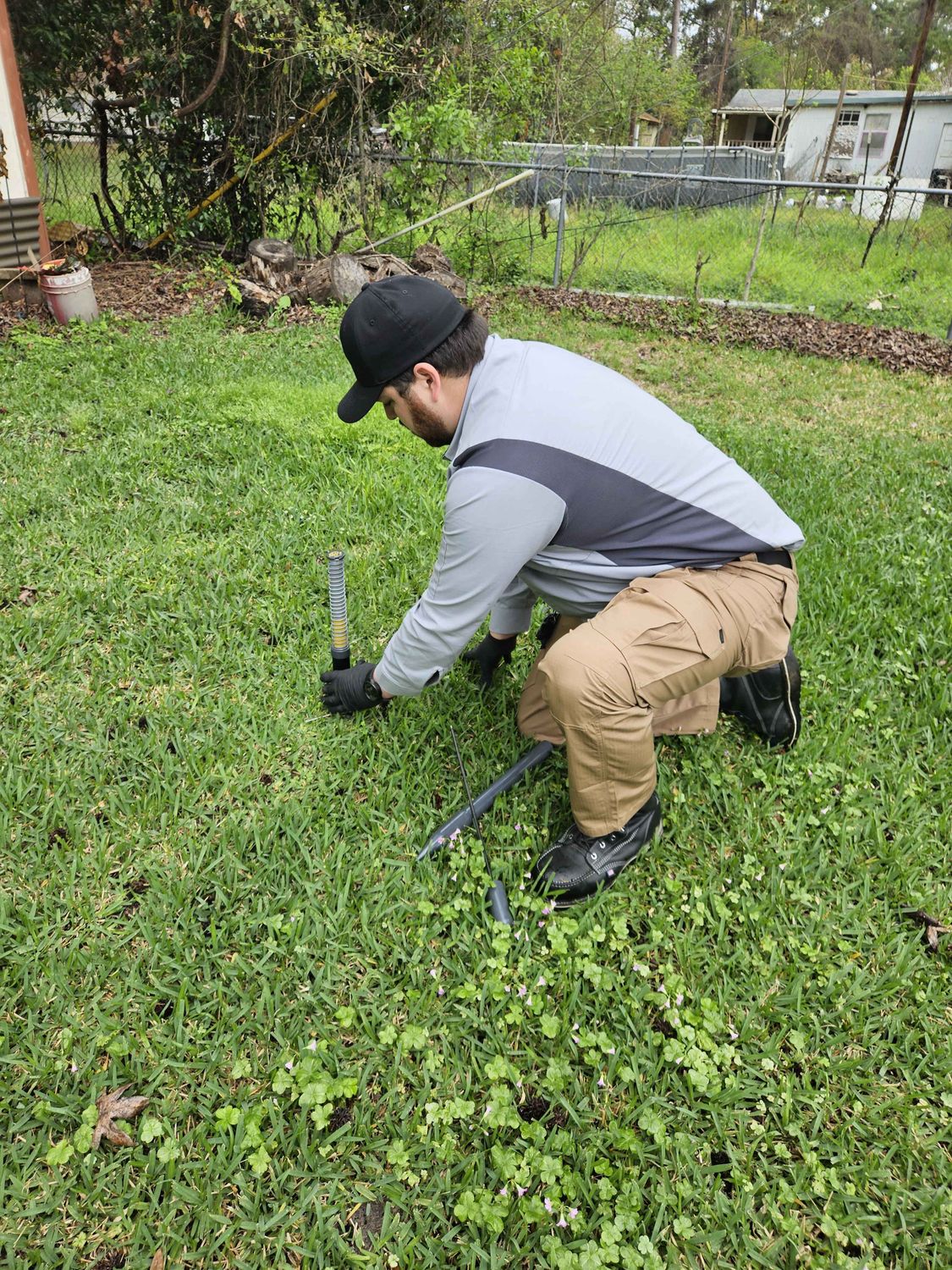
- Trap or bait along those runs. Depending on the yard, the owner traps, baits with a product shaped and formulated to mimic the earthworms moles feed on, or uses both. AgriLife explains why mole traps are a specific design: a mole that meets an ordinary trap tends to back up and burrow around it, but it will push through a plug of soil in its tunnel, which is what harpoon and choker loop traps are built around.
- Follow-up trap checks. Traps are checked and reset, baited runs are rechecked, and new activity gets new placements. This continues until the tunneling stops.
- Ongoing service if you want it. The owner offers recurring mole maintenance, and it can be combined with quarterly pest control for the house, so new activity is caught before it spreads across the yard.
What we do not do is sell a granule broadcast across the lawn as a mole cure. AgriLife is plain that poisoning moles with grain baits is usually not effective because moles do not normally eat grain. Some fumigants are registered for moles, but the extension guide notes they may be restricted-use products and work best in deep burrows rather than surface runs.
Why placement decides the result
Most failed mole control is a placement problem, not a product problem. A trap or bait set in a tunnel the mole has abandoned will sit there indefinitely, and the homeowner concludes nothing works. That is why the first visit is spent working out the layout of the runs rather than setting gear in the most damaged spot.
The best spots tend to be predictable once you know how moles use a yard. Straight runs that connect two areas, such as a path along a fence or the edge of a bed, are usually main travel routes and get reused. The meandering ridges in the middle of the lawn are often feeding tunnels used once or twice. A run that keeps coming back after it is pressed down, especially one near a mound, is where the effort pays.
Disturbing the tunnel as little as possible also matters. A mole that finds its runway badly caved in may simply dig around the spot, which is the same behavior AgriLife describes when moles meet an ordinary trap. Placement is done carefully, the turf is put back over it, and the location is marked so follow-up checks find it again.
What a follow-up visit involves
Follow-up trap checks are part of the service, not an add-on. On each one the technician checks and resets traps, rechecks baited runs, presses down fresh ridges to test them, and moves placements if activity has shifted. When the runs stay flat and no new mounds appear over a few checks, the job is done. If you are on recurring maintenance, later visits watch for a new mole moving into the old network, which happens because a good run system does not stay empty for long.
The signs, and what each means
- Fresh, raised ridges after rain. A mole feeding near the surface. Check whether the ridge comes back after being pressed down.
- Round mounds of loose soil. Deeper tunneling nearby; the mound marks where soil was pushed up from a travel route.
- Spongy ground underfoot. A network of shallow runs under the turf.
- Grass dying in lines. Roots lifted away from soil by the tunnel, so the grass dries out along the run.
- Plants in a bed heaving or wilting. A run passing under the root zone.
- Ridges along a sidewalk, fence or bed edge. These edges are often main travel routes and good placement spots.
Sprinklers, beds and the edges of the lawn
Irrigation is the detail that comes up on almost every mole visit in north Houston. Sprinkler zones that run every day keep the top few inches of soil soft and full of worms, and moles follow the wettest zones. Tunnels sometimes follow buried lines through the looser backfill of the trench, and a mole working along one can disturb heads and drip tubing. If you are seeing ridges that track a sprinkler line, mention it, because it helps with placement and because the line may need a check once the moles are gone.
Beds are the other hot spot. Mulched beds stay damp, and the worms under them draw moles in from the lawn. Runs along a bed edge are often well-used travel routes, which makes them good places to work.
What waiting costs
Moles do not move on because the lawn is torn up. Their food is still there. AgriLife describes the damage as mostly root dislocation from tunneling, which can disfigure lawns, destroy flower beds and tear up grass roots. The longer a mole works a yard, the more of it becomes tunnel, and old runs can be reused by the next mole that finds them. Lawn repair after a long infestation means filling, leveling and often re-sodding, which costs more than getting control early.
Homes, and where this service applies
This is a residential service, aimed at lawns, beds and landscaped yards. If you manage a property with large turf areas and a mole problem, contact us and describe the site; larger grounds are scoped on a visit. For pest work inside commercial buildings, see our commercial page.
What you can do yourself
These come from the AgriLife guidance and from what keeps a yard less inviting:
- Water deeply and less often. Constantly wet soil pulls earthworms up and makes tunneling easy.
- Press runs down and watch them. It costs nothing and tells you whether activity is spreading or fading.
- Protect high-value beds with a barrier. AgriLife describes burying sheet metal or hardware cloth about twelve inches deep with a ten-inch outward bend at the bottom, which is practical for a small bed and not for a whole lawn.
- Treat grubs where the lawn actually has them, knowing it will not on its own end mole activity.
- Skip the gadgets. Sonic stakes, castor oil and household remedies have a long record of disappointing people.
- Call early. One mole in a few runs is a far smaller job than a network that covers the back yard.
A word on the 100% Service Guarantee
Mole work is covered by our 100% Service Guarantee under the terms on that page, which means re-service at no added charge if covered activity returns between scheduled visits. It does not cover repairing turf or irrigation the moles already damaged, and it depends on conditions the technician flags, like overwatering, being corrected.
Related services
Moles are not the only thing digging around a north Houston house. If the activity is in the attic or walls, it is a job for rodent control. Animals under a deck or shed are covered under opossum removal and exclusion, and anything getting into the house itself starts with exclusion and repairs. Fire ant mounds that come up in the same lawn belong to ant control.
Where we work
We handle mole problems across Harris County and Montgomery County, including Spring, Tomball, Magnolia, Cypress, Champions and The Woodlands.
Frequently asked questions
Is it a mole or a gopher?
Look at the mound and the surface. Moles push up raised ridges that wander across the lawn, along with round mounds of loose soil. Gophers leave fan-shaped mounds with a plugged hole off to one side and rarely make surface ridges. Voles leave open runways on top of the grass rather than under it.
Will killing the grubs make the moles leave?
Not by itself, and sometimes not soon. Earthworms make up much of a mole's diet, so a lawn with no grubs still feeds them. Texas A&M AgriLife Extension also warns that moles may dig more for a while as they search for food after soil insects are reduced. Grub control is a reasonable part of a plan, not the whole plan.
Do castor oil, sonic stakes or chewing gum work?
We find these remedies give little lasting control, and the extension guidance points the same way: traps placed in active runs are the dependable method. Grain-based poison baits are also a poor choice, because moles normally do not eat grain. Worm-shaped baits made for moles are a different product.
How do I know which tunnels are active?
Step a few ridges flat in the evening and look the next morning. Texas A&M's guidance says the runways a mole is still using will be raised again by then. The ones that stay flat are old travel routes or abandoned feeding tunnels and are not worth setting on.
Are moles a danger to my family or pets?
Not in the way rodents in a house can be. Moles live almost entirely underground and are not a household health concern. The problems are a torn-up lawn, damaged roots in beds, loose soil around sprinkler lines and soft ground that is easy to turn an ankle in.
Our largest service areas
Mole Control in north Houston?
No long-term contracts, and service agreements are backed by our 100% Service Guarantee.
Because we are based in Spring, we can often come out the same or next day for urgent problems. Call before noon, Monday through Friday, for the best chance at next-day service.
Last updated