
Jumping Spiders in Texas: The Small Black Spiders That Jump
The small black spider with white spots that hops along a Houston window sill is very likely a jumping spider, and a common one is the bold jumper, Phidippus audax. Jumping spiders hunt insects by day, spin no catching web and are harmless to people. The Missouri Department of Conservation calls the bold jumper's bite harmless.
Call 281-627-4810 Request a free inspection
Year-round protection plans from $70 Core · Premium · Legendary See the plans
If a small, fuzzy black spider has ever hopped onto your hand from a fence rail, or watched you from the corner of a window frame and then turned its whole body to keep you in view, you have met a jumping spider. Around Houston homes they are a common daytime sight on window frames and fences, and they are among the least worth worrying about.
Black spiders that jump: the bold jumper
When people describe black spiders that jump, they are usually describing the bold jumper, Phidippus audax. It belongs to the jumping spider family, Salticidae, and it is common across most of the United States. The University of Arkansas Arthropod Museum describes it as widespread from southeastern Canada and the eastern United States into the West, and the Missouri Department of Conservation’s field guide says it is found in much of the country.
What to look for:
- A fuzzy, mostly black body. The front section is often solid black or reddish brown and can look larger than the oval abdomen.
- Spots on the back. Usually a large central spot on the abdomen with smaller spots behind it. MDC says the spots are often white but can be orange or reddish, and the Arkansas museum notes juveniles often have orange spots that turn white as they mature.
- Shiny green or blue mouthparts. The bases of the fangs are iridescent, metallic green in most descriptions. Catch them in sunlight and they flash.
- Small size. MDC gives females a body of a quarter to three-quarters of an inch and males usually under half an inch. The Arkansas museum says the species averages about half an inch, with some in Texas and Mexico reaching closer to 0.8 inch.
Its habits match where Houston homeowners see it. MDC lists broad-leafed plants in open areas, tree trunks, fence posts and house siding. The Arkansas museum adds gardens, old fields and open woodland, as well as around and inside homes.
How jumping spiders hunt
Texas A&M AgriLife’s Spiders (E-408) describes jumping spiders as stocky, territorial daytime hunters with excellent vision. They have eight eyes, including one large pair at the front. That forward-facing pair is what gives them their look of paying attention.
They do not wait in a web. A jumping spider stalks, then leaps onto its prey and overpowers it. Before each jump it lays down a dragline of silk, a safety line, and E-408 notes you can sometimes see one dangling from that thread after a leap that missed. MDC adds that the bold jumper walks with jerky movements, jumps remarkable distances relative to its size, and uses silk mainly for that safety line and for small retreats where it hides and guards eggs.
The menu is insects and other spiders. MDC lists true bugs and caterpillars as preferred prey, and the Arkansas museum calls the bold jumper a common predator of many crop pests. On a house in Spring or Klein, that usually means flies, gnats and small moths around windows and lights.
Other jumping spider species you may see
The bold jumper is the one people ask about, but it is not the only member of the family in Texas. E-408 describes jumping spiders as a group that comes in many colors: browns, grays and black, brilliant red and yellow, and metallic or iridescent greens, blues and coppers. Some have conspicuous black and white bands on the body or legs. Males tend to be especially ornate and use their colors in courtship displays, waving their front legs to attract a female.
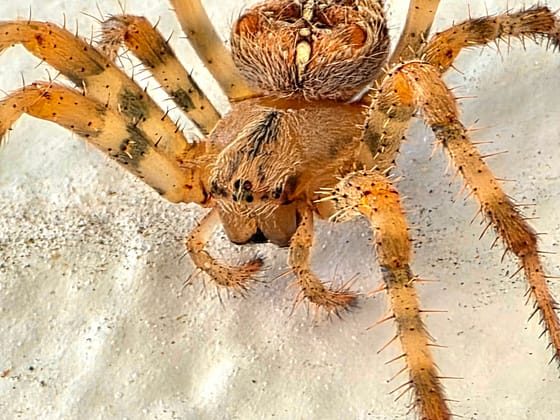
You do not need to identify a jumping spider to species to know what to do about it. If it is compact, has that large pair of front eyes, moves in short hops and is out hunting in daylight, it belongs to this harmless family.
Are jumping spiders dangerous?
No. E-408 says that despite their startling jumps, jumping spiders are unlikely to bite unless cornered or handled. MDC goes further for the bold jumper specifically: it can bite if squeezed or otherwise molested, and the bite is harmless. Neither source treats them as a medical concern.
That is different from the two groups of spiders in Texas that are medically significant, the recluses and the widows. A brown recluse is plain tan with six eyes and hides in boxes. A southern black widow is glossy black with a red marking underneath and hangs in a messy web near the ground. A small, spotted black spider hopping along a window screen in daylight fits neither description. For a side-by-side on the whole cast, see spiders in Texas.
If anyone does get bitten and has more than a mild local reaction, or you are unsure what bit them, see a doctor.
Do jumping spiders need treatment?
Usually not. Jumping spiders are harmless to people, and E-408 describes them as territorial hunters that work by day, so the one on the windowsill is most likely there for the gnats and flies gathered at the glass. Removing it by hand or with a vacuum is all most homes need.
When people do see a lot of them indoors, it tends to point to a few things worth fixing:
- Torn window screens or loose frames. E-408 recommends keeping weather stripping and seals around doors and windows in good repair.
- Insects gathering at lights. Lit doors and windows pull in flying insects, and the spiders follow. AgriLife suggests pointing lights away from doors, turning them off when not in use or switching to yellow bug lights.
- Vegetation against the walls. Shrubs and vines touching the siding give spiders and their prey an easy bridge.
To move one out, AgriLife’s cup method works: cover the spider with a cup, slide a sheet of paper underneath, and release it outside. A vacuum is fine too.
Our spider control service is built for situations that warrant it, such as recluses in the garage, widows around the meter box, or a heavy load of spiders and the insects feeding them. If the only spiders you are seeing are jumpers, the honest advice is that you probably do not need us for them. If you are seeing large, hairy spiders running across the floor at night instead, the are wolf spiders dangerous? post is the next read.
Frequently asked questions
Do jumping spiders bite?
Rarely. Texas A&M AgriLife says jumping spiders, like most spiders, are unlikely to bite unless cornered or handled. The Missouri Department of Conservation says the bold jumper can bite if squeezed or otherwise molested, but the bite is harmless.
Why does a jumping spider turn to look at me?
Because it can see you. AgriLife notes jumping spiders have excellent vision for hunting, with eight eyes including one large pair facing forward. They track movement and will swivel to face something nearby, which is part of why people find them oddly charming.
What are the shiny green mouthparts on a black jumping spider?
Those are the chelicerae, the bases of the fangs. On the bold jumper they are iridescent green or blue, according to the Missouri Department of Conservation, and the University of Arkansas Arthropod Museum describes them as metallic green.
Do jumping spiders need to be treated?
Almost never. They hunt flies and other small insects, and the bold jumper's bite is described as harmless. If many are showing up indoors, the useful question is what insects are drawing them and how they are getting in, not how to kill the spiders.
Sources
- Texas A&M AgriLife Extension — Spiders (E-408), read November 11, 2026
- Missouri Department of Conservation Field Guide — Bold Jumper, read November 11, 2026
- University of Arkansas Arthropod Museum — Bold jumping spider, read November 11, 2026
Related posts
- Are Kissing Bugs in Texas? How to Identify One and What to Do Next
- How Houston Landlords and Renters Should Handle Spring Pest Outbreaks
- Love Bugs in Texas: A Houston Guide to the Twice-a-Year Swarm
- Mosquito Control in Houston, TX: What Actually Works in This Climate
- Mosquito Control in Spring and Tomball, TX
- Mouse vs Rat: Telling Them Apart in a Houston Home
Pest problem in north Houston?
No long-term contracts, and service agreements are backed by our 100% Service Guarantee.
Because we are based in Spring, we can often come out the same or next day for urgent problems. Call before noon, Monday through Friday, for the best chance at next-day service.
Last updated