
House Flies Around the Doors in Spring and North Houston
House flies gathering at a door or a patio rarely breed inside the house. They come from garbage, pet waste, compost or a dumpster somewhere nearby, most within half a mile to a mile, and slip in when the door opens. Finding and cleaning up that outdoor source matters more than anything sprayed in the kitchen.
Call 281-627-4810 Request a free inspection
Year-round protection plans from $70 Core · Premium · Legendary See the plans

What to do, in order
- Walk the yard and the side of the house for the nearest bin, compost pile, pet waste or dumpster pad.
- Pick up dog waste daily and keep outdoor trash and recycling bins closed, rinsed and away from the door.
- Repair torn screens and fit sweeps or weatherstripping where daylight shows around exterior doors.
- Keep doors shut rather than propped open while the source is being cleaned up.
- Use a fly swatter for the odd one indoors instead of fogging the room.
- If large shiny flies or maggots appear inside, look for a dead animal in the attic or a wall and call us.
What it usually turns out to be
The quarter-inch gray fly with dark stripes on its back, landing on the screen door and diving in the moment it opens, is the common house fly. Texas A&M AgriLife’s publication on indoor flies and their control calls it an outdoor fly that does not bite, and generally not an important indoor pest unless doors or windows are poorly screened or left open.
House flies breed in decaying organic matter. AgriLife names livestock manure and garbage, poorly kept dumpsters and garbage cans, compost that is not managed properly, and nearby livestock or compost operations. In a north Houston subdivision the usual culprits are smaller and closer: a trash can that has not been rinsed since spring, dog waste in a side yard, a compost bin that stays wet, a neighbor’s chicken run or the dumpster behind a strip center across the fence.
Heat makes it worse. AgriLife says the life cycle takes about 45 days at 60 degrees and only 7 days at 95. Adults live up to three weeks. A source left alone through a Gulf Coast July can turn over a new generation every week.
The lookalikes
- Blow flies are larger and shiny blue or green. Indoors they almost always mean an animal has died in the attic, a wall or a chimney. AgriLife says new flies keep appearing for one to three weeks, and the house should be checked for the opening the animal used.
- Flesh flies are big and gray with black stripes, sometimes with a red tip on the abdomen, and they come for the same reason as blow flies.
- Fruit flies and other small flies are an eighth of an inch or less and breed indoors. Those are covered on the fruit flies in the kitchen and drain flies in a bathroom pages.
How to tell where they are coming from
Start at the door where flies are worst and walk outward. Look at anything within a short flight that smells or stays wet: bins, the grill grease tray, pet areas, compost, mulch beds that stay soggy under a dripping AC line, and the corner of the yard where grass clippings get piled. AgriLife notes house flies can travel as far as 20 miles, but most stay within half a mile to a mile of where they bred. On a typical lot, that means the source is on your property or one of the next few.
If the flies are big and metallic rather than gray, and you also see wandering maggots on the floor or a smell from a wall, stop looking outside. That is a carcass inside the structure, which is a different job.
What we do
Our method for house flies is below. The rest of the fly service is described on our fly control page.
- Inspect for breeding and resting sites around the structure, from bins and dumpster pads to damp mulch and exterior drains.
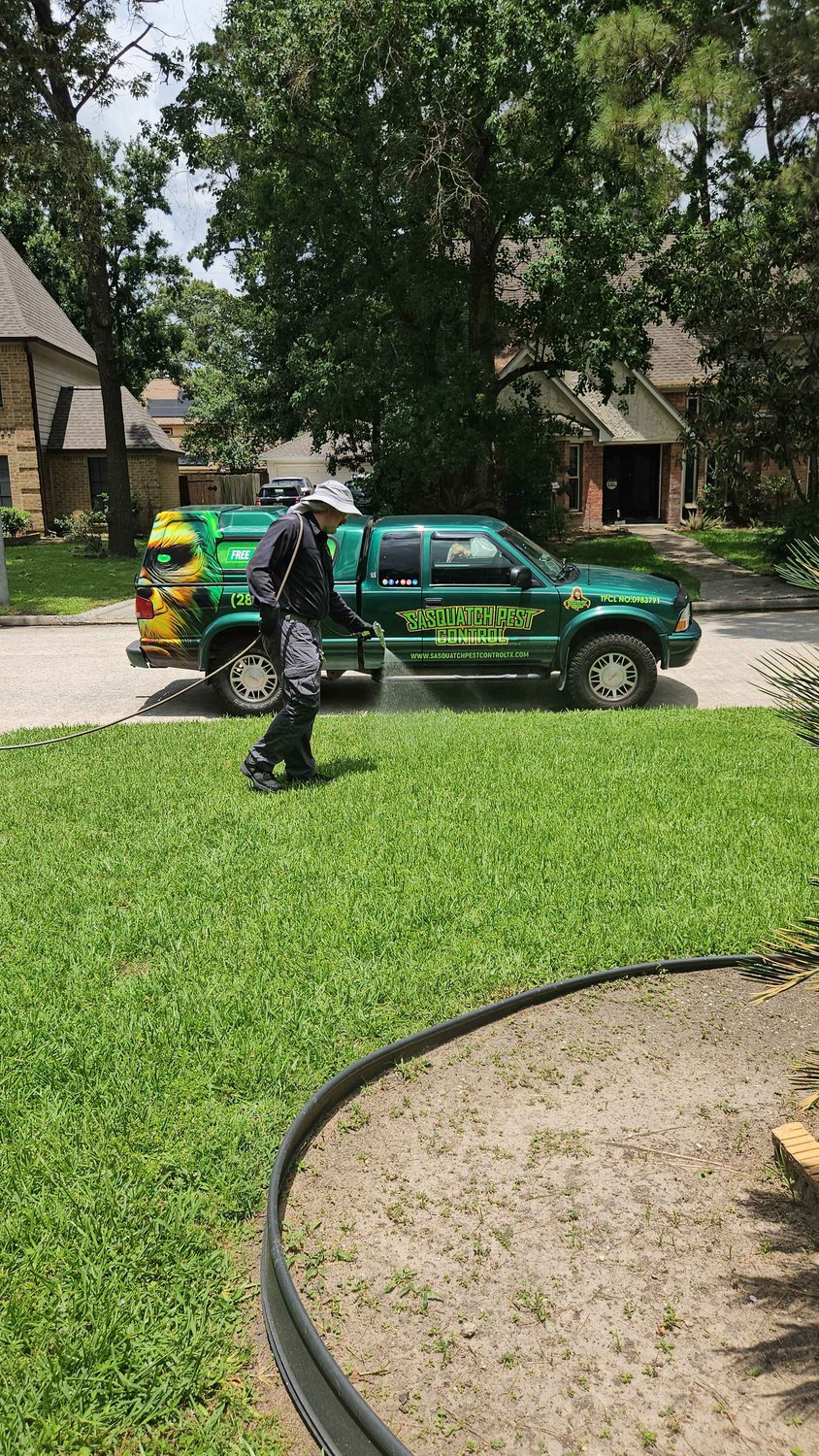
- Treat resting surfaces with a targeted residual spray, the walls, eaves and door frames where flies sit in the sun.
- Place fly baits where they feed, following the label.
- Set monitoring or light traps where they will help, particularly in commercial spaces.
- Address the larval source with sanitation guidance and, where a source cannot be removed, a larvicide.
- Schedule follow-up visits to knock down remaining adults and break the breeding cycle.
Work is covered by our 100% Service Guarantee; the terms are on that page.
Homes and businesses
At a house, the fix is usually a bin, a pet area and a screen. At a restaurant, a grocery or a building with a loading dock, the source is often the dumpster pad and the grease bin, and the flies follow deliveries in. AgriLife notes that commercial sites usually rely on insect light traps and that automatic air curtains over doorways help cut down the number of flies getting in. If you run a food business, see our commercial page for how service is set up.
When to call
Clean up the obvious source first and fix the screens. Call if flies are still crowding the doors after a week or two, if the source is somewhere you cannot reach or control, such as a neighboring property or a dumpster you do not manage, or if you are seeing large shiny flies and maggots indoors. A dead animal in the attic usually also means an opening that let it in; our exclusion and repairs page covers sealing those. For a free inspection, use the contact page.
Frequently asked questions
Why are there so many flies at my back door and not the front?
Flies gather where the smell is. The back door is usually closer to the trash, the pet area and the grill, and it gets opened more often. Texas A&M AgriLife says most house flies stay within half a mile to a mile of where they bred, so the source is usually close.
Are house flies a health concern?
They can be. AgriLife says house flies are thought to carry more than 100 diseases and that they constantly deposit feces and regurgitate on surfaces. That is why health departments consider them unsanitary in a restaurant or any food business.
Can I just spray the doorway?
A residual product labeled for outdoor fly control can help at entryways, and that is one of the things we do. Many labels now restrict spraying pavement or surfaces that drain onto it, to keep runoff out of storm drains. A spray without a source fix only buys a short break.
What about bug zappers?
AgriLife advises against using high-voltage outdoor zappers indoors, because they scatter insect fragments. Businesses use insect light traps mounted four to six feet off the floor and placed so they are not visible from outside, which keeps them from drawing more flies in.
Fly & Gnat Control in north Houston?
No long-term contracts, and service agreements are backed by our 100% Service Guarantee.
Because we are based in Spring, we can often come out the same or next day for urgent problems. Call before noon, Monday through Friday, for the best chance at next-day service.
Last updated