
Odorous House Ant in Spring and North Houston
Tapinoma sessile · Ants
The odorous house ant is a small, native brown ant that trails into kitchens and bathrooms and smells like rotten coconut when crushed. It does not sting or damage the house. It warrants treatment once it is trailing indoors, because city colonies grow into many linked nests that a store-bought spray tends to scatter rather than kill.
Call 281-627-4810 Request a free inspection
Year-round protection plans from $70 Core · Premium · Legendary See the plans
We treat this, and finding it usually warrants treating.
Odorous house ant at a glance
| Worker size | About an eighth of an inch; every worker the same size |
|---|---|
| Color | Brown to dark brown |
| The test | A sharp rotten-coconut smell when a worker is crushed |
| Antennae | Twelve segments with no club at the tip |
| Sting or bite | Neither, per Texas A&M's household ant table |
| Nest | Soil under stones, boards and mulch; indoors in walls and under floors |
| Foods indoors | Sweets, meats and dairy |
Signs you have them
- A steady single-file trail of small brown ants along a counter edge, sill or baseboard
- A coconut-like or rancid smell when ants are wiped up
- Ants active in daylight as well as at night
- Trails coming from a gap at a window frame, outlet or slab joint after heavy rain or a dry spell
- Several separate trails in different rooms that all seem to start at once
A native ant that does better in town than in the woods
Tapinoma sessile is a North American native. Texas A&M’s Urban and Structural Entomology Program, in its odorous house ant profile, says it occurs throughout the United States, from Canada to Mexico, though it is scarce in the southwestern deserts. It nests on sandy beaches, in open fields, woodlands, bogs and, inevitably, in houses.
The detail that matters for anyone in Cypress or Champions is the difference between wild and urban colonies. The same profile explains that in natural habitat a colony tends to be small, in a single nest, under one queen. In towns and cities the colonies are several orders of magnitude larger, spread across multiple nests and headed by multiple queens. The ant in a suburban flower bed is, in practice, a different problem from the ant in a pine forest.
How to identify it
The profile gives the workers as brown, about an eighth of an inch long and all one size. Under magnification the antennae have twelve segments with no club at the end.
The quickest field test is the one that gives the ant its name. Texas A&M’s native ant page describes a pungent “rotten coconut” smell when the ant is crushed. Wipe a few off the counter with a paper towel and smell it. Few other small household ants do this.
Texas A&M’s household ant guide, B-6183, adds that the workers are active during the day, which helps separate them from species that forage mostly after dark. Its comparison table lists the odorous house ant as neither stinging nor biting, following trails, and rarely swarming.
What it gets confused with
- Red imported fire ants. B-6183 notes the two look somewhat alike. Fire ant workers vary in size on one trail, build lawn mounds and sting. Odorous house ant workers are uniform, rarely build anything you would call a mound, and smell when crushed.
- Ghost ants. Smaller still, with a dark head and thorax and a pale, almost see-through abdomen and legs. A ghost ant trail is hard to see at all; an odorous house ant trail is plainly brown.
- Pharaoh ants, the light tan to reddish ant B-6183 calls the one most often seen indoors in Texas, are also tiny and trail to sweets but are paler and do not have the smell.
Biology and what the Houston weather does to it
Colonies range from a few hundred to 10,000 ants and usually carry several queens, according to the Texas A&M profile. Winged reproductives appear only once a colony is four or five years old. Development from egg to adult runs through an egg stage of 11 to 26 days, a larval stage of 13 to 29, and a pupal stage of 10 to 24, faster in warm months.
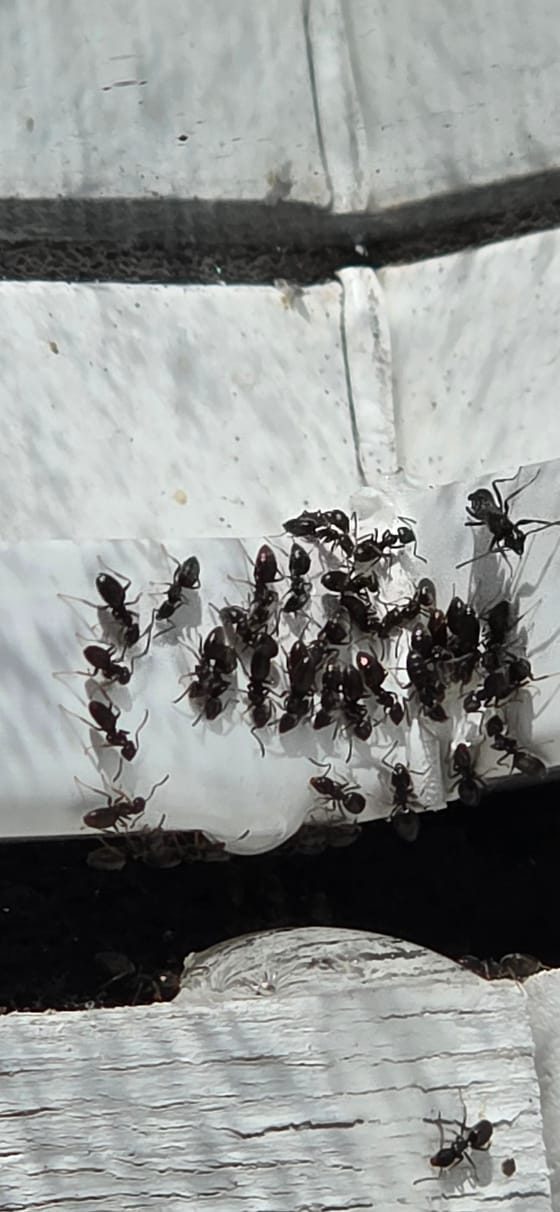
The trait that defines this ant is mobility. The profile describes nests that are not well structured and colonies that move often. B-6183 adds that ant colonies of this kind may move indoors when the weather is abnormally hot and dry or very wet, and can relocate almost overnight. North Houston supplies both extremes: a three-week August drought, then a tropical downpour that floods every bed along the slab. Both push foragers, and sometimes whole nests, inside.
Where it shows up
Outdoors, the profile lists soil beneath stones, logs, concrete blocks and fallen limbs, under bark, in plant cavities and in mulch. Around homes and businesses that translates to:
- mulched beds tight against the foundation
- under pavers, edging stones and landscape timbers
- under potted plants on the patio
- inside wall voids, especially near plumbing
- under floors and behind baseboards and cabinets
Foods indoors, per B-6183’s table, are sweets, meats and dairy. Ants trailing to a pet bowl, a sugar canister, a trash can or a sticky drink ring are typical.
Health and damage risk
This is a nuisance species. It does not sting, bite or excavate wood, and Texas A&M attaches no disease concern to it. The cost is food that has to be thrown out, a kitchen that cannot be left with a crumb on it, and trails that come back whenever only the visible workers are killed. In restaurants, daycares and food-handling businesses, any ant on a prep surface is a sanitation finding in its own right.
Finding the nest before anyone treats
B-6183 makes the case that locating the nest is the single most important step, because treating the nest is the most effective way to eliminate ants. Its method suits this species well. Watch the ants both in the day and after dark. Note which foods they go for and where most of them appear. Then set out small squares of aluminum foil or bottle caps with a dab of sugar water, peanut butter, mint apple jelly or bacon grease and watch the workers carry it home.
The publication points out that foragers use “highways” to get in and out: the edges of the building, the borders of landscape beds, wires, fences, hoses and plumbing lines. Following one of those back outdoors often leads to a nest under a paver or in a mulched bed. When the trail ends at a wall or a slab joint instead, the nest is likely inside, and knowing that saves a pointless outdoor treatment.
B-6183 also notes that indoor treatment may be needed in winter, when outside treatments are less effective. An odorous house ant trail in a warm Houston kitchen in January is therefore still worth treating where the ants actually are.
What treatment realistically involves
Repellent sprays are where most home attempts go wrong. B-6183 warns that insecticide sprayed on ant trails kills a few foragers, does not eliminate the colony, and can split it into two or more. With an ant whose urban colonies are already spread over many nests, that is the worst possible outcome.
The Texas A&M profile’s management advice runs inside and out: survey both; treat nests in wall voids by injecting dust or aerosol around baseboards, cabinets, door frames, switches and outlets; drench exterior nests; and treat the perimeter to stop reinfestation.
Our method on the ant control page fits that. We identify the ant first, follow the trail back toward the nest, place gel bait where foragers will carry it home, use crack-and-crevice treatment where the ants are nesting indoors, and treat the foundation, eaves, window and door frames and other entry points outside. Repellent and non-repellent products are chosen for this ant specifically, so the colony is not scattered. Follow-up timing depends on how heavy the activity was. Visits are covered by our 100% Service Guarantee.
Prevention between visits
- Leave a live trail in place until the technician arrives; it is the map to the nest.
- Store sweets, pet food and anything greasy in sealed containers.
- Pull mulch and landscape rock a few inches back from the slab; B-6183 notes both keep soil moist and draw ants.
- Control aphids and other honeydew producers on shrubs near the house.
- Caulk gaps where pipes and wires enter, and replace worn weatherstripping.
- Check potted plants before bringing them indoors for the winter.
Related pages
- Ant and fire ant control
- Carpenter ants in the house, for the large ants seen at night
- Restaurants and food service: commercial pest control
- For a free inspection, use the contact page.
Frequently asked questions
Are these the 'sugar ants' people talk about?
Sometimes. 'Sugar ant' is a nickname, not a species, and in Texas it gets applied to several small trailing ants, including pharaoh ants. Odorous house ants are the brown ones that smell like coconut when crushed and are all one size.
Why did the ants get worse after I sprayed them?
Texas A&M warns that spraying ant trails kills only some foragers and can make the problem worse by causing a colony to split into separate colonies. Odorous house ant colonies in towns already live in many nests, so the effect is pronounced.
Do odorous house ants damage anything?
No. They do not sting, bite or excavate wood. The problem is contamination of food and the persistence of the trails, which can reappear for weeks if only the visible ants are dealt with.
Why do they come in after a big rain?
Texas A&M's household ant guide notes ant colonies may move indoors when the weather is abnormally wet or abnormally hot and dry, and that whole colonies can relocate almost overnight. A flooded bed against the slab is a common trigger.
Sources
- Texas A&M Urban and Structural Entomology Program — Odorous house ant, Tapinoma sessile — read October 5, 2026
- Texas A&M AgriLife Extension B-6183 — Managing Household Ant Pests — read October 5, 2026
- Texas A&M Imported Fire Ant Research and Management Project — Native ants — read October 5, 2026
Next scheduled review of this page against its sources: October 5, 2027.
Pest problem in north Houston?
No long-term contracts, and service agreements are backed by our 100% Service Guarantee.
Because we are based in Spring, we can often come out the same or next day for urgent problems. Call before noon, Monday through Friday, for the best chance at next-day service.
Last updated