
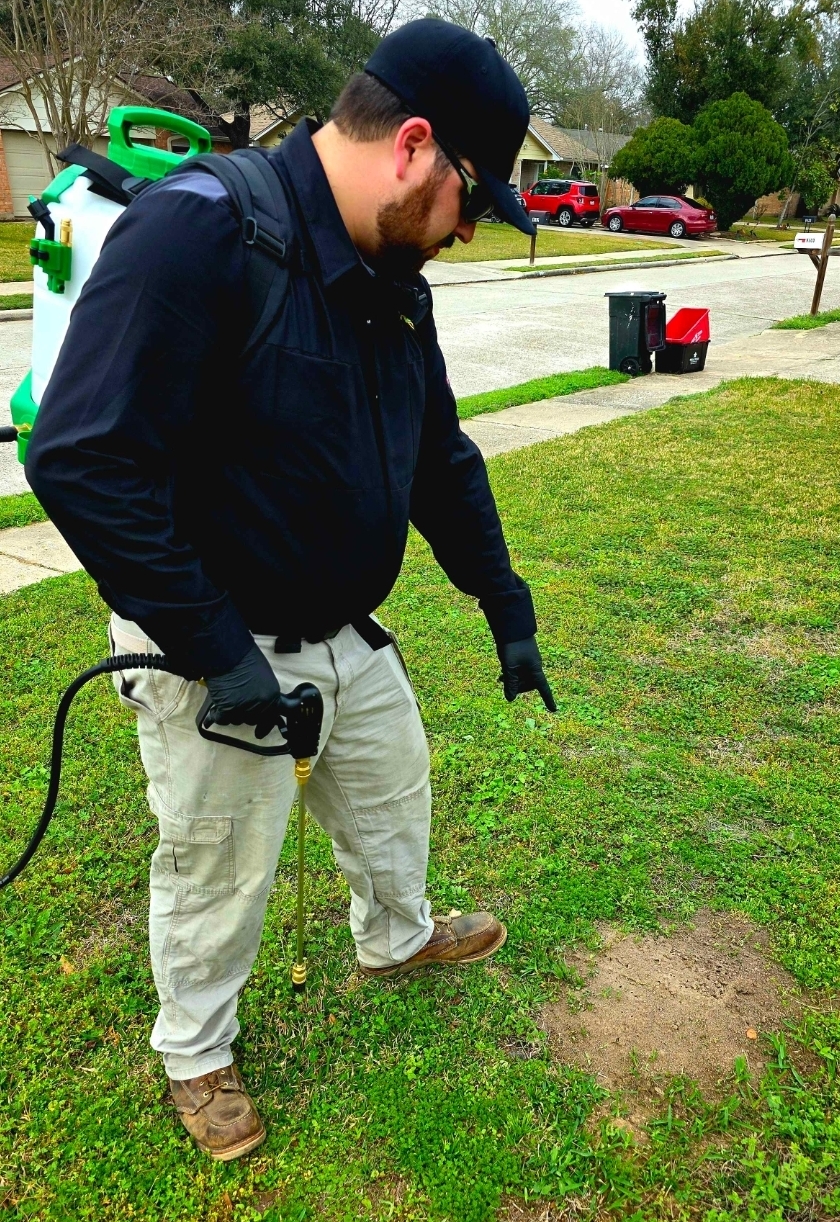
One of the most common springtime surprises is waking up to several new fire ant mounds in the yard after a rainstorm. These mounds can seem to appear overnight, often in places where none were visible the day before.
Understanding why this happens requires looking at the biology and behavior of red imported fire ants (Solenopsis invicta), one of the most studied invasive insects in the southern United States.
A mature fire ant colony typically contains 100,000–250,000 worker ants, although some large colonies can exceed 400,000 individuals under favorable conditions.
The colony is organized around one or more queens that may produce 800–1,500 eggs per day during peak reproduction.(Source: Texas A&M AgriLife Extension; USDA Agricultural Research Service)These colonies construct underground tunnel systems that can extend 2–3 feet deep and spread several feet outward from the mound itself. When environmental conditions change—especially rainfall—the colony rapidly reorganizes itself to survive.
Across the greater Houston and Tomball area, spring rain events frequently trigger new mound construction, something technicians at Sasquatch Pest Control commonly observe during early-season property inspections.
Why do fire ant mounds appear after rain?
Fire ant mounds appear after rain primarily because water fills or saturates their underground tunnels, forcing the colony to relocate upward.When flooding threatens the nest, worker ants quickly transport the queen, eggs, and larvae to higher chambers or build new mound structures above the saturated soil layer.
Rain also softens soil dramatically. Research from the University of Georgia shows fire ants can excavate up to 20–30 pounds of soil per colony each year, which explains how visible mounds can appear very quickly once the ground becomes workable again.For homeowners, this means a colony that was previously hidden underground can suddenly produce a visible mound within hours after rainfall.
Why do fire ant mounds seem to appear overnight?
Fire ants operate with extreme efficiency because thousands of workers perform tasks simultaneously.Studies of colony excavation have shown worker ants can move several cubic inches of soil per minute collectively, allowing colonies to rebuild mound structures rapidly after disturbances.
A typical fire ant mound measures:
8–12 inches in height 12–24 inches in diametercontains hundreds of interconnected tunnels
However, the visible mound is only a small part of the colony. The underground nest can extend 3–4 times wider than the mound itself.
This is why pest professionals often focus on treating the colony rather than just the visible mound, since the majority of the ants remain underground.—
How common are fire ants in Texas?
Fire ants are one of the most widespread invasive insects in the southern United States.Researchers estimate they currently infest over 367 million acres across the southeastern U.S., including nearly all of Texas.
(Source: USDA Agricultural Research Service)
In heavily infested areas of Texas, surveys have documented up to 200–300 fire ant mounds per acre in unmanaged land.Even residential lawns can support multiple colonies depending on environmental conditions.
Because of this widespread presence, fire ants are estimated to cause over $6 billion in annual economic damage across the United States through:agricultural lossesmedical costsproperty damagepest control expenses
(Source: Texas A&M AgriLife Extension)
Why do fire ants sometimes float during floods?One of the most fascinating survival behaviors of fire ants occurs during flooding.Worker ants interlock their bodies to form floating rafts, with the queen and brood protected in the center.Research published in the journal Proceedings of the National Academy of Sciences documented that these rafts can remain intact for several weeks while drifting on floodwaters.
The ants create a waterproof living structure using their bodies, allowing the colony to survive long enough to reach dry ground and rebuild.
This unusual adaptation helps explain why fire ants spread rapidly in regions that experience frequent rainfall or flooding.
—How painful are fire ant stings?
Fire ant stings are medically significant because they inject venom called solenopsin, which produces an immediate burning sensation followed by a small blister-like pustule.
Statistics from medical studies estimate:30–60% of people living in fire ant regions are stung each year1–2% of people may experience severe allergic reactions
Fire ants are responsible for thousands of emergency room visits annually
(Source: American College of Allergy, Asthma, and Immunology)
Each worker ant can sting multiple times because they attach to the skin and pivot while injecting venom.
This defensive behavior is why disturbing a mound often results in multiple stings within seconds.
—Why fire ants are so successful in Texas
Fire ants thrive in Texas because the climate closely matches the warm, humid environment of their native South America.
Their success comes from several biological advantages:
• Large colony size (often 200,000+ ants)
• Rapid reproduction rates
• Ability to relocate colonies quickly
• Aggressive defense behavior
• Flexible diet including insects, seeds, and sugary foods
Because of these traits, colonies can expand rapidly once established in residential landscapes.
For many homeowners across the Houston region, recurring fire ant activity often indicates multiple colonies developing beneath the lawn over time.
—Why fire ants often return to the same yard
Fire ant colonies reproduce through mating flights, where winged males and females take flight to establish new colonies.
During peak mating periods, researchers have recorded thousands of queens per acre launching from established colonies.
Although only a small percentage survive to form new colonies, the number of queens produced makes reinfestation common.
This is why long-term fire ant management often focuses on seasonal monitoring and colony elimination, particularly in regions where fire ants are widespread.In practice, pest professionals often recommend proactive yard treatments during spring and early summer—periods when colony growth is most active.
At Sasquatch Pest Control, fire ant management programs are designed around these seasonal activity patterns to reduce colony establishment before populations expand.
—Why fire ant activity spikes during spring rain
Spring in Texas provides the perfect conditions for fire ants to expand:soil temperatures above 70°Fincreased rainfallabundant food sources
When these conditions combine, colonies begin expanding and building new mounds.
This is why homeowners frequently notice fire ant activity returning within days of warm spring rainstorms.
Understanding the science behind this behavior can help homeowners recognize the early signs of activity before colonies grow larger throughout the season.
—Sources
Texas A&M AgriLife Extension – Imported Fire Ant Biology
USDA Agricultural Research Service – Fire Ant Distribution Data
University of Texas Fire Ant Research Program
American College of Allergy, Asthma, and Immunology
Proceedings of the National Academy of Sciences – Fire Ant Raft Studies
Sasquatch Pest Control
Spring, TX
281-627-4810
SasquatchPCTX@gmail.com
sasquatchpestcontroltx.com
https://www.facebook.com/SasquatchPCTX
https://www.instagram.com/sasquatchpctx
https://nextdoor.com/page/sasquatch-pest-control
https://www.tiktok.com/@sasquatch.pest.co?_r=1&_t=ZP-94kCAZR1i2g
https://www.linkedin.com/in/sasquatch-pest-control-houston-tx-536a183b2/